Get Full Government Meeting Transcripts, Videos, & Alerts Forever!
Get email alerts on the Electric Vehicle Charging topic
No spam. Unsubscribe anytime.
MSU student urges Bozeman to publish official EV-charger map to ease range anxiety
Summary
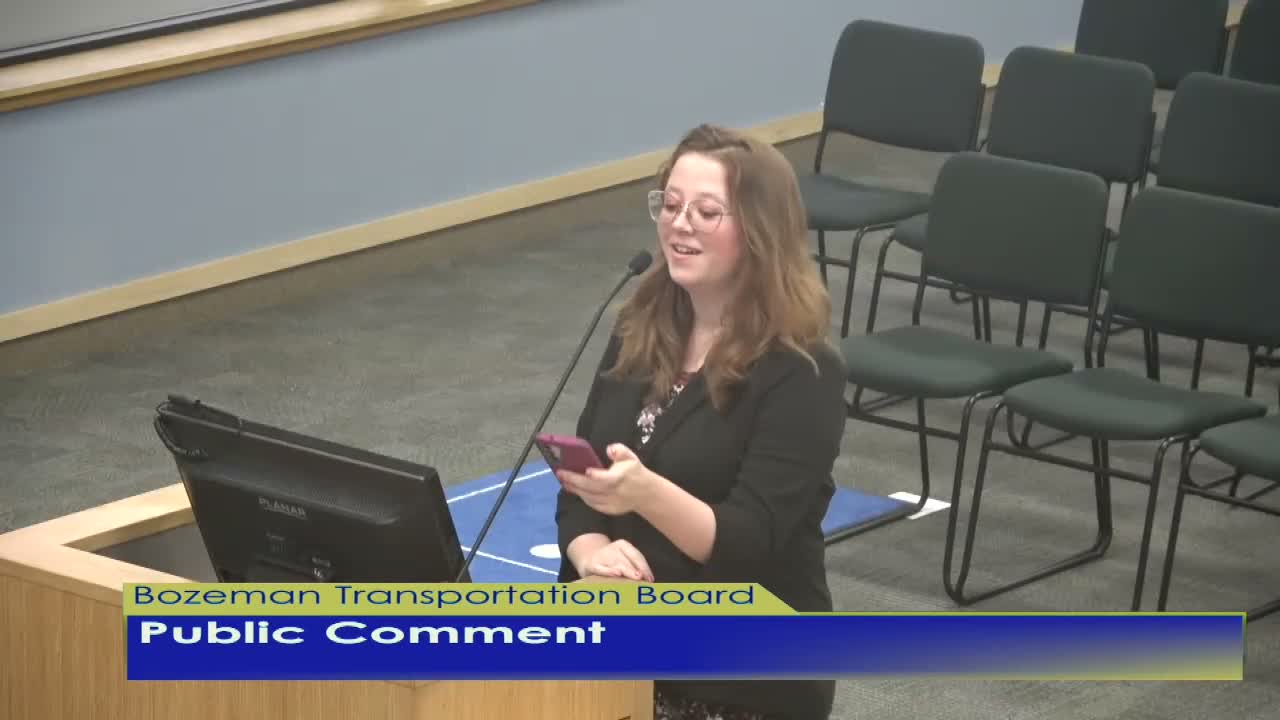
Gracianne Caldwell, a Montana State University student, told the Transportation Advisory Board on March 25 that an official city map of electric-vehicle charging ports would reduce range anxiety and encourage EV adoption.
Gracianne Caldwell, a student in Dr. Paul LaChapelle’s Politics of Climate Change course at Montana State University, urged the Transportation Advisory Board on March 25 to publish an official, city-sanctioned map of electric-vehicle charging stations to reduce "range anxiety" among local drivers. The board met without a quorum and took no formal action.
Caldwell said range anxiety — the fear of being stranded on longer or unexpected trips — is a key barrier to switching to electric vehicles in rural and semi-rural areas. She cited the Montana Department of Transportation’s June 2022 prioritization study and argued that privately maintained maps are frequently incomplete or out of date. "Making an official city sanctioned map makes these charging ports visible, reduces uncertainty, and displays a strong alignment with sustainability goals," she told the board.
Why it matters: A reliable, up-to-date public map could make it easier for Bozeman residents and visitors to plan trips and consider EVs, particularly where private mapping services omit or mislabel chargers.
Caldwell framed her comment as part of a class assignment and said she hoped the suggestion would spur collaboration between the City of Bozeman and the Montana Department of Transportation. She described updating municipal information as a "practical, low cost step" toward safer, more resilient transportation and broader sustainability goals.
The Chair thanked Caldwell for her remarks. Because there was no quorum, the board did not take action; Caldwell’s comment was recorded as public testimony for consideration at a future meeting when the board is fully convened.
Proposed next steps were not specified during the meeting; the suggestion could be considered by staff or the full Transportation Advisory Board at a later date.