Get Full Government Meeting Transcripts, Videos, & Alerts Forever!
Get email alerts on the Historic Preservation Landmark Program topic
No spam. Unsubscribe anytime.
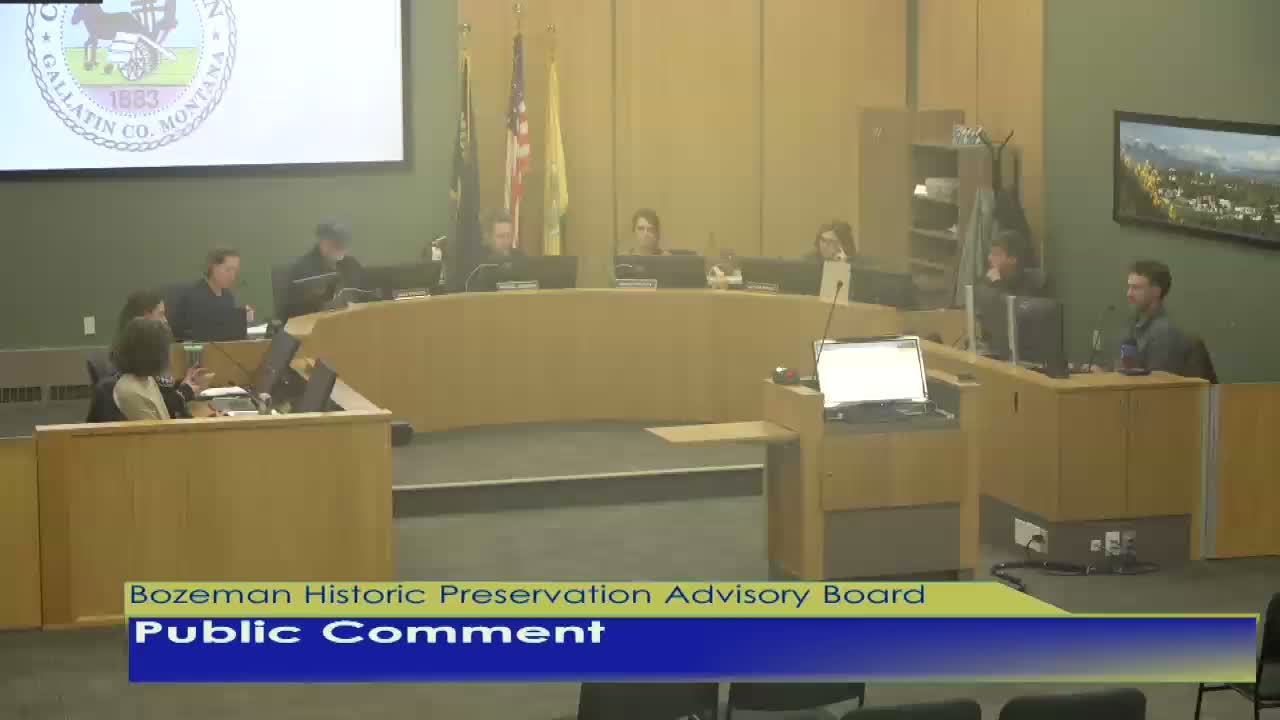
Bozeman preservation board weighs local landmark program and how it would work inside and outside NCOD
Summary
Bozeman’s Historic Preservation Advisory Board heard a consultant on options for a local landmark program, including regulatory and non-regulatory tiers, and debated whether landmark regulations would require zoning map amendments for districts; staff will consult the city attorney and coordinate with the NCOD design-guidelines work.
The Historic Preservation Advisory Board on Wednesday heard a staff-and-consultant presentation on a proposed local landmark program and spent more than an hour asking how any new landmark rules would interact with Bozeman’s Neighborhood Conservation Overlay District (NCOD).
Erin George, the city’s community development director, introduced consultant Adrienne Burke of Community Planning Collaborative, who outlined two broad approaches: a regulatory program that triggers design review and a certificate of appropriateness (COA) process, and a non‑regulatory, honorary tier that offers recognition and incentives without automatic regulatory review. “Historic preservation as a process does not exist outside the NCOD right now,” Burke said, arguing a local landmark program would extend preservation tools citywide.
The discussion turned to a legal and procedural distinction staff said is central to drafting regulations. George summarized advice from the city attorney, saying he told staff that any regulatory elements “needed to live in Chapter 38 because it’s following our zoning powers,” and that creating a landmark district would typically require a zone‑map amendment (ZMA). Staff and the consultant explained that individual site designations can often be mapped and processed without the full district ZMA pathway, while district nominations that impose new regulations on multiple properties commonly follow the ZMA process.
Board members and residents raised concerns about accessibility and cost. Multiple speakers warned that high signature thresholds or ZMA fees would deter neighborhood petitions and urged staff to seek alternatives, such as starting with non‑regulatory single‑site nominations, lowering owner‑consent thresholds, or proposing fee waivers for landmark nominations. Resident Natsuki Nakamura said she was “nervous about replacing the NCOD” and asked whether the landmark pathway would truly provide comparable protections.
Burke recommended building flexibility into the program so that cultural designations—where architecture is not the primary basis—could be regulated only on specified features rather than applying broad design rules. She also recommended a simplified local inventory form to reduce cost and barrier to entry; staff noted the state historic inventory forms can be time‑consuming and costly for property owners.
Staffers said they will follow up with the city attorney to clarify which regulatory elements must be codified in the city’s unified development code, and they will coordinate with the Lakota Group, the firm updating the NCOD design guidelines, to align draft regulations and guidance. The board did not take a vote on the landmark program; staff said they will return with more detailed draft language after legal review and further coordination with design‑guidelines consultants.
The board also heard public testimony urging that landmark rules address landscape and natural features—trees, trails and view sheds—and several residents urged greater coordination between HPAB and the Parks and Urban Forestry boards for any heritage‑tree proposals.
Next steps: staff will check legal options with the city attorney, refine draft regulations in coordination with the design‑guidelines project, and bring revised materials back to HPAB, which will be able to provide additional public input during the Lakota Group’s engagement week in mid‑April.