Get Full Government Meeting Transcripts, Videos, & Alerts Forever!
Get email alerts on the Charter Language topic
No spam. Unsubscribe anytime.
Commission debates draft Article 7 on neighborhood associations and INC; no final vote
Summary
Commissioners and members of the public spent substantial time reviewing proposed charter Article 7 language to strengthen neighborhood associations and advisory boards, raising concerns over 'consensus‑based' wording, a suggested 20‑neighborhood cap, enforceability of INC recommendations, and staff support; commissioners asked drafters to revise language and return.
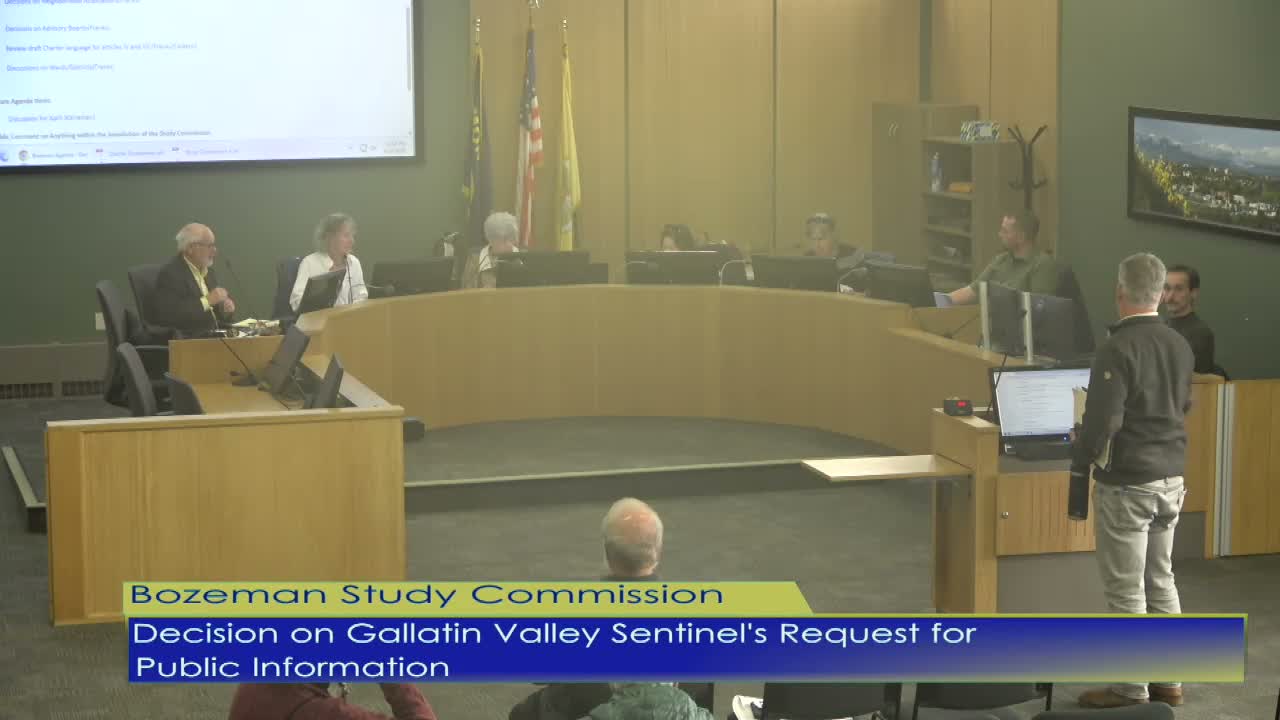
Bozeman’s Study Commission devoted the second half of its April 24 meeting to an extensive review of proposed charter changes that would create a new Article 7 on public engagement, neighborhood associations and advisory boards. Commissioners and public commenters generally supported elevating civic engagement in the charter but disagreed over several specifics.
Commissioners Barbara (Barb) and Becky, who co‑authored the draft language, framed the proposal as an effort to strengthen two‑way communication between the city and residents and to improve the functioning of neighborhood associations and the Inter‑Neighborhood Council (INC). They said the draft borrows from the National Civic League model and local public input gathered over the last year.
Key areas of debate included whether to require or encourage "consensus‑based" decision making for neighborhood associations, a proposal to cap the city at "no more than 20 neighborhoods," and whether the charter should require a full‑time neighborhood liaison and a budget line to support local association activities. Drafters said the 20‑neighborhood figure was not fixed and arose from attempts to balance representative size for INC with broader inclusion.
Public commenters voiced mixed views. Several residents and INC representatives asked for stronger guarantees that formal INC recommendations will receive timely, on‑the‑record consideration by the commission and proposed a clearer formal process for bringing recommendations forward. Some speakers urged insertions that would guarantee a written, public response to INC recommendations; staff cautioned that overly prescriptive charter procedures could create conflicts with state law and suggested using ordinances or staff policies for procedural detail.
Other recurring concerns included representation equity at INC (each INC rep gets one vote despite wide variation in neighborhood sizes), the practicability of a strict neighborhood cap, and practical barriers to outreach: volunteers lack time and capacity to door‑knock or compile comprehensive contact lists for large neighborhoods. INC representatives suggested using existing city touchpoints — for example, utility billing messages or an opt‑in link — to help residents join neighborhood email lists.
Commissioners said they remain committed to creating a discrete charter article focused on public engagement but agreed the current draft needs revision. They asked the drafters and staff to incorporate public and INC feedback — including clearer language on the limits of any neighborhood cap, alternative wording to avoid imposing formal consensus requirements, and options for staff support and budgeting — and to return with updated text at the next meeting.
Next steps: commissioners scheduled further discussion at the next meeting to complete neighborhood association language and to take up proposed changes to advisory boards and wards and districts. No charter language was adopted at this session.