Get Full Government Meeting Transcripts, Videos, & Alerts Forever!
Get email alerts on the Vacancies Election Policy topic
No spam. Unsubscribe anytime.
Bozeman commission debates special elections and timeline for filling vacancies; no final decision
Summary
Commissioners discussed Montana statute requiring a 30-day appointment, options to require special elections via charter language, and tradeoffs including cost (staff cited ~$105,000–$135,000) and turnout; they asked staff for more research and did not adopt a final approach.
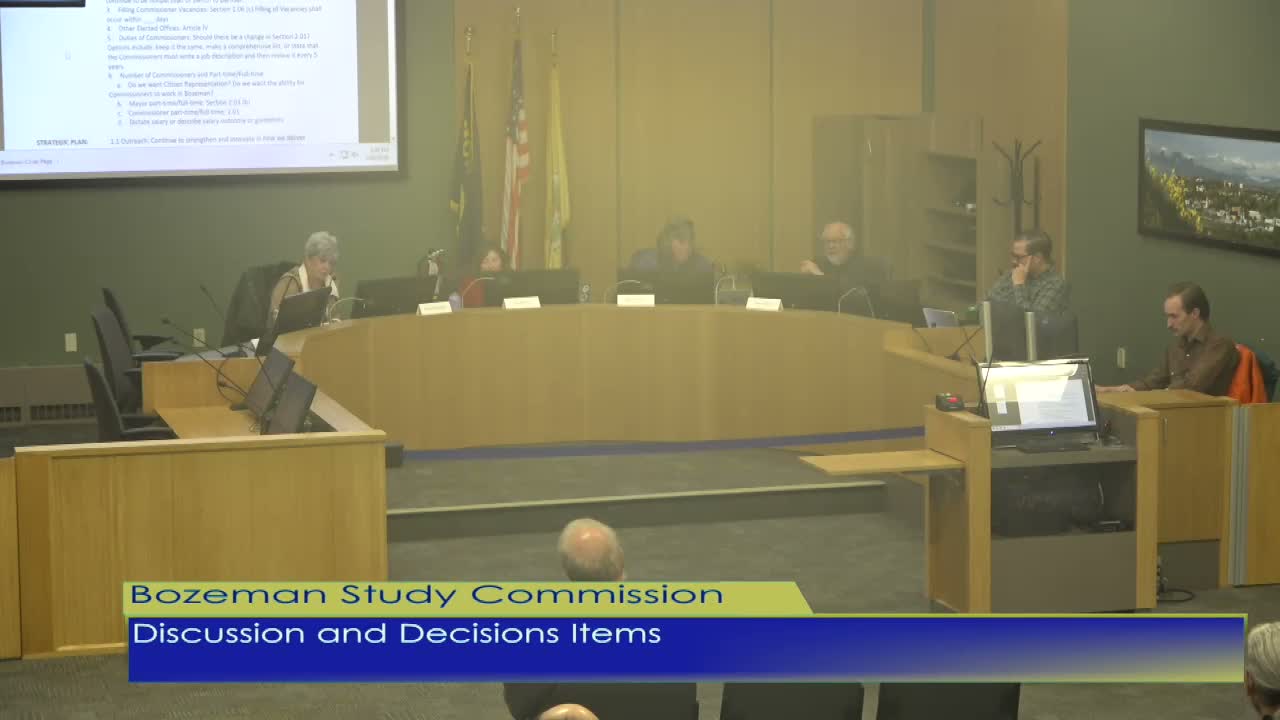
The Bozeman City Study Commission spent substantial time on Jan. 28 debating how to fill vacancies on the city commission and mayor’s office, but took no final action.
City Attorney Greg Sullivan briefed the commission on Montana statutory constraints and said the charter may specify methods for filling vacancies (for example, special elections) but that any charter language must fit state statutes governing elections and notice. Sullivan explained the statutory 30-day appointment window often cited as a default and said the commission could adopt a different method — for example, a special election — by specifying that method in the charter.
Commissioners debated practical tradeoffs. Staff said the most recent City of Bozeman municipal election cost roughly $105,000; one commissioner reported a special-election estimate of about $135,000. Commissioners noted that special elections can have low turnout, can be costly if held alone, and may be easier to justify if piggybacked on other scheduled elections. Several members suggested a hybrid: appoint when short of time, but require election for vacancies with more than a year remaining, or extend the appointment window from 30 to 60 days to allow more public engagement.
No motion to change the charter’s vacancy method was adopted; commissioners asked staff to research election costs, statutory timelines and turnout statistics and to return options for future meetings. They also connected the vacancy discussion to the larger district/ward conversation, noting that district-based seats could alter turnout and cost calculations.
Next steps: staff will consult the county elections administrator and return cost estimates, legal options and turnout data for the commission to consider at a later meeting.