Get Full Government Meeting Transcripts, Videos, & Alerts Forever!
Get email alerts on the Municipal Government Structure topic
No spam. Unsubscribe anytime.
Consultant outlines mayor-manager options and trade-offs for Bozeman charter
Summary
Consultant Dan Clark told the Bozeman Study Commission there is a spectrum of executive arrangements — from a strong mayor to a commission-manager with a chief administrative officer — and that the right choice depends on the city's size, risk tolerance and whether voters want an elected executive or a professional manager.
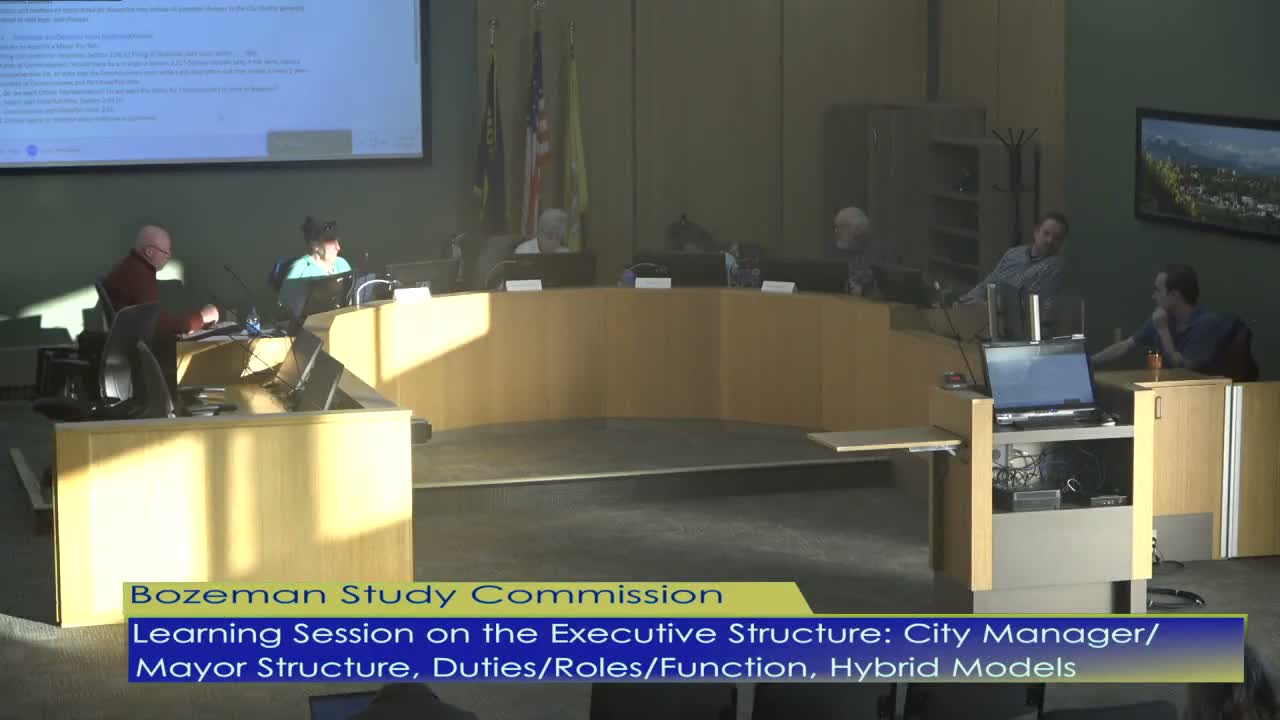
Consultant Dan Clark told the Bozeman Study Commission on Feb. 5 that cities can choose a range of executive structures and that the "best" model depends on local priorities and capacity. Clark walked commissioners through statutory options that vary who hires and fires department heads, who prepares the budget and whether an elected mayor has veto power.
"If you wanted a strong-mayor form of government, they can adopt [the statute] and the mayor would appoint and remove without the consent of the council," Clark said, describing a model that concentrates executive control. He contrasted that with versions in which department-head appointments require commission consent or where the mayor prepares a budget only in consultation with the commission and department heads.
Why it matters: the commission is reviewing Bozeman's charter as part of a voter-authorized study. The choice affects who is accountable for day'to'day operations, how quickly the city can act administratively, and how personnel disputes are handled.
Clark described a hybrid used by several Montana cities in which an elected mayor retains political accountability while hiring a chief administrative officer (CAO) to manage operations. "Some communities get the best of both worlds — an elected official accountable to the voters and professional support from a CAO," Clark said, citing Missoula and Laurel as examples who use a CAO while the mayor remains a political office.
Commissioners pressed Clark on personnel oversight. Clark warned that giving the commission direct control over hiring and firing can turn HR moves into political decisions. "If you require council consent for termination, it moves an HR issue into a political decision," he said, adding that charters typically leave details like grievance procedures to HR policies and ordinances rather than embedding them in the charter.
On veto power and budgets, Clark explained statutory variations: a mayor might possess a veto that can be overridden by a majority or require a two'thirds vote, and budget preparation may be a mayoral duty or a collaborative process with the commission and department heads. "Most municipalities operate under a collaborative default," he said, "but larger cities sometimes adopt stronger executive authority in the charter."
Commissioners also asked about manager oversight, review practices and whether mayors are usually full time. Clark said that a manager'hire creates a direct employment relationship the commission can contract and evaluate, and that industry norms include contracts with annual reviews and benchmarks. He noted that some Montana cities have full'time elected chief executives (e.g., Butte'Silver Bow), while others treat the mayor as a ceremonial or part'time role.
What happens next: Clark encouraged the commission to identify the specific powers it wants to retain or delegate and to craft charter language that reflects those trade'offs. Commissioners asked for more materials and a follow'up session before drafting final recommendations.
Quote: "The structure has a part to it, but the people you elect are often the stronger indicator of effectiveness," Clark said. "If you want professional management, a CAO or a manager is one way to get it without losing elected accountability."