Get Full Government Meeting Transcripts, Videos, & Alerts Forever!
Get email alerts on the Transportation Master Plan topic
No spam. Unsubscribe anytime.
Board frames scope for 2027 Transportation Master Plan, moves to begin consultant procurement
Summary
City staff told the Transportation Advisory Board it will begin procuring a consultant team for a 2027 Transportation Master Plan update, emphasizing safety-focused scope, a prioritization matrix for projects, and a preference for volume/origin-destination analysis over exhaustive intersection-level LOS studies to keep costs within the estimated budget.
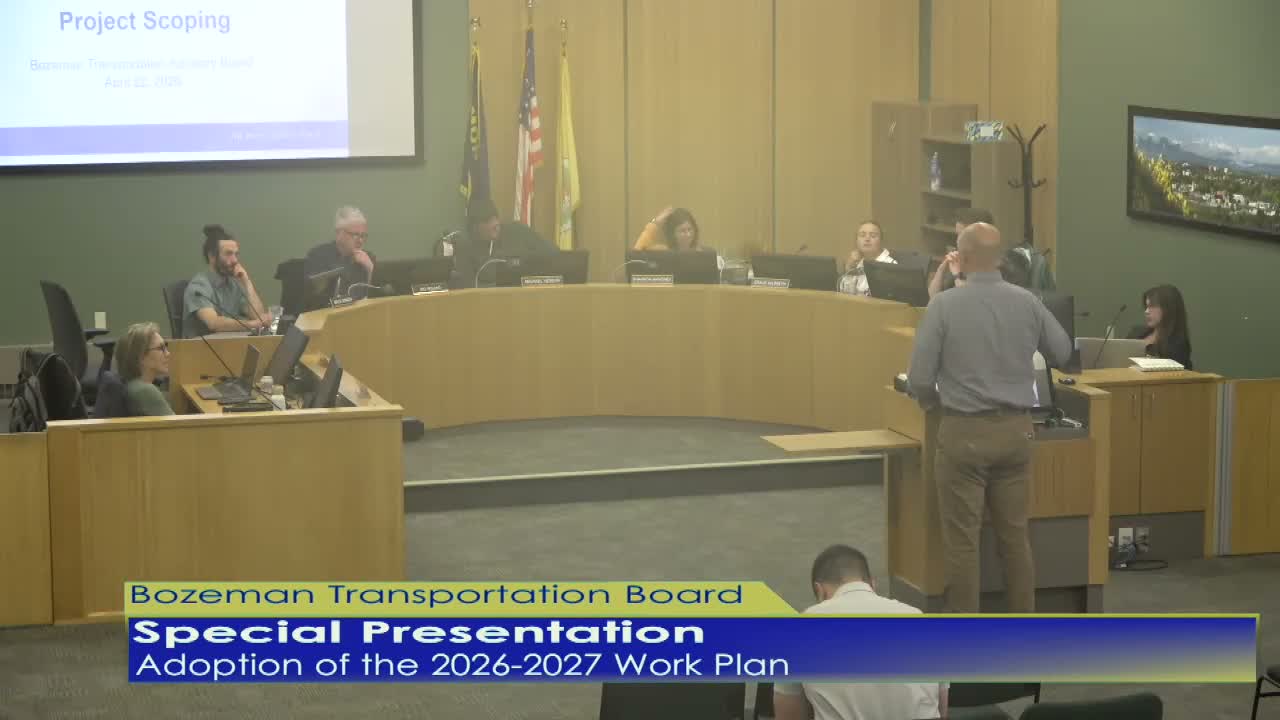
The Transportation Advisory Board on April 22 discussed the scope and schedule for a 10-year Transportation Master Plan (TMP) update and supported staff's plan to begin consultant procurement. Director Nick Ross framed the TMP as a city-focused facility plan required under the Montana Land Use and Planning Act and distinguished it from the MPO's regional long-range transportation plan (LRTP).
Ross said the TMP will focus on the city planning area, be MLUPA-compliant, and primarily use local revenue sources (street impact fees, the Arterial/Collector district, and the street maintenance district). He told the board the TMP baseline scope and budget will include a minimum consultant budget of roughly $250,000, plus about $300,000 in federal funding that will support the safety portion of the work. "I want this done by 2027," Ross said, urging the release of an RFQ next month so the city can select a project team and begin work by July 1 if funds are appropriated.
Board members debated what analyses the TMP should emphasize. Several members said the board should prioritize community goals and practical analyses—vehicle volumes, origin-destination patterns and targeted intersection operations—over doing comprehensive intersection-level service (LOS) calculations for every intersection, which staff said would be expensive and of limited utility. Ross proposed using a prioritization matrix and limited cost-benefit guidance for major capital projects so the city can better sequence projects in the capital improvement plan and be transparent with the public about why projects are prioritized.
The board also supported bringing a technical committee and community institutional partners (for example, Montana State University and downtown business organizations) into the TMP process and adding an ecological or "road ecology" lens to route projects away from sensitive riparian or wetland corridors where feasible. Ross said the city's existing sensitive-lands plan has data that can be used for this purpose and recommended bringing an expert into the project team.
Board members generally supported issuing a request for qualifications now and developing a more detailed scope with the selected consultant to keep the project on schedule. Staff will return with a refined scope and public engagement plan in a future meeting.