Get Full Government Meeting Transcripts, Videos, & Alerts Forever!
Get email alerts on the Engagement Plan topic
No spam. Unsubscribe anytime.
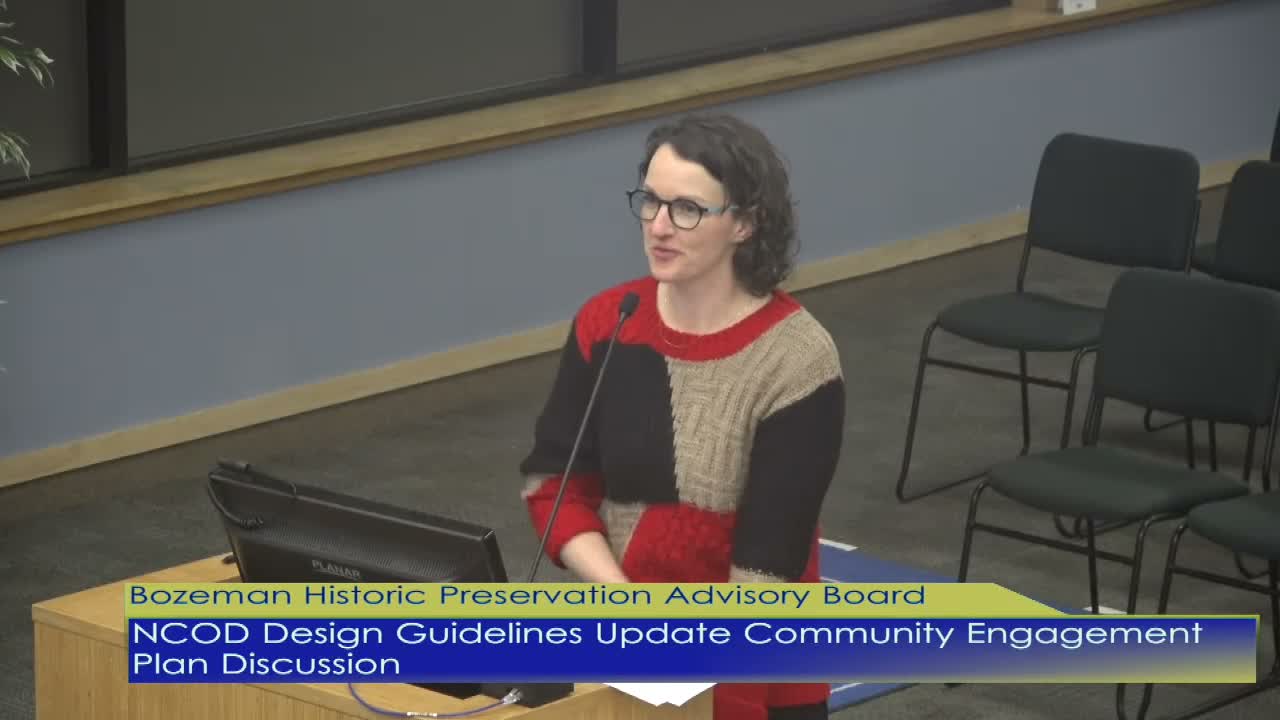
Historic Preservation advisory board endorses community engagement plan for NCOD guidelines with amendments
Summary
The Historic Preservation Advisory Board voted to recommend the City of Bozeman's community engagement plan for updating the Neighborhood Conservation Overlay District design guidelines to the City Commission, adding the Inter‑Neighborhood Council to key partners, making walking tours and an online survey required engagement methods, and committing to publish raw engagement data.
The Historic Preservation Advisory Board on Tuesday voted to recommend the City of Bozeman’s community engagement plan for updating the Neighborhood Conservation Overlay District (NCOD) design guidelines to the City Commission, approving an amended plan that adds neighborhood representation and strengthens recommended outreach methods.
Board members debated and approved three amendments before forwarding the plan: explicitly listing the Inter‑Neighborhood Council (INC) as a key partner, elevating walking tours and an online survey from “considered” to explicit methods used in the outreach, and adding walking tours as an action in the spring 2026 engagement timeline. A majority of members supported the changes and the board approved the amended recommendation by voice vote.
City staff framed the plan as required under the Montana Land Use Planning Act (MLUPA) and said the proposed outreach will include open houses, stakeholder interviews, facilitated neighborhood focus groups (one representative per NCOD neighborhood), workshops with design professionals, and digital tools posted on the city’s Engage Bozeman project page. The staff presentation emphasized that the plan’s goal is to build shared understanding of the role of design guidelines and to gather meaningful input about neighborhood character, historic preservation and review procedures.
Consultants from the Lakota Group, the team contracted to update the guidelines, told the board their approach prioritizes clarity, predictability and usability. Suraj Advani of the Lakota Group said the consultants aim to “help protect character, provide clarity, offer predictability” and to pair national best practices with local context. The consultants described using clear illustrations and color‑coding to distinguish advisory guidance from regulatory provisions used in Certificate of Appropriateness reviews.
Public commenters urged strong outreach and transparency. “Guidelines matter and are not loosey‑goosey language that we can take or leave,” said Zara Osman, a Bozeman resident who cited city code and the Secretary of the Interior’s Standards for Rehabilitation in urging enforcement. Several residents pressed for walking tours so consultants and elected officials could see on‑the‑ground conditions, and asked that the city publish raw survey data and detailed engagement findings rather than brief summaries.
Board members said the amendments aim to ensure the engagement reaches both neighborhood residents and the design professional community. One member argued for moving walking tours and the survey into the early engagement phase so feedback can inform draft language rather than arriving after the first draft is written.
Next steps: staff will present the amended community engagement plan to the City Commission for adoption on March 10. The consultant team will conduct an in‑person visit in April 2026 to begin spring engagement activities, and the project timeline anticipates draft guidelines in summer and a final draft for commission review in winter 2026.
Action: The board’s recommendation is advisory; the City Commission retains final decision authority on adopting the engagement plan and the NCOD guideline revisions.