Get Full Government Meeting Transcripts, Videos, & Alerts Forever!
Get email alerts on the Employee Survey topic
No spam. Unsubscribe anytime.
Bozeman city employees favor manager-led status quo in internal survey, consultant says
Summary
A preliminary employee survey presented to the Bozeman City Study Commission found staff generally favor retaining the current city manager-led structure and prioritized accountability, efficiency and stability; the presentation counted 176 responses out of roughly 524 city employees and flagged areas for further analysis.
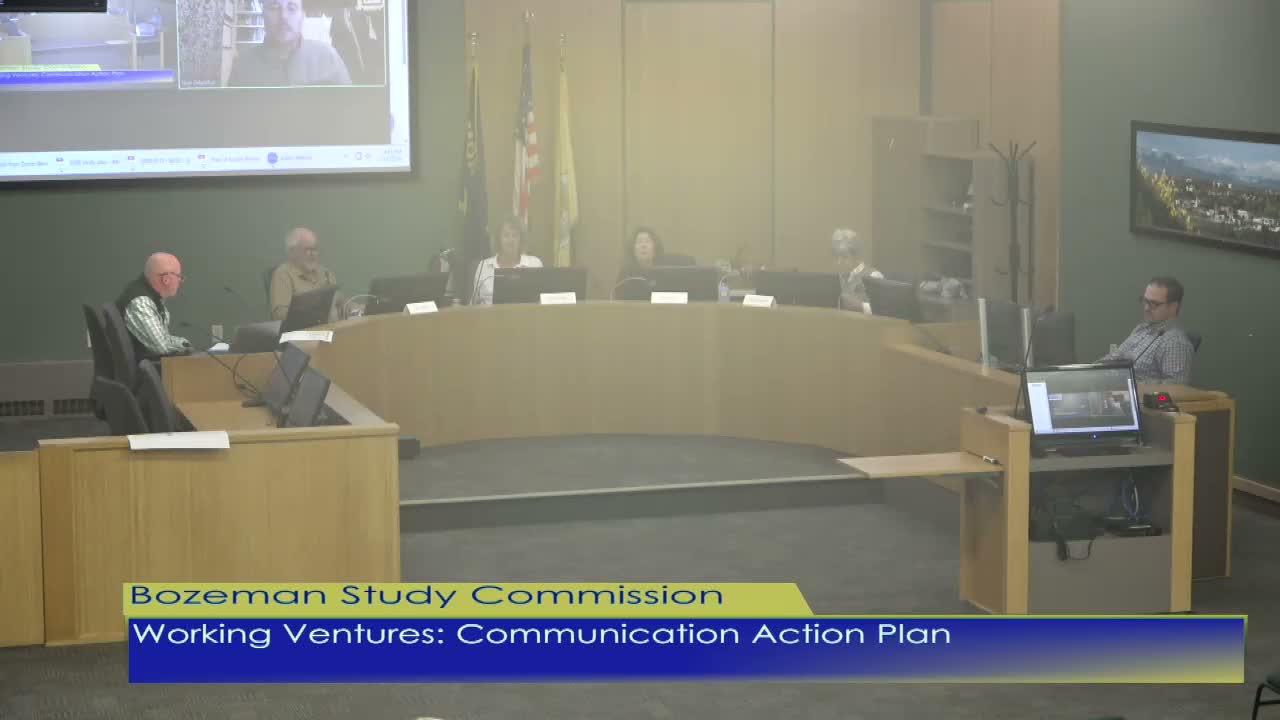
Stan (Working Ventures) presented preliminary results from the city employee survey at the Jan. 15 Study Commission meeting, saying "174 total surveys completed as of noon today, Mountain Time," and later noting the tally rose to 176. He told commissioners those responses came from a pool of about 524 city employees.
The presentation showed city employees rated the city manager as having the greatest day-to-day impact on their work (average impact score 3.87 on a 1'5 scale) compared with the mayor (2.2) and neighborhood councils. On a direct question about who should run daily operations, 72% of participating employees selected "yes, full executive authority" for a professional city manager, Stan said.
Commissioners heard department and tenure breakdowns: infrastructure and utilities provided the single largest group of responders (45 replies), followed by internal administration (30) and public safety (25). Stan also summarized residency and experience information: 92 respondents said they live inside city limits and 72 said they do not, and responses clustered toward employees with under five years on the job and a sizable group with more than 10 years.
Stan cautioned that the employee survey results often diverged from the community survey, reflecting an employee preference for stability and efficient administration. "There's definitely a feeling of wanting the status quo to continue onward," he said, noting those patterns should be read alongside community responses and later survey rounds.
Commissioners pressed for methodological clarity. Jan asked how many employees received the survey; Mike (city staff) answered that the city has 498 full-time and 26 part-time employees, a total of 524. Commissioners also discussed the treatment of "unsure" responses and whether follow-up surveys or educational outreach would be appropriate to reduce ambiguity; Stan said anonymous surveys limit targeted follow-ups but that question wording and public education could be refined.
Next steps: Stan said the team will publish the full results, add a missing city commission item that was omitted from the presentation, and roll out two additional surveys this month (a commission survey going back roughly 10 years and an advisory-board survey capturing members around consolidation). Commissioners asked for the updated data once the final overnight responses are processed.