Get Full Government Meeting Transcripts, Videos, & Alerts Forever!
Get email alerts on the Public Safety Curfew topic
No spam. Unsubscribe anytime.
Committee approves emergency juvenile curfew after rejecting shorter amendment
Summary
The Public Safety and Criminal Justice Committee voted to invoke a temporary countywide youth curfew under Proposal 99 after rejecting an amendment to shorten its duration; IMPD said the move is one tool to address rising shares of juvenile-involved violence and emphasized diversion resources such as the Connection Center.
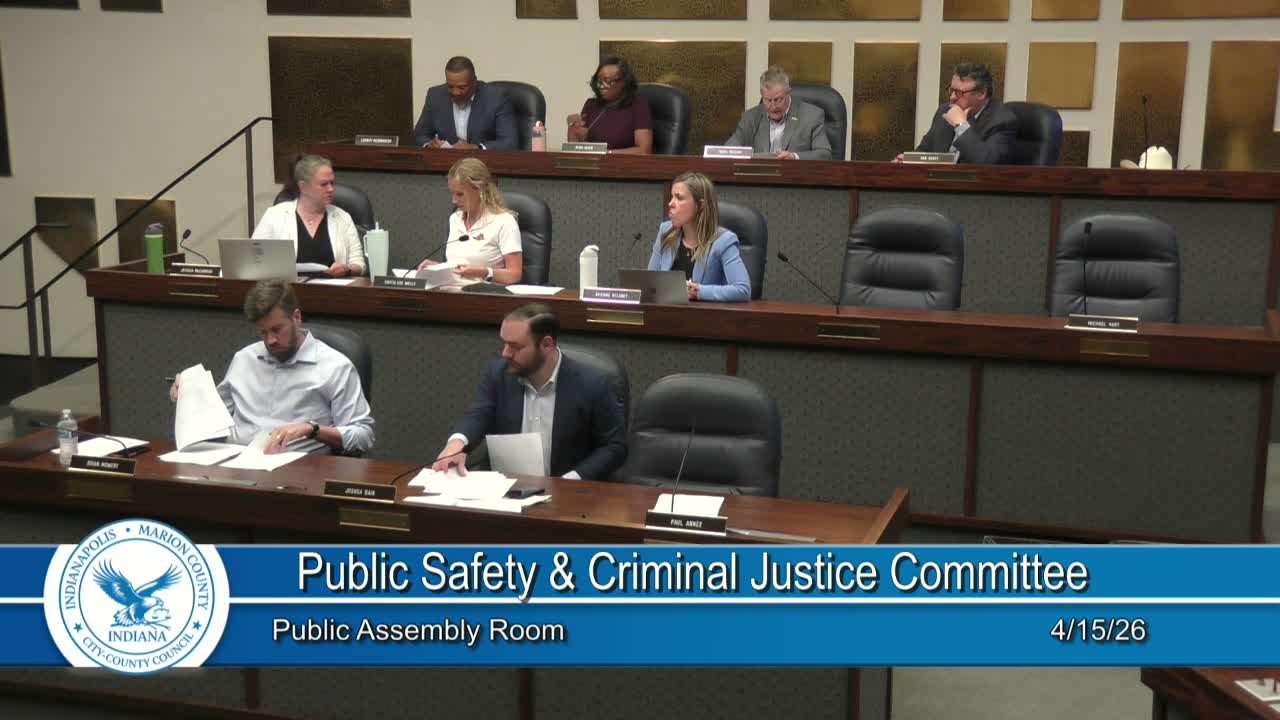
The Public Safety and Criminal Justice Committee on Wednesday approved Proposal 99, a temporary countywide public-safety curfew for juveniles, after rejecting an amendment that would have limited the curfew to 60 days.
Chair Leroy Robinson presided over the roll-call vote, and the committee approved the ordinance by a recorded vote of 9–1. Councilor Renee Allen’s amendment to shorten the curfew invocation to 60 days failed on a separate roll-call vote.
The committee heard from Indianapolis Metropolitan Police Department leadership, who presented data and examples to justify the measure. Chief Terry said the department is seeing troubling juvenile involvement in violent incidents even as overall homicide totals have fallen year to date. "In the first quarter of 2026, we've had 28 homicides. But still, three of them have been juvenile victims," the chief said, noting the share of juvenile victims has risen compared with the same period in 2025.
Terry described the Connection Center (previously called the Reunification Center) as a diversion-focused resource where juveniles encountered during curfew enforcement are connected to community partners for services rather than automatically arrested. "We're calling it now a Connection Center," he said, adding that officers generally use behavior-based guidance and that officers seek disruptive or criminal conduct before intervening.
Council debate focused on whether the invocation should be limited to a shorter review period or left in place through the summer for fuller implementation. Supporters of the 120-day window said it gives IMPD time to measure impact across peak months and avoids repetitive council action; proponents of the 60-day limit said a shorter window would force an earlier evaluation and guard against unnecessarily long restrictions.
Chief Terry urged the longer period so enforcement and outreach can run through summer months. He also reviewed legal defenses that caregivers and youth can assert—exceptions include accompanying a parent or guardian, travel to or from lawful employment, school-sanctioned activities, religious events and certain First Amendment-protected activities.
After the amendment failed, the committee advanced Proposal 99 in its presented form. The chair announced the motion carries and thanked IMPD and committee staff for their work. The ordinance will move to the full council for further consideration.
The committee also recorded public concern that curfew must be paired with summer programming and jobs to provide alternatives for young people; several councilors and presenters noted coordination with schools, parks and community organizations was already planned.