Get Full Government Meeting Transcripts, Videos, & Alerts Forever!
Get email alerts on the Pay And Personnel topic
No spam. Unsubscribe anytime.
West Lafayette hears Baker Tilly study proposing new pay framework for city staff
Summary
Consultants from Baker Tilly presented a citywide compensation and classification study that proposes an open-range pay plan and four implementation scenarios; the firm recommended adopting a baseline system now and phasing larger adjustments later as lawmakers and budget projections allow.
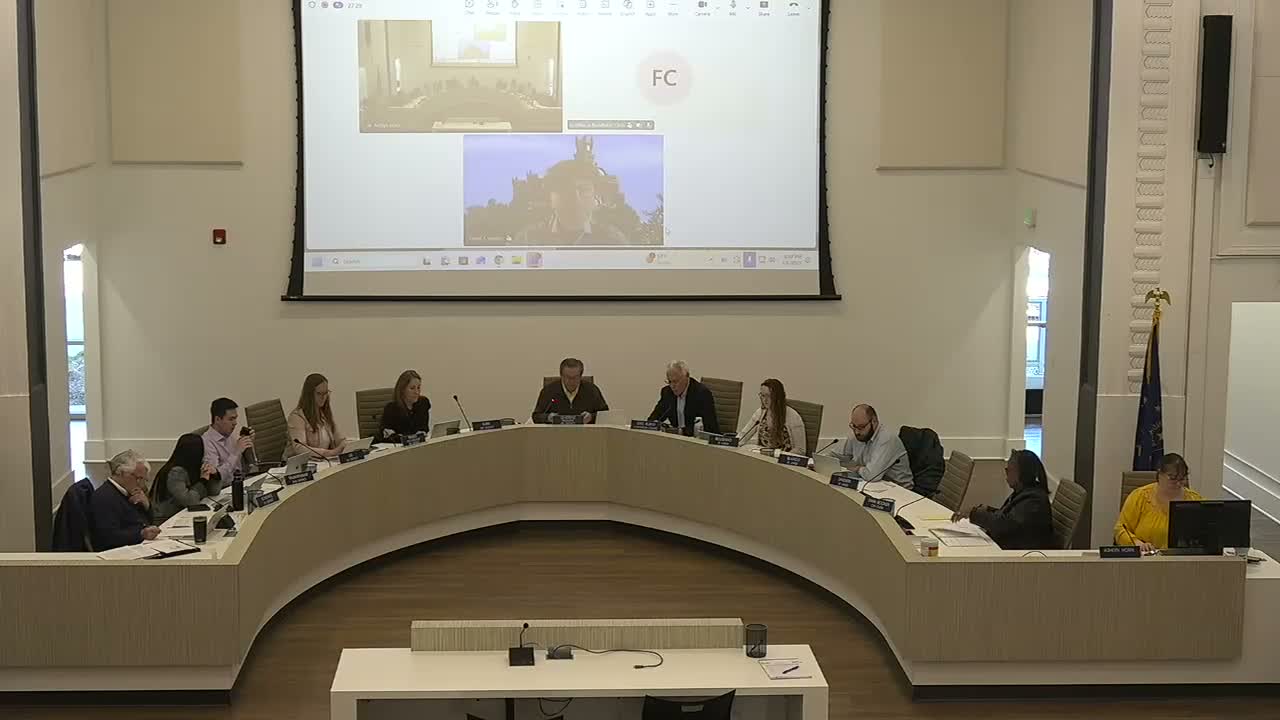
Baker Tilly consultants presented a months-long compensation classification study to the West Lafayette City Common Council on April 6, outlining a new pay-plan framework intended to standardize job titles, evaluate positions by a point-factor tool and align pay ranges to market benchmarks.
Jada Kent, the project lead, said the study focused on measuring positions, not people, and combined internal job evaluation with market data from public and private peer organizations. "This is a measurement of the position, not the person," Kent said, describing a nine-factor job-evaluation tool and a regression analysis used to map job-evaluation scores to market midpoints.
Consultant Eric Walsh told the council the firm modeled several implementation scenarios and emphasized the city’s fiscal context. He said the study covers base pay only and that Baker Tilly recommended beginning with a minimal implementation that establishes the system. "You have very healthy cash reserves. You have a balanced budget. You'll be able to get through it," Walsh said, while also warning that state legislative changes could change revenue forecasts.
The study proposed two parallel pay structures: a 23-grade open-range general plan and an 8-grade public-safety plan tailored to rank progression. For the roughly 249 employees included in the analysis, consultants found about 92% of current salaries already fall within proposed ranges; some maximums lag market benchmarks. The firm presented four adoption scenarios: a minimal fix to bring employees below new minimums into range (Option 1), an across-the-board modest adjustment (Option 2), and two compression-based approaches (Option 3 and 3b) that move employees into ranges based on years in position. Option 3b was described as the most equitable long-term approach; Option 1 was recommended as the practical first step to establish the system.
City Controller Peter Gray and council members pressed consultants about budget impacts and how pending state legislation (discussed in the meeting) might affect long-term revenue. Walsh said the firm has modeled the city’s fiscal projections and recommended continuing multi-year budgeting and scenario analysis to account for legislative changes to local income and property tax rules.
Kent and Walsh said training for HR is brief and the pay-plan tool is delivered in a spreadsheet format that city staff can operate; the firm also offered follow-up support for periodic recalibration. The council did not vote on adopting the plan at the meeting; members asked staff to draft implementing policies and bring options for phased adoption back for future consideration.
Next steps: staff will consult with Baker Tilly on implementation logistics, finalize policy language and place an adoption vote on a future agenda.