Get AI Briefings, Transcripts & Alerts on Local & National Government Meetings — Forever.
State concedes trial‑court error on entrapment instruction but disputes inducement in State v. Clark appeal
Loading...
Summary
At oral argument in State v. Clark (596890), the state conceded the trial court misapplied entrapment law but told the court the record shows opportunity rather than government inducement; the appellant argued a late phone call (exhibit 19) and prosecutorial remarks were prejudicial and that the sentence is disproportionate.
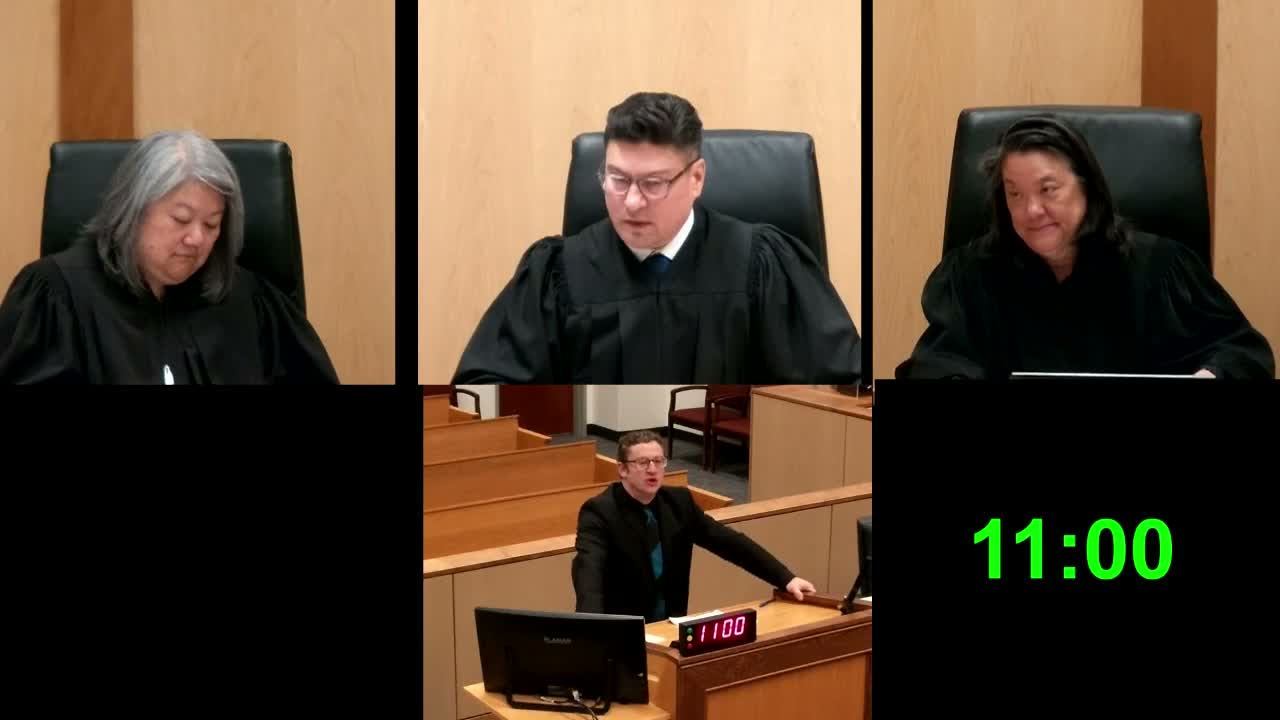
Colin Patrick, attorney with the Washington Novella Project representing appellant Douglas Clark, told the court that Clark “faces the very real possibility of spending the remainder of his life in prison” and asked judges to reverse a conviction because the trial court wrongly denied an entrapment instruction and the prosecutor’s conduct prejudiced the verdict. Patrick pointed to a phone call labeled as exhibit 19 and argued that, considered in the light most favorable to Clark, that call supplied inducement rather than merely an opportunity to commit the charged act.
The state, through Sarah Taggart, counsel for the State, conceded the trial court incorrectly treated the law on the entrapment instruction and said the appellate standard is therefore de novo. But Taggart told the court the written record — including two days of prior text messages and Clark’s initiation of contact — shows the exchange presented opportunity, not the kind of government persuasion or coercion that legally constitutes inducement.
Why it matters: the court must decide whether a reasonable juror could have found inducement such that an entrapment instruction was warranted; that determination affects whether the conviction should be reversed and, if so, whether the case should be retried. Appellant counsel also argued that prosecutorial commentary during cross‑examination and closing irreparably framed Clark’s testimony, and separately challenged the sentence as cruelly disproportionate when measured against comparable attempted‑offense penalties.
Appellant’s argument: Patrick urged that entrapment has two elements — lack of predisposition and government inducement — and said predisposition is not contested in briefing. On inducement he emphasized timing and content: the recorded phone call immediately preceded Clark’s alleged substantial step (driving to the aquatic center), and the undercover officer’s questions and sexual framing in the call, he said, went beyond mere opportunity. Patrick also argued the prosecutor repeatedly made commentary rather than posed questions on cross‑examination, which he said fused the state’s framing with Clark’s testimony and undermined the jury’s independent credibility determination. He cited appellate authorities the brief relies on and argued the government did not meet the harmless‑error burden.
State’s response: Taggart agreed the trial court erred in applying the entrapment instruction but said the error does not mean inducement occurred. She emphasized the totality of the communications — an initial online posting the defendant saw, two days of texts (including a message indicating age earlier in the exchange), and the defendant’s repeated initiation and questioning — and characterized the phone call as contextual confirmation rather than fresh inducement. On prosecutorial conduct she acknowledged two complained‑of statements but argued they were not flagrant or so prejudicial, in the context of a lengthy cross‑examination (about 110 pages of reporter’s transcript), as to warrant reversal.
Sentencing argument: Patrick also challenged the sentence as disproportionate, noting the record shows no actual meeting or physical contact and describing the offense in the transcript as “attempted rock 2.” He said that because the state alleged age as the distinguishing fact, Clark faces a life sentence with parole eligibility that is out of step with penalties for related attempted offenses (the transcript compares treatment to an attempted “rock 3”).
Bench exchanges and possible outcomes: Judges questioned counsel about when opportunity crosses into inducement and whether the so‑called “open door” arguments permitted some lines of cross‑examination. Both sides acknowledged reasonable disagreement about how to read the phone call and the texts together. If the court finds a prima facie showing of inducement or that prosecutorial misconduct produced a substantial likelihood of prejudice, it indicated the normal remedy would be reversal and remand for retrial; the state acknowledged that outcome would follow if the court deems the error harmful.
The court took the matter under advisement. The presiding judge concluded the oral argument session and said the remainder of cases would be considered in chambers before adjourning.