Get Full Government Meeting Transcripts, Videos, & Alerts Forever!
Get email alerts on the Advisory Boards topic
No spam. Unsubscribe anytime.
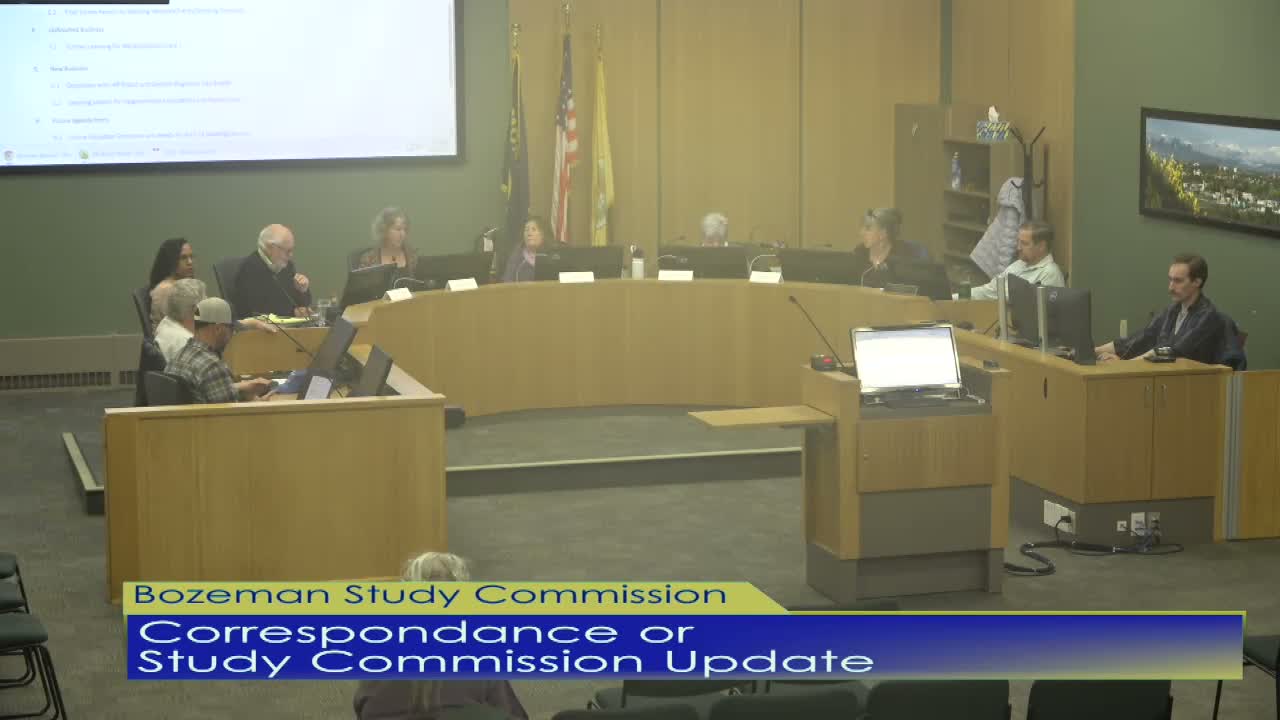
Panel and residents press Bozeman Study Commission to strengthen advisory boards and neighborhood engagement
Summary
Panelists, city staff and dozens of residents told the Bozeman City Study Commission on April 2 that volunteer advisory boards need clearer purpose, better onboarding, and more staff support so neighborhood voices are heard; commissioners heard options for charter language and neighborhood councils versus ward-based representation.
Panelists, city staff and dozens of residents pressed the Bozeman City Study Commission on April 2 to make the city's advisory boards and neighborhood councils more effective and accessible, saying loose goals and limited staff support have reduced meaningful public participation.
At a study session that featured three longtime volunteers and a city staff overview, the commission heard that consolidation of dozens of boards into a smaller set improved system-level coordination but also concentrated workload and made it harder for everyday residents to take part.
"The lack of wards has created a geographic monopoly on the city commission," said Abby Jones, a Bozeman resident and reporter for the Gallatin Valley Sentinel, urging the commission to consider structural fixes. Jones also criticized Resolution 5,323, saying it "effectively inhibits advisory board members from openly expressing viewpoints that differ from those of the city staff and the city commission."
Panelists who had served on or worked with boards offered mixed views. City staff summarized the current landscape and explained which bodies are statutorily required (library board, police commissions, historic-preservation board, planning-related boards and the new TIF advisory board) and which were created by the city.
Former Mayor and commissioner Jeff Krause said the older volunteer boards were a "watchdog" and a training ground for future public servants, and lamented that COVID-era changes and later consolidation reduced public connection. "There's a necessity for a public connection outside of this formal room," Krause said, urging the city to invest staff time and training to restore meaningful engagement.
Danielle Rogers, chair of the Economic Vitality Board, described the practical work of advisory panels: reading ordinances and policies, conducting interviews and making recommendations. She said current onboarding includes ethics training and suggested more comprehensive orientation on bylaws, rules of order and disclosures. "I usually spend about an hour and a half just reading all of the material," Rogers said, and recommended more flexible meeting times and virtual options so young professionals, parents and people with disabilities can participate.
Jason Delmue, vice chair of the Community Development Board, supported consolidation for system thinking but urged regular joint sessions among related boards (for example, land use and transportation), saying such meetings could surface expertise without overburdening commissioners. He also said boards can be a "tryout ground" for policy work and suggested trials of alternative meeting formats to encourage deeper dialogue with staff.
Dan Clark, an outside consultant who reviewed charter language from peer Montana cities, presented four criteria that research links to effective neighborhood councils: 1) improved two-way communication with elected officials; 2) increased resident participation in planning and budget discussions; 3) recognition of councils as legitimate advisory bodies (not merely advocacy platforms); and 4) capacity-building for neighborhood leadership. Clark provided sample charter and ordinance language options ranging from permissive authorization to more prescriptive requirements tied to purpose and resources.
Commissioners focused on what belongs in the city charter versus what should remain in bylaws or resolutions. Several commissioners warned the charter should not be overly prescriptive because it is difficult to change; others suggested embedding a clear "purpose and intent" so future councils and commissions understand the role of neighborhood bodies. The meeting packet included comparative charter text from Helena, Missoula and Great Falls and research summaries on neighborhood-council effectiveness.
Public commenters generally urged more neighborhood-level engagement. Residents suggested practical steps: city-funded outreach (postcards, use of utility-bill email lists), elected neighborhood seats (an example cited was Great Falls), better polling/survey tools to capture neighborhood preferences, childcare or meeting-time adjustments, and clearer mechanisms to revise neighborhood boundaries when local conditions change.
The commission also handled routine business: it approved the consent agenda by a 5-0 voice vote. No formal charter amendment was proposed at the meeting; commissioners directed staff to provide the public-resolution text (Resolution 5,323) for review at the next meeting and scheduled additional sessions to continue the ward-versus-at-large and neighborhood-council discussion.
What happens next: commissioners said draft language and options will be circulated and discussed at future meetings, with an eye to distinguishing charter-level directives (items intended to be durable) from more flexible bylaws or administrative practices. The Study Commission set follow-up meetings in late April to continue the debate and invited additional public comment.