Get Full Government Meeting Transcripts, Videos, & Alerts Forever!
Get email alerts on the Open Meetings topic
No spam. Unsubscribe anytime.
Board member accuses colleagues of secrecy as Groveport Madison board debates executive session for exit interviews
Summary
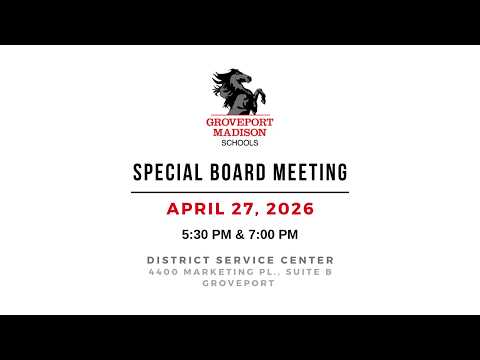
At a special April 27 meeting, board members argued over whether to hold exit interviews in executive session after a member read a statement alleging past secret settlements and Open Meetings Act risks; the meeting ended in disagreement and an adjournment at 7:08 p.m.
Groveport Madison School Board of Education members spent a special April 27 meeting sharply divided over whether to hold exit interviews in an executive session, with at least one board member reading a formal statement alleging the board had a pattern of secretive behavior and legal risk.
The dispute centered on the legal and procedural question of whether “exit interviews” with departing employees are an administrative function that must be public or whether parts of them can properly be heard in executive session. A board member (Committee member) read a prepared statement saying, “this is an attempt by the board to conduct business that is not board business,” and warned that the approach could bind discussions to confidentiality and risk violation of Ohio law.
Why it matters: Board procedures for personnel-related meetings touch on public-record and open-meetings requirements under Ohio law. Several members cited conflicting advice from counsel, and one raised past financial costs the district incurred in litigating open-meetings concerns.
The Chair, who led the proceeding and read the executive-session recommendation, said the board should consider entering an executive session “to consider the investigation of charges and complaints against a district employee or official pursuant to RC 121.22(G)(1) and to confer with the board’s attorney concerning disputes…subject to pending or imminent court action pursuant to RC 121.22(G)(3).” The text of that recommended motion was read aloud to the assembled members.
Board members offered competing views. The board member who read the statement cited a prior settlement involving former board president Latoya Doudle Burger and alleged that the district previously paid large sums and that board members had been bound by confidentiality provisions; the statement noted potential fines and described the public’s right to transparency. “The information shared will not be statutorily confidential, and I intend to treat this as such,” the member said.
Other members defended following counsel’s guidance about when executive session is appropriate and said they had solicited legal advice before posting the special meeting notice. The chair and several colleagues said counsel had recommended limited statutory language and that the board had previously agreed to similar steps at an April 14 meeting.
The meeting also included heated exchanges over whether individual requests to meet with the board — specifically a request by Ty Overson mentioned in the record — met the policy thresholds for a public meeting or for executive-session consideration. One member argued Overson’s request included multiple items and had not been given a fair chance to be heard; others said counsel advised against meeting in that format.
Votes and procedure: Members moved and seconded a recommendation to enter executive session under RC 121.22(G)(1) and (G)(3). Roll-call discussion and votes were recorded while members continued to dispute the notice’s specificity and the appropriate scope of executive session. The transcript records roll-call responses and procedural objections; the meeting concluded with a motion to adjourn that was carried and the meeting ending at about 7:08 p.m.
What was claimed and contested: The principal accusation was that the board planned to conduct exit interviews in a way that would shield matters from public view and potentially violate the Open Meetings Act. The board member making that claim cited past settlements and alleged costs tied to prior closed deliberations; other members said legal counsel had been consulted and urged adherence to counsel’s advice.
Next steps: The meeting record reflects no formal public finding resolving those allegations at the session. Members recorded objections and votes on the motion but left substantive resolution of whether and how exit interviews will be conducted for a later step; the board adjourned amid continuing disagreement.
Quotes
"This is an attempt by the board to conduct business that is not board business," said a board member reading a prepared statement about planned exit interviews.
"It is recommended that the board of the Groveport Madison School Board of Education enter executive session to consider the investigation of charges and complaints against a district employee…pursuant to RC 121.22(G)(1) and to confer with the board’s attorney concerning disputes…pursuant to RC 121.22(G)(3)," the chair read during the meeting.
"I'm super embarrassed to be sitting here, as a part of this board at this moment. It's really unprofessional…intimidation and bullying tactics are inappropriate towards our staff," another board member said.
Ending
The special meeting ended in procedural disagreement and an adjournment at approximately 7:08 p.m.; the transcript shows members recorded objections and votes but does not resolve the underlying dispute about whether exit interviews should proceed in executive session.