Get Full Government Meeting Transcripts, Videos, & Alerts Forever!
Get email alerts on the Streets Infrastructure topic
No spam. Unsubscribe anytime.
Marshall City Council awards multiple street resurfacing contracts under budget
Summary
The council approved three pavement projects — a chip-seal contract with Pearson Brothers ($132,459.35), a local mill-and-overlay low bid from Dunnick ($532,361.50), and a state-aid overlay by Donek ($485,609.50) — and debated whether to include alternate streets to take advantage of unusually low unit prices.
The Marshall City Council on Monday approved several street maintenance contracts that city staff said came in well under estimates, allowing the city to add recommended alternate streets without exceeding budget caps.
City engineer Jason Anderson told the council the apparent low bid for the chip-seal project was "from Pearson Brothers of Hanover, Minnesota, in the amount of $132,459.35," well below the $153,000 estimate. Staff recommended adding alternate streets (South Bend and Marguerite) and awarding the contract with a not-to-exceed amount of $165,000. Council approved the resolution on a roll-call vote; Councilmember Luzinski recorded the lone "no."
Anderson also reported four bidders on the local mill-and-overlay project; the low proposal was from Dunnick of Prinsburg, Minnesota, for $532,361.50, under the $650,000 capital budget. Because contractor pricing was favorable, staff recommended adding an alternate segment (Canoga Park Drive), bringing the recommended total to $594,841.24. Council approved the award including the alternates after debate over whether to defer the extra work to next year.
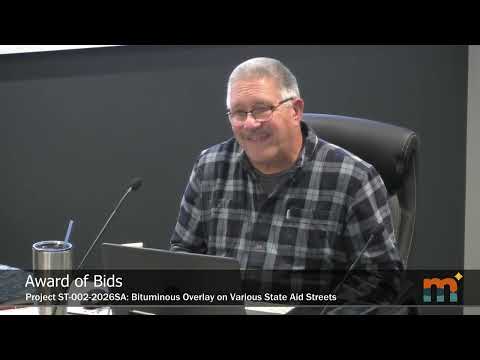
On a separate state-aid mill-and-overlay project, Anderson said prevailing wages applied and the low bid from Donek was $485,609.50, below the city's estimate of $505,000. He told the council that "no local dollars" were required for that project because it is funded with state aid and that the city's state-aid account is in an "advanced status" with a negative balance just under $1.2 million, which he said is "within policy" (threshold −$4,000,000). Council voted to award that contract as recommended.
Council members pressed staff on the tradeoffs of adding alternates now versus saving money for future budgets. Councilmember Jim asked whether the roughly $62,000 alternate should be deferred to reduce taxpayer burden next year; Anderson replied that skipping the alternate would typically push that segment into the following year when it would compete with other streets for limited overlay capacity and possibly increase overall costs.
The council approved the three construction contracts by roll call. The consent agenda — which included festival declarations, temporary liquor licenses, advertisement authorizations and project payments — was approved separately earlier in the meeting.
What happens next: Public works staff will finalize contracts with the awarded contractors and schedule work; the city expects to proceed with the alternates while remaining under the approved budget limits.