Get Full Government Meeting Transcripts, Videos, & Alerts Forever!
Get email alerts on the Middle School Schedule topic
No spam. Unsubscribe anytime.
Park Ridge CCSD 64 unveils new middle school schedule, boosts ELA and math time
Summary
Assistant Superintendent Samantha Laimo presented a new middle school schedule for Park Ridge CCSD 64 to begin in 2026–27 that lengthens ELA and math to 80-minute double blocks, shifts all courses to trimesters, reduces elective slots for 7th–8th graders from four to three, and expands co-taught and intervention programming.
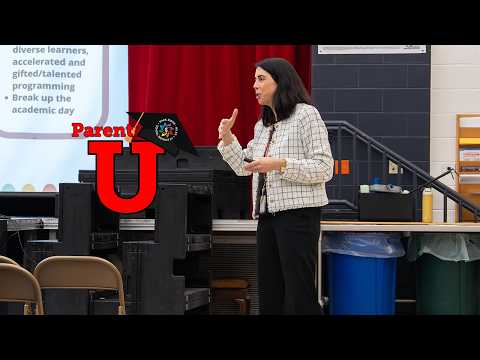
Assistant Superintendent Samantha Laimo told families the district will implement a new middle school schedule in 2026–27 designed to increase instructional time in core subjects while breaking up long blocks with electives and lunch.
"Research says there's two things that really helps kids grow and develop academically in core programming. One is quality of instruction, and the other one is length of instruction," Laimo said as she explained why the district narrowed 25 initial schedule options down to a single plan.
Under the schedule Laimo described, daily homeroom (advisory) remains at 08:05 for five minutes (30 minutes on Wednesdays), and dismissal remains at 3:00 p.m. The district will move all classes to trimester reporting. For seventh and eighth graders, ELA and mathematics will be lengthened to 80 minutes (two 40-minute periods that function as a double block), which reduces elective periods from four to three.
Laimo walked families through a sample seventh-grade day: homeroom, PE/health or an elective, a double-block ELA period, lunch, social studies, science and an elective, followed by a double-block math period. She said the common bell schedule is intended to reduce the complexity of staggered movement and make it easier for elective teachers who serve multiple grades.
Sixth graders will have an exploratory ‘‘wheel’’ of nine trimester-long rotations that expose incoming students to departments including art, family and consumer sciences, industrial technology, music, technology, world language (Spanish or French), physical education and a quarter of health. Laimo said world language is optional beginning in seventh grade; students who opt out of language will open three elective slots for other choices.
Laimo said some programming changes aim to increase inclusion and differentiated instruction. The district will offer co-taught social studies for the first time at Emerson and Lincoln in Laimo’s tenure and allow co-teaching models in ELA and math where appropriate. She described tiered supports: tier 1 core instruction for all students, push-in co-teaching with special education or multilingual staff, pull-out replacement classes, and resource/related services for students with IEPs. The Academic Support Class (ASC) will continue as an option; placement is by teacher or team recommendation and may take the place of an elective for a trimester or longer.
Laimo also listed specialized programs across Emerson and Lincoln, including a Structured Learning Community (SLC) at Lincoln, the new HOPE (Healthy Opportunities for Positive Empowerment) program, and Emerson’s Functional Life Skills and Academic Life Skills programs; she said the district has two new facilities to support those offerings.
Extracurriculars were addressed: band and orchestra remain outside the regular day and will not occupy elective slots; sports offerings vary by grade (all sixth graders can participate in cross country and wrestling; seventh and eighth graders may also play basketball and volleyball). Laimo closed by providing contact information for further questions and directing families to a QR code with detailed elective lists and the recorded presentation.
The presentation did not include a formal board vote; Laimo said the schedule decision followed committee work, stakeholder surveys and cross-district visits. Families were invited to ask questions after the session and contact named administrators by email for individualized concerns.