Get Full Government Meeting Transcripts, Videos, & Alerts Forever!
Get email alerts on the Public Transportation Funding topic
No spam. Unsubscribe anytime.
Jack Hoffman tells Walker commission state funding shortchanges cities, urges passage of HB4210
Summary
At the April 27 Walker City Commission meeting, Jack Hoffman, a public transportation advocate, argued the 2025–26 state transportation budget favors rural roads and trucking over cities and transit, cited per-capita funding gaps and urged passage of House Bill 4210 to dedicate sales-tax proceeds to public transportation.
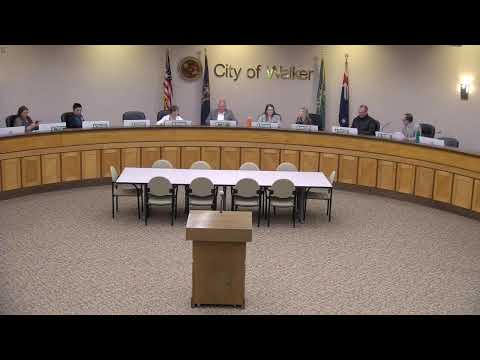
Jack Hoffman, identified in the meeting as a public transportation and urban advocate, told the Walker City Commission on April 27 that the state’s 2025–26 transportation budget “subsidizes rural roads and the trucking industry at the expense of cities” and public transportation. Hoffman presented per-capita figures and legislative recommendations in a 10‑minute presentation.
Hoffman said state funding is imbalanced: rural county road commissions receive about $444 per resident, cities receive roughly $195 per resident, and public transportation receives about $27 per resident. He said the Michigan Department of Transportation estimates an additional $280 per capita is needed to keep trunk lines in good repair and noted that an infusion in last year’s budget added about $18 per capita for trunk lines. “Heavy trucks caused 95% of pavement damage in the amount of about $8,000,000,000 per year and paid only $600,000,000 in state road taxes,” Hoffman said.
Hoffman argued those funding patterns undermine dense urban cores that produce higher per-capita economic output and attract younger adults. "Where there is a healthy public transportation system, the higher the density, the more young people in the 25 to 34 year old age group," he said, linking transit to economic and demographic vitality.
As a legislative remedy, Hoffman urged support for Representative Morgan’s House Bill 4210, which he said would restrict the use of proceeds from sales taxes on transportation products to public transportation purposes; Hoffman estimated HB4210 would generate an additional $25 per capita for transit. He also noted that the region’s transit millage is scheduled to come up in 2029 and that local millage efforts could occur in 2027 or 2028.
A commissioner asked Hoffman about proposed legislation to require testing for drivers age 75 and older. The commissioner said the issue is complicated because in many rural areas driving is the only option for seniors to reach medical care and groceries. Hoffman responded that, as a citizen, he would support testing on safety grounds but emphasized that public transportation alternatives must be available to avoid isolating people who lose driving privileges.
Hoffman closed by urging continued regional advocacy to maintain and expand transit funding and said he was available to continue the conversation with local officials.
The commission did not take any formal action on HB4210 at the meeting; Hoffman’s presentation served as an informational briefing and appeal to commissioners and staff to consider funding and policy options ahead of future local and state decisions.