Get Full Government Meeting Transcripts, Videos, & Alerts Forever!
Get email alerts on the Social Media Safety topic
No spam. Unsubscribe anytime.
Senate committee advances bill to restrict addictive social‑media features for minors
Summary
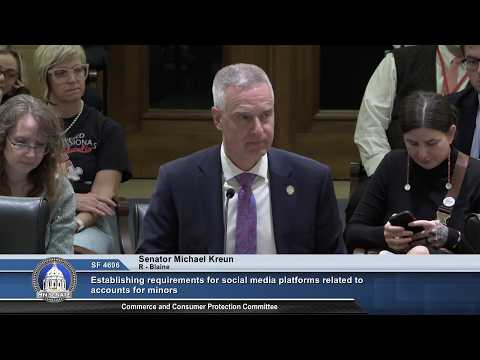
The Minnesota Senate Commerce and Consumer Protection Committee advanced Senate File 4696 as amended after testimony from parents, students, tribal advocates and industry. The bill would require verifiable parental consent for accounts under 16, limit addictive features and restrict targeted advertising to minors; it moves to general orders.
The Commerce and Consumer Protection Committee voted to recommend passage of Senate File 4696, the "Stop the Harms of Addictive Social Media Act," after a day of testimony from parents, students, tribal advocates and tech industry representatives.
Senator Kroon, the bill’s author, told the committee the measure does not ban social media but would require verifiable parental consent for accounts belonging to children under age 16, default to the most restrictive privacy settings for those accounts, and restrict design features such as infinite scroll, autoplay videos and targeted advertising aimed at minors. He said the bill’s effective date is July 1, 2027, to allow implementation time.
Parents and young people who testified in favor said platform design has contributed to harms including cyberbullying, anxiety and, in one parent’s testimony, an online pathway to violence. Mike Raldi, who identified himself as a parent of students at Annunciation, told the panel that ‘‘features built to keep a child coming back’’ can expose vulnerable youth to communities that glorify mass violence. High school student Molly Snyder said targeted advertising and manipulative content had harmed family members and urged senators to support the bill.
Tribal and faith‑based witnesses voiced conditional support. Kirsten Buescher of the Minnesota Indian Affairs Council said Native youth face higher rates of mental‑health challenges and urged safeguards that preserve access to supportive online communities. Maggie Hange of the Minnesota Catholic Conference backed the bill and cited Federal Trade Commission guidance for parental‑consent methods such as automated calls or government‑issued ID options.
TechNet’s Midwest executive director Nina Laniero warned the committee the bill’s age‑estimation and parental‑consent rules could push platforms to collect additional data and that prescriptive product requirements could be difficult to implement without unintended consequences. She also flagged litigation and constitutional risks.
Committee members pressed the author on definitions and scope, including whether services such as YouTube would be covered. Senator Kroon said the bill’s definition of social‑media platform is intended to be narrow and said he is open to refinement for vulnerable children who lack a legal guardian. He described staged penalties in the amendment, including statutory damages that trigger only upon a reckless or knowing finding and a safe‑harbor for good‑faith compliance.
Several senators urged outreach to groups that submitted opposition letters, noting concerns raised by LGBTQ advocates and minority‑owned businesses about potential disparate effects. Others said protecting minors from addictive design features is a high legislative priority.
Senator Rasmussen moved to recommend SF 4696 as amended to pass and be placed on general orders; the committee approved the motion by voice vote. The committee record shows the motion adopted and the bill will proceed to the Senate floor for further consideration.
Next steps: the bill advances to general orders and may be debated on the Senate floor, where members said they expect additional refinement and review before final passage.