Get Full Government Meeting Transcripts, Videos, & Alerts Forever!
Get email alerts on the Parks Bond topic
No spam. Unsubscribe anytime.
Renton committee leans toward $60 million parks bond focused on modernization, asks staff to add Tri Park design work
Summary
The Renton Parks & Recreation committee reviewed bond scenarios and project groupings and signaled support for a revenue-focused modernization package (~$60 million), while asking staff to return with a breakdown of costs, projected revenue streams and design funding for the partial Tri Park master plan.
The Renton Parks & Recreation committee spent the meeting weighing bond options and project packages and directed staff to prioritize a revenue-oriented modernization package while also funding design work for the partial Tri Park master plan.
A city finance official laid out sample debt-service scenarios and taxpayer effects, saying, “At a $10,000,000 bond issuance, it would be about $800,000 per year debt payment,” and using a 20-year term at a 5% assumption to estimate impacts at larger bond sizes. The official warned that issuance costs typically run from about $100,000 to $500,000 and that interest-rate changes would alter those estimates.
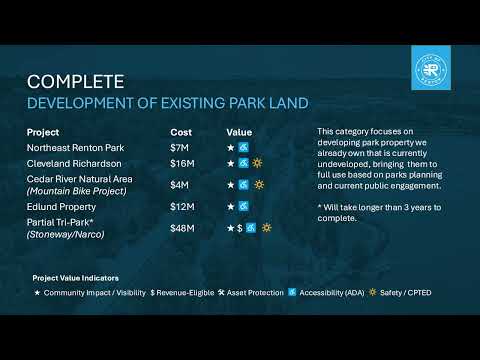
Staff presented a project framework organized into six groupings — complete projects, a hybrid (the partial Tri Park), modernization (upgrades to existing parks and revenue-generating facilities), core investments (asset protection), enhancements (beautification and wayfinding) and continuation (no-bond baseline). A parks department official said modernization items (restrooms, courts and fields) “have the most potential for revenue generation to offset operations and maintenance.”
Council members focused on two practical constraints: a legal or administrative three-year requirement to spend 85% of bond proceeds after issuance, and construction-timing uncertainty for the Tri Park sites. When asked what “partial” Tri Park meant, the parks planner said the partial scope represents roughly two-thirds of the Tri Park program and that much of the construction would likely fall outside the three-year spend window; the planner added the $48 million program figure includes both design and construction and staff would follow up with a construction-versus-design breakdown.
Several council members raised affordability and voter-communication concerns. Councilmember Alverson pressed what would happen if design consumed bond proceeds but construction could not start within three years; staff acknowledged that if construction cannot be completed in the spend window, a bulk of construction costs would need separate funding after the bond period. Councilmember Prince cautioned about escalation in construction costs and asked staff to build contingencies into estimates.
Multiple councilmembers favored starting with the modernization package because it touches more neighborhoods and contains revenue-eligible components; Councilmember Rivera said the modernization package “has the most bang for its buck” and noted a personal priority: “I have a passion for restrooms and accessibility.” Council members also discussed structuring a voter measure to allow issuance in tranches so the city could meet the 85% rule while phasing borrowing.
Staff outlined a tentative schedule: define scope and borrowing amounts in March–April, draft election ordinances and explanatory language with bond counsel (Pacifica Law Group), pass ordinances and designate pro/con committees in July, submit paperwork in August for a November election (noting November is tight because of the property-tax levy calendar), and complete bond issuance the following year after rating actions. Staff also said the city could use banked property-tax capacity as an alternative funding source but emphasized that the banked capacity represents levy authority, not cash on hand.
The committee did not take a formal vote but gave direction to staff to prepare more-detailed follow-ups: (1) refined cost breakdowns and escalation scenarios for the modernization package; (2) projected revenue streams for modernization elements (tournaments, fees, rentals); (3) the cost to add Tri Park master planning and design into the package; and (4) an estimate of election costs and timing. Staff also noted the King County levy will contribute to trail funding (staff cited approximately $60 million for trails impacting the city).
The committee asked staff to return with those specifics at a follow-up council meeting. The meeting closed after staff agreed to coordinate scheduling and deliver the requested cost and scope details.