Get Full Government Meeting Transcripts, Videos, & Alerts Forever!
Get email alerts on the Discipline topic
No spam. Unsubscribe anytime.
District presents discipline‑data update showing fewer referrals but persistent disparities
Summary
A district presentation reviewed conduct‑referral definitions, showed a decrease in referrals since 2024, and highlighted persistent disparities by race and gender; presenters acknowledged data gaps on newcomer status and school‑initiated contacts with school resource officers.
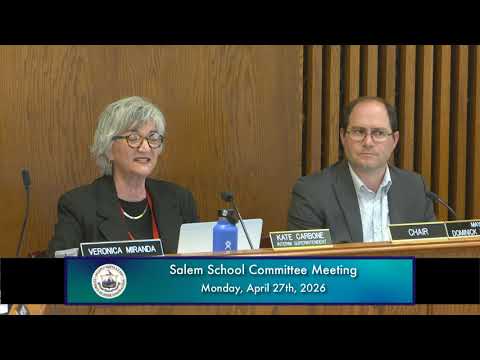
The Salem School Committee heard a follow‑up presentation April 27 on school discipline data and district practices intended to reduce suspensions and disparities.
Ellen Wingard reviewed how conduct incidents are recorded in the Aspen conduct workflow and cautioned that several schools (EECC/pre‑K, Salem Prep, New Liberty) do not use the Aspen conduct workflow; their incidents are excluded from the reported totals. "We have considerably decreased the number of behavior referrals instances, since 2024," Wingard told the committee, and added that the majority of incidents recorded occur in classrooms and hallways, most commonly for skipping class and disorderly conduct.
Wingard emphasized the difference between incident counts and unique students: incident totals count events (one student can have multiple incidents) and the district reported 135 suspensions last year out of nearly 4,000 students. She presented a breakdown showing higher incident counts among students identified as male and among Latino students; she described the district’s use of a risk‑ratio metric to measure disproportionality and noted that the district’s suspension rate (3.1 percent) places Salem at the low end of comparison districts.
The presenter explained emergency removal rules (principals or designees may remove a student up to two days when the student poses a danger or creates substantial disruption, with oral and written notice to families and a hearing after the removal) and clarified that school‑resource officers are involved only when a criminal complaint is filed.
Wingard reviewed alternatives to suspension that reflect an August 2022 state law requirement (restorative practices, collaborative problem solving, mediation, conflict resolution) and said the district has trained more than 200 staff in restorative practices and has seven district safety‑care trainers who certify more than 230 staff annually in de‑escalation and safe physical management.
Committee members asked about anti‑bias components of training, whether trainers reflect student demographics, access to registration data (place of birth), and whether SROs have access to that data. Wingard said the de‑escalation module integrates culturally responsive practices and bias awareness, that trainer demographics do not yet mirror the student body but the district is working on workforce diversification, that teachers and select staff have access to registration birthplace data on a need‑to‑know basis, and that SROs do not have access to that registration field.
Wingard also flagged data gaps: the district cannot currently cross‑reference place‑of‑birth registration fields with discipline events in Aspen, and it does not centrally collect school‑initiated contacts with SROs or whether those contacts resulted in legal action. She recommended working with data‑integration tools to improve future reporting.
The committee did not take a vote on policy changes; the session served as an informational update followed by committee questions.