Get Full Government Meeting Transcripts, Videos, & Alerts Forever!
Get email alerts on the Capital Budget topic
No spam. Unsubscribe anytime.
Appropriations Committee adopts Maryland’s fiscal 2027 capital budget
Summary
The Maryland Appropriations Committee approved the fiscal 2027 capital budget after the capital budget subcommittee presented a favorable report that increased funding for dozens of projects, added miscellaneous and local initiatives, and preauthorized new projects; the budget passed on a roll-call vote with 21 recorded yeas and no recorded opposition.
The Maryland Appropriations Committee voted to adopt the fiscal 2027 capital budget during a committee meeting, approving a subcommittee report that increased funding for multiple projects and preauthorized new authorizations, committee leaders said.
Delegate Malcolm Ruff, chair of the capital budget subcommittee, presented the subcommittee’s favorable report and said the plan was guided by “ensuring the maximum return on the state's investment from a statewide equity lens.” He told members the package balances urgent infrastructure needs with long-term economic growth and includes investments in schools, public safety facilities and community revitalization.
Ruff described specific adjustments: the subcommittee increased funding for 13 miscellaneous projects and decreased funding for three; it increased funding for 33 of the Senate’s 191 miscellaneous projects; and it added more than 100 miscellaneous projects and over 140 local house initiative projects. He also cited higher-education changes, including added funding for roof repairs and graduate student housing at the University of Maryland, College Park; maintenance and security upgrades at Bowie State University; a new school of veterinary medicine project at the University of Maryland Eastern Shore; and $1,000,000 added for deferred maintenance at Baltimore City Community College. The subcommittee also modified authorizations and narrative language across multiple agencies, including the Interagency Commission on School Construction, the Department of General Services, the Department of Natural Resources, the Department of Housing and Community Development, and the Department of Public Safety and Correctional Services.
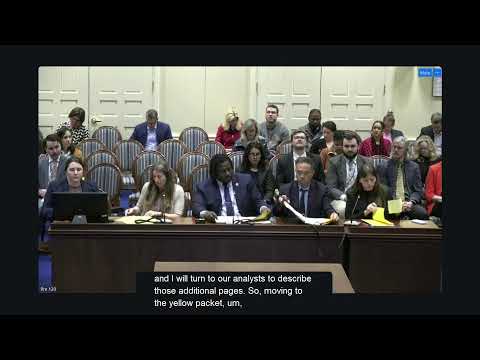
A committee analyst reviewed the meeting materials labeled the “yellow packet,” detailing technical amendments that would change allocation methods for school construction funds, break out $4.5 million from the supplemental capital grant program for the county with the greatest enrollment growth above the statewide average, restrict funds for specified projects within DHCD programs, and amend provisions of the State Finance and Procurement Article related to termination and reporting for capital grants.
Ruff moved adoption of the subcommittee report as amended; the motion was seconded and adopted by voice vote. The committee then moved and seconded adoption of the overall capital budget. A subsequent roll-call vote recorded 21 delegates voting "aye" and no recorded opposition. The motion to adopt the capital budget passed; the chair declared, “We have capital budget. Congratulations.”
Votes at a glance
- Motion: Adoption of capital budget (moved by Delegate Malcolm Ruff; seconded by the chair). Roll-call result: 21 yeas, 0 nays, 0 abstentions recorded in the transcript. Names recorded as voting "yea" included Vice Chair Kaiser; Delegates Smith, Shetty, Watson, McCaskill, Ruff, Grace, Ivy, Jones, Tolles, Spiegel, Beauchamp, Stonko, Woolick, Heinbach, Harrison, Edelson, Chang, Acevedo, Forbes and Chair Barnes.
The committee had no further business and adjourned.
(Reporting based on committee remarks and the roll-call recorded in the meeting transcript.)