Get Full Government Meeting Transcripts, Videos, & Alerts Forever!
Get email alerts on the Transit topic
No spam. Unsubscribe anytime.
Yavapai Plan director urges Chino Valley to fund transit match, study regional tax; council weighs scale of contribution
Summary
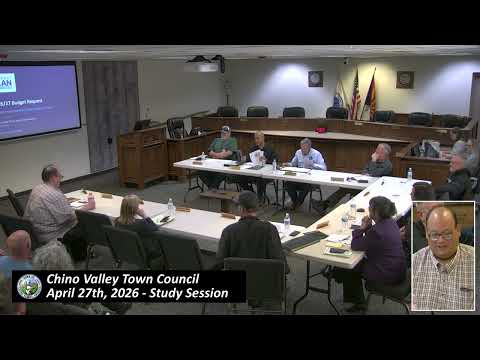
Yavapai Plan executive director Vinny Gallegos and YRT manager Tom presented transit dashboards and a request for existing budget reallocation, arguing Chino Valley’s match (about $77,447 as presented) helps unlock federal transit dollars and regional planning capacity; council members probed subsidy concerns and asked for more analysis before increasing local contributions or committing to an RTA study.
Vinny Gallegos, executive director of Yavapai Plan, told the Chino Valley Town Council at a budget work session that the town’s local match helps unlock federal transit dollars and regional planning capacity. "That match is unlocking about $1,900,000 of federal transit funds for the region," he said, describing how the MPO’s work leverages planning staff, grant capacity and traffic modeling to stretch Chino Valley tax dollars.
Tom, speaking for Yavapai Regional Transit (YRT), presented the agency’s operating dashboard and financials, noting the year-to-date cost per rider had fallen from $25.15 last year to "$22 and some odd cents." He said a recent $47,000 reimbursement helped produce a positive March profit-and-loss of $7,288 and explained why YRT does not collect fares: small fare collections reduce ADOT reimbursements and can cost the operator roughly $3,800–$4,200 a year in net administrative costs.
Tom also requested a technical amendment: $3,000 originally budgeted for the Pauline Plunge be reallocated to YRT and absorbed within the council’s currently proposed $20,000 contribution. "That $3,000 be given to YRT," he said; staff noted this would require a contract amendment.
Council members pressed Vinny and Tom on the value proposition. Several questioned whether the town’s roughly $77,000 contribution (as presented in staff materials) truly translates to direct local benefit or mainly subsidizes larger systems in Prescott and Prescott Valley. Vinny responded that the boundary change and population-based formula had reduced Chino Valley’s share (from about 9.09% to 7.76%) and that regional work has yielded projects that benefited Chino Valley in the past, such as sidewalk design and safety improvements. He added that Yavapai Plan has funded a short-term transit plan (paid by the MPO at $175,000) and is buying two vehicles to improve service connections.
The council also discussed a longer-term regional transportation authority (RTA) Vinny described as a multi-year study and possible future ballot measure. He cautioned this is a study item and not a near-term tax: "Over the next couple of years, we as a region are going to study this, bring it back to you, and tell you what an RTA is and what it isn't." Council members were split: some said they could accept a modest increase or maintain the prior year contribution (17), while others said the town should not shoulder a large share until service consolidation and clearer local benefits are shown.
The town did not take any vote. Staff and council asked for more detailed analysis of what Chino Valley specifically receives for proposed funding levels, options to amend the existing intergovernmental funding agreement (IGA), and follow-up discussion at a future meeting before any final budget action.
The council's next formal budget steps are a brief review at the May 12 regular meeting and tentative adoption paperwork due May 26.