Get AI Briefings, Transcripts & Alerts on Local & National Government Meetings — Forever.
Inspector General: MONSEY Sidestep pilot had gaps in data, controls and a juvenile data exposure
Loading...
Summary
The Office of Inspector General told a Baltimore City Council committee that its review of the mayor's Office of Neighborhood Safety and Engagement (MONSEY) found weak contract management, missing case documentation, two suspected fraudulent invoices and a data exposure affecting juvenile records; MONSEY said it has reformed controls and redesigned diversion work with DJS.
The Office of Inspector General told the Public Safety Committee on May 1 that its review of the mayor's Office of Neighborhood Safety and Engagement (MONSEY) found multiple oversight gaps in the agency's Sidestep youth diversion pilot and related youth‑serving spending.
Inspector General Isabelle Cummings and Deputy Inspector General Matt Neal said the OIG began investigating Sidestep in June 2025 after complaints and found shortcomings in documentation, data tracking and financial oversight. Neal said the OIG's review showed that MONSEY did not track case-level activities consistently, that the agency failed to provide the OIG with unredacted records after requests, and that two organizations received payments tied to invoices the OIG identified as fraudulent. "This matter has been referred to law enforcement for criminal prosecution," Neal said.
The OIG described the Sidestep pilot as a limited pre‑arrest diversion that ran in the Western Police District from 2022 to 2024 for eligible first‑time, category‑2 offenses. The OIG and the external evaluator disagreed about documentation and access: the evaluator reported not being given full access to participants or their families, and the OIG said the evaluation’s findings were not provided to the full City Council when MONSEY later lobbied to expand the program.
The OIG also reported a data exposure: "A MONSEY employee sent post‑arrest information for over 700 people, many of which were juveniles, to a personal Google account that belonged to a relative," Neal told the committee. The diversion table reportedly contained names, dates of birth and specific charges. The OIG said MONSEY leadership told the office it was unaware of the exposure until the OIG discovered it.
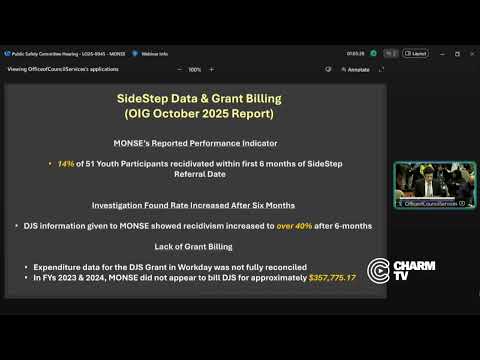
On finance, the OIG reported that MONSEY did not appear to bill the Department of Juvenile Services for roughly $357,000 in grant funds for FY2023–24 and that approximately $694,000 was issued to 15 organizations and one evaluation consultant for the pilot and related youth work. The office said some subrecipients used city funds for activities or clients beyond Sidestep’s stated scope; some contracts served young people well above the pilot’s age limit of 17.
MONSEY Director Stephanie Mavronis told the committee she "sincerely appreciates the work of the Office of Inspector General" and said the agency stands by its mission while accepting the need to fix operational problems. "We have overhauled agency financial processes and procedures," she said, and described an internal audit of past expenditures and a commitment to recoup misspent funds where possible in partnership with the law department.
Mavronis said MONSEY has implemented multi‑step invoice review, retrained staff on subrecipient monitoring, and moved from its older case system to Microsoft Dynamics to improve time‑stamped case notes and secure data sharing with the Department of Juvenile Services (DJS). She told the committee that Sidestep "as it previously existed will not be expanded citywide" and that future youth diversion work will be redesigned in partnership with DJS, with a memorandum of understanding under development.
Committee members pressed both offices on metrics and transparency. Chair Mark Conway asked how the records problems developed, noting a discrepancy between MONSEY’s internal count of 51 pilot participants and another reported count of 55. Mavronis said 51 unduplicated referrals appear in MONSEY’s internal systems and that prior entries could have duplicates; she acknowledged the older Apricot system limited case‑note functionality and that documentation practice varied under the prior director.
The committee made multiple follow‑up requests, including copies of MONSEY’s evaluations and a written explanation of how the old pilot handled participants who did not complete diversion services. The OIG said it had issued subpoenas to obtain unredacted records and that the matter is in litigation to enforce compliance.
Why it matters: Council members called the hearing a chance to learn where operations failed so the city can avoid repeating mistakes. For any future expansion of youth diversion, the council signaled it will expect clearer data, reconciled financial records and formal agreements with referral partners.
The committee recessed after public testimony from several community partners who praised MONSEY’s victim services and youth work even as the council pressed for accountability and better recordkeeping. The OIG and MONSEY said they will provide additional materials to the committee as requested.