Get Full Government Meeting Transcripts, Videos, & Alerts Forever!
Get email alerts on the Temporary Use Permit topic
No spam. Unsubscribe anytime.
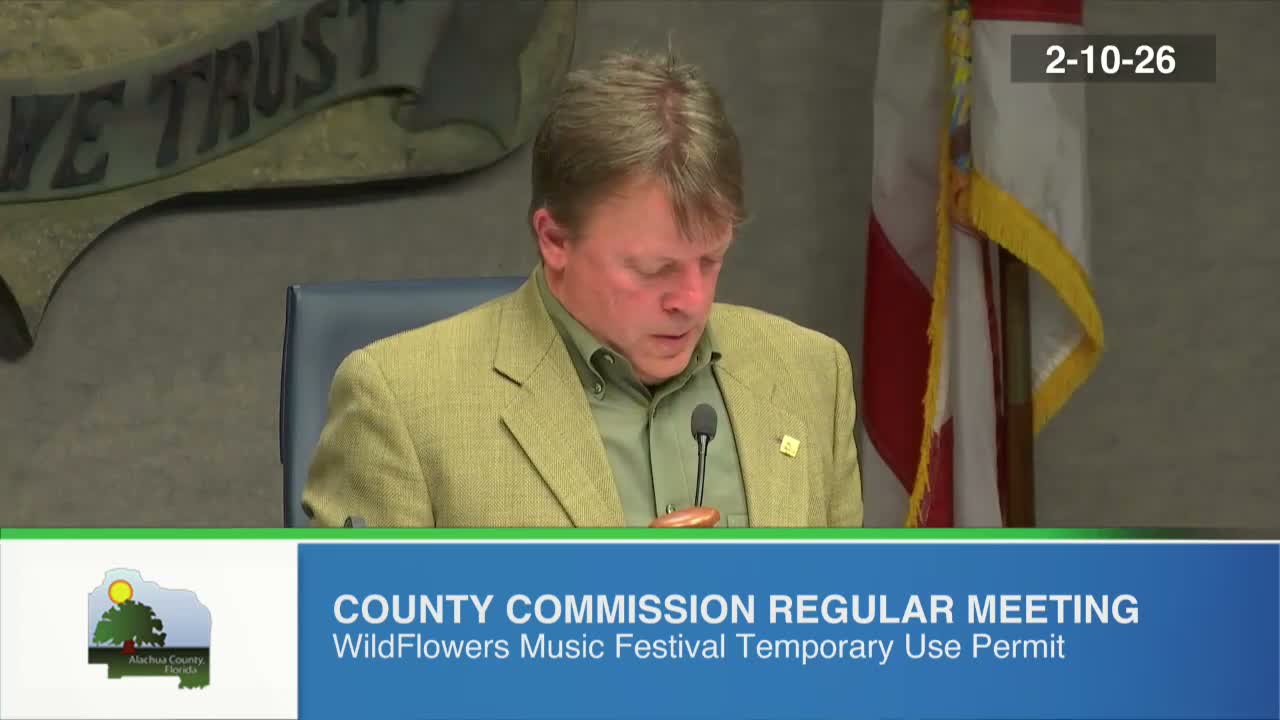
Alachua County approves temporary permit for Wildflowers Music Park festival amid sharp neighborhood debate
Summary
The Alachua County Commission approved temporary use permit TU2520 allowing the Wildflowers Music Park festival March 12–16 with up to 5,000 attendees and camping, imposing staff conditions plus board-added requirements to post no-parking and no-trespassing signs after hours of staff presentations, expert testimony and public comment.
The Alachua County Commission voted unanimously to approve temporary use permit TU2520, clearing the Wildflowers Music Park to hold a multi-day music festival with camping on the privately owned property south of Melrose.
The permit authorizes amplified events and camping for a limited period in March under dozens of staff conditions and county rules, including a maximum on-site attendance of 5,000 (including vendors and staff), specified amplified-music hours and a public-works maintenance surety of $15,950 to cover potential road repairs. Commissioners added two conditions before voting: the applicant must post no-parking signs along Northeast 35th Avenue and no-trespassing signs along the property boundary.
Staff said the application requires board approval because the event requested multiple thresholds in the county code: attendance up to 5,000, overnight camping and more-than-three-day activity. "This is a temporary use permit, a request for a temporary use permit for Wildflowers Music Festival," Principal Planner Chris Dawson told the board, summarizing staff's environmental, traffic and emergency-management review and recommending approval with conditions.
Why it matters: the proposal combines a private cultural event with conservation aims on roughly 210–267 acres in eastern Alachua County. Supporters say the festival will underwrite restoration and public-access programming; neighbors warned the event would strain unpaved roads, bring noise and trespass risks, and change rural character.
What the permit requires and how staff analyzed it Staff's packet lists specific conditions that must be met before and during the event: staging, fencing and turbidity/silt controls near mapped wetlands, monitoring and exclusion for gopher-tortoise burrows, a special-event permit signed off by Alachua County Fire Rescue, traffic-control plans using off-duty deputies, tent and building permits for structures over 900 sq ft, and limits on amplified sound measured at property lines (60 dBA day; 55 dBA night under county code). Dawson told commissioners the applicant must secure a right-of-way/driveway connection permit and suggested a maintenance bond be posted "no later than 03/06/2026" to ensure the county can restore roads if needed.
The staff-recommended operating schedule in the packet sets guest gates to open no earlier than 9 a.m. on March 12 and requires all attendees to have left the property by 2 p.m. on March 16. Amplified sound was limited in the recommendation to defined hours: 10 a.m.–9 p.m. Thursday, until 10 p.m. Friday and Saturday, and to 7 p.m. Sunday. Dawson said tents and larger structures will require separate county permits and inspections.
Applicant and experts: safety and mitigation plans Applicant representatives — including Guy Fortune, president of Wildflowers Music Park Inc., and festival veterans Charles "Jordan" Puryear and others — described a program of music, workshops, craft vendors and volunteer stewardship. "This event has a great history...and the team that has been assembled here is something I'm very proud of," Fortune said, describing the park’s restoration and volunteer efforts.
Traffic and sound consultants presented technical reviews. Traffic engineer Larry Hagen said county roads near the site operate at acceptable levels of service and that the plan uses movable barricades, staging areas and variable message boards to steer festival traffic away from Quail Street. Sound consultant Peter Theoctisto reported on on-site test measurements and recommended property-line monitoring; his brief tests found average property-line readings within the county's numeric limits but acknowledged low-frequency bass can travel farther and remain perceptible to neighbors.
Environmental witnesses including Lee Cook (Quest Ecology) and Mark Brown (Alachua County Environmental Protection) presented field delineations: the site contains mapped wetlands and several gopher-tortoise burrows; staff and the applicant proposed fenced exclusion zones, perimeter signage and volunteer monitoring to protect sensitive features. Cook said wetlands mapped on the property total roughly 59.4 acres, about 22% of the site, and that wetland boundaries were verified in the field.
Neighbors’ objections and public safety concerns More than 60 speakers addressed the commission during a packed public-comment period. Opponents — many of them neighbors living within miles of the site — warned the event would bring prolonged noise, overwhelmed volunteer emergency services, dust on lime-rock roads, damaged rural character, and repeated trespass. "This is a large commercial festival venue... not a small community gathering," Sandra Nacho said, urging denial and pointing to long set-up and tear-down that neighbors say could extend disruption over weeks.
Speakers documented prior trespassing on adjacent properties and urged strict enforcement and perimeter fencing. Several residents said they rely on private wells and raised groundwater and sanitation concerns; health and fire officials responding at the hearing said special-event permits require first-aid/medical coverage and inspections for large tents and food trucks.
Supporters and conservation advocates Other residents and conservation groups supported the permit as a way to fund restoration and public access. Longtime neighbors who backed the project said volunteer stewardship and prescribed burns have improved live-oak habitat. Local conservation volunteers and representatives of the Alachua Audubon Society told the commission they have participated in habitat work and surveys and see the park as an asset.
Board action and conditions After public comment and deliberation, a commissioner moved to approve staff's recommendation with the addition of two board-requested conditions requiring the applicant to post no-parking signs along NE 35th Avenue and no-trespassing signs along the property boundary. The motion passed unanimously.
What happens next Approval of a temporary use permit authorizes this single event under the county's land-development rules; a future event with similar thresholds (attendance, camping, duration) would require a fresh application and review. The permit is conditional on obtaining the other required administrative permits (driveway/ROW connection, fire-marshal tent inspections, special-event permit) and on meeting the conditions in the staff report (including the maintenance surety and environmental protections). The commission noted that a single approved temporary permit does not automatically create entitlement to repeat or permanent approval.
The commission said it will watch performance on this event as the test of whether future permits would be appropriate.