Get AI Briefings, Transcripts & Alerts on Local & National Government Meetings — Forever.
Denison Reinvestment Zone No. 5 board approves developer reimbursement after TIF update
Loading...
Summary
The Denison Reinvestment Zone No. 5 board on April 27 voted unanimously to disburse $142.56 to the city and $21,701.86 to a developer after staff reported the zone's tax increment fund balance of $1,681,805.88 and reviewed submitted invoices for the Rosemary/Viking Street work.
The Denison Reinvestment Zone No. 5 board on Monday, April 27 approved reimbursements of $142.56 to the City of Denison and $21,701.86 to the developer identified in the meeting record (variously transcribed as JPN PHM, JNPHM, JMPHN or JMPHM Development) after a staff presentation on the zone’s tax increment fund.
Macedo, who presented the tax increment fund update, said “the total balance as of March 8 is $1,681,805.88,” and told the board the zone has shown an average valuation growth of about 14% year over year. He noted prior reimbursements, including a DDA sewer-line reimbursement, and a small consulting charge in fiscal year 2022.
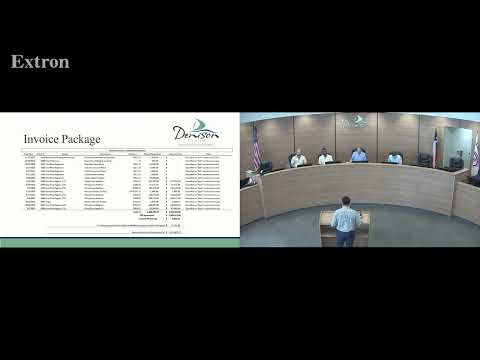
Staff described developer-submitted invoices for the Rosemary project and Viking Street work totaling $1,229,495.33 across 2024–2026. Macedo said a review of those invoices determined that $1,183,189.38 qualified as reimbursable under the TIF agreement’s limits; the agreement’s maximum reimbursement to the developer was stated as $1,190,011, leaving a remaining potential reimbursement balance under the existing agreement.
A board member summarized the remaining exposure as roughly $7,000 if additional qualifying expenses were later submitted; Macedo confirmed that estimate. When asked whether impact fees or engineering/design (soft) costs were reimbursable, Macedo replied such items are not reimbursable under the current agreement and that reimbursable items are limited to physical hard construction costs (for example, concrete street work). He offered to circulate more descriptive invoice line items and the invoices themselves for board review.
A staff member explained that the TERS policy and state legislation define eligible costs, and that the city uses a third-party financial modeler (referred to in the record as “p3”) to verify project costs and the financial projections used to set reimbursement amounts over the agreement’s defined time period.
Member Thomas moved to approve the disbursement of $142.56 to the City of Denison and $21,701.86 to the developer; Member Poole seconded. The board voted in favor, and the motion carried unanimously.
The meeting adjourned at 11:16 a.m.; no public commenters had signed up.
Notes on naming: the developer’s name appears with multiple spellings in the meeting record (JPN PHM, JNPHM, JMPHN, JMPHM); the article follows the meeting text in flagging that variation and reports the reimbursement amounts as presented to the board.