Get Full Government Meeting Transcripts, Videos, & Alerts Forever!
Get email alerts on the Municipal Budgeting topic
No spam. Unsubscribe anytime.
Pearland staff preview FY2027 budget, propose ‘no new revenue’ tax-rate approach and cap on motor-pool lease transfers
Summary
City staff presented an early FY2027 budget preview April 27, 2026, outlining a no-new-revenue tax-rate approach, mid-range financial assumptions and a proposal to cap general-fund lease-fee transfers to the motor-pool capital holding fund at $2.5 million.
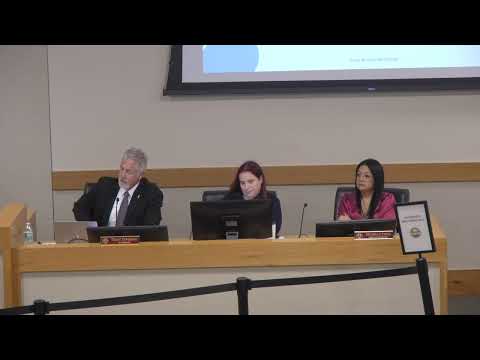
Pearland city staff presented an early preview of the fiscal year 2027 budget at a special City Council meeting on April 27, 2026, saying the process will emphasize projections, mid-range planning and only the highest council priorities.
Staff member Trent Everson told the council the city is planning to develop and deliver “a no new revenue tax rate based budget,” meaning property tax growth in the baseline would come only from newly added taxable value. Rachel Winslow, identified as the head of office management and budget, described the budget structure and the city’s hybrid approach (line-item, priority-based and target-based budgeting) and said target-based budgeting of FY26 requests has produced roughly $1.5 million in anticipated general-fund savings and $300,000 in enterprise-fund savings.
Winslow noted the city’s revenue mix: property taxes (including TIRs) comprise nearly half of general-fund revenue, sales tax about 25% and other sources the rest. She warned that under a no-new-revenue tax-rate scenario the city would rely on new construction for property-tax growth and that sales taxes and charges for services can be volatile. "The purpose of this scenario is to look toward the future to allow for discussion of future events and adjustments that may be necessary or desired," Winslow said.
On expenditures, staff said personnel and benefits make up the largest portion of general-fund spending (Winslow cited about $91 million for salaries and benefits) and explained that only a modest share of the general fund is service-level variable spending; those categories are the most sensitive to cuts. Winslow illustrated that a 2% reduction applied only to service-level variable costs would result in a much larger proportional reduction to those services.
Staff also presented a mid-range fiscal scenario that assumes modest new-value growth, specific sales-tax growth rates and caps on some transfers. Under those assumptions projected expenditures would exceed revenues out through the forecast horizon, a result staff described as illustrative of tradeoffs the council must consider. Winslow said the city will continue to monitor economic conditions and that assumptions can change based on actual revenue and cost experience.
Among specific proposals, Winslow recommended capping general-fund lease-fee transfers to the motor-pool capital holding fund at $2.5 million per year and using the capital holding fund balance to purchase vehicles rather than budgeting overlapping lease fees in the general fund. "Proposal is to cap the general fund lease fees at 2,500,000 going forward and begin to utilize the capital holding fund balance to make vehicle purchases," Winslow said. Staff reported the capital holding fund currently holds about $10 million and explained the approach is intended to draw down older balances as needed and then replenish over time.
Council members pressed staff on details, asking for an estimate of the no-new-revenue tax rate (staff said it is too early to determine), the amount of new taxable value currently on the roll (staff cited an assumption of roughly $160 million) and whether any new positions are included in the FY27 planning (staff said none are proposed under the no-new-revenue scenario). Members also urged staff to break down large "miscellaneous" and "transfers out" buckets into more descriptive categories for public transparency.
Winslow said the city is undertaking a risk-based fund-balance policy review aligned with Government Finance Officers Association guidance and could bring recommended policy changes in September 2026. Staff also outlined the FY26/FY27 schedule: FY26 budget amendment 2 first reading on May 18 and second reading June 8, a CIP workshop June 22, budget discussion sessions beginning July 13, and the first reading of the FY27 budget and property-tax rate on September 14 with a second reading and adoption scheduled for September 18.
The presentation closed with council requests for more detailed breakdowns of personnel cost components (salaries, benefits, retirement, health) and for additional analysis of EDC abatements and the EDC budget. Staff agreed to provide the requested detail and to return with further information as the budget process proceeds.
The council took no formal votes on budget items at the meeting; staff called the presentation an early-input session and the council opened the floor for detailed follow-up work over the coming months.