Get Full Government Meeting Transcripts, Videos, & Alerts Forever!
Get email alerts on the Municipal Budget topic
No spam. Unsubscribe anytime.
Richmond officials detail FY27 finance and administration budget, highlight $17.3 million in procurement savings and major IT, HR and risk investments
Summary
City officials presented the FY27 finance and administration portfolio with targeted staffing changes, a $500,000 compensation study, $17.3 million in procurement savings, a $3.3 million increase for IT lifecycle work, and higher risk-management costs tied to actuarial projections. Councilors pressed for vacancy breakdowns, payment-registry compliance and 311 integration.
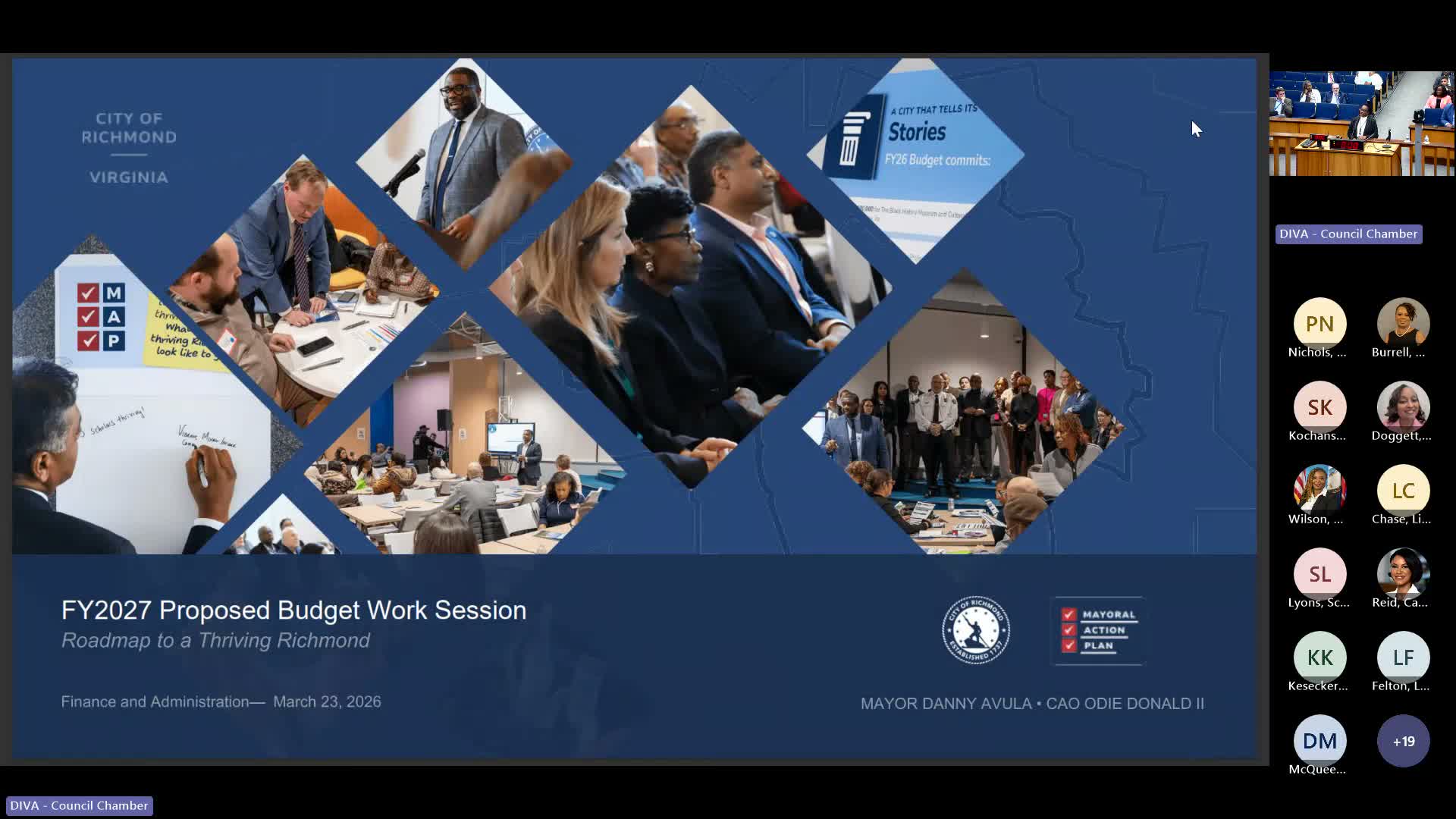
Richmond City officials on the dais outlined the finance and administration portfolio proposed for fiscal 2027, emphasizing cost-savings from procurement, investments in information technology and steps to stabilize staffing and internal controls.
"Did you know that they delivered $17,300,000 in savings this year?" DCO Jackson said during the presentation, pointing to a reverse auction that the city projects will save roughly $1.7 million over the next three years and to a newly launched transparency dashboard for contracting.
Jackson described the portfolio as the "engine" behind city government and said the budget reflects both reductions and targeted increases across units: the budget office shows a modest personnel decrease and $32,000 in operations reductions, while the budget for one operational area includes a $198,000 personnel increase to support frontline services. Finance is presented with a $414,000 personnel decrease and a $31,000 operating increase to "right-size" the department and address structural issues that previously produced audit findings and staffing gaps.
Human resources would receive a $111,000 personnel increase and $309,000 in operating funds, plus a $500,000 one-time allocation in the general fund for a compensation study that Jackson said will take about six to nine months after procurement. "This will provide a comprehensive review of job classifications, compensation structures, pay equity and market competitiveness," Jackson said.
IT is budgeted for a $3.3 million operating increase to replace aging equipment, upgrade core infrastructure, expand disaster recovery and sustain cybersecurity; Jackson said many systems are approaching end-of-life. Risk management showed a roughly $90,000 personnel increase and an approximate $709,000 operating increase driven by actuarial projections, rising claims and higher insurance premiums.
Procurement director Renee Alvarez told council the largest price increases are in capital construction projects, particularly material and service costs tied to the Department of Public Utilities and Department of Public Works. Alvarez said the city is using reverse auctions on commodity purchases to lower costs.
Leticia Schultz, director of finance, clarified how some positions were restructured. "It27s only one customer service technician [cut]," she said, and described other eliminations as finance regulatory technician roles tied to a departmental restructuring.
Council members pressed staff on several implementation details. Council Member Trammell asked how 311 tickets are routed to code enforcement, zoning, public utilities and public works; Jackson said intake is centralized in 311 and tickets are routed to the department responsible, and noted dashboards and reporting are available to council. Councilwoman Robertson requested a department-level breakdown of vacancies (Jackson said finance currently shows 59 vacancies) and asked for timelines and reports on non-general funds, debt-service schedules and the disparity-study implementation plan.
Jackson said the disparity study has moved into implementation and that a new software platform is intended to help the city track participation and outcomes; Pat Foster, director of minority business development, said MBD will track revenue growth, profit, vendor participation and bid outcomes as measurable indicators.
On technology and compliance, councilors raised the city's delayed payment registry publication (statutory citation discussed during Q&A). CA O'Donnell described the payment registry as part of a broader technology roadmap and said the administration is evaluating whether an automated redaction solution or a concise local ordinance change provides a feasible compliance path.
The presentation concluded with assurances that most ARPA categories are on track, with the homebuyer program singled out as needing guideline adjustments to accelerate spending.
Next steps: council members requested follow-up reports including a vacancy-by-position list, a breakdown of non-general fund sources and uses, a timeline for disparity-study implementation and an estimate for payment-registry compliance costs. The work session adjourned after those requests were made.