Get Full Government Meeting Transcripts, Videos, & Alerts Forever!
Get email alerts on the Workforce Stability topic
No spam. Unsubscribe anytime.
City HR: turnover down sharply since FY22 but vacancies and time‑to‑fill remain high in key departments
Summary
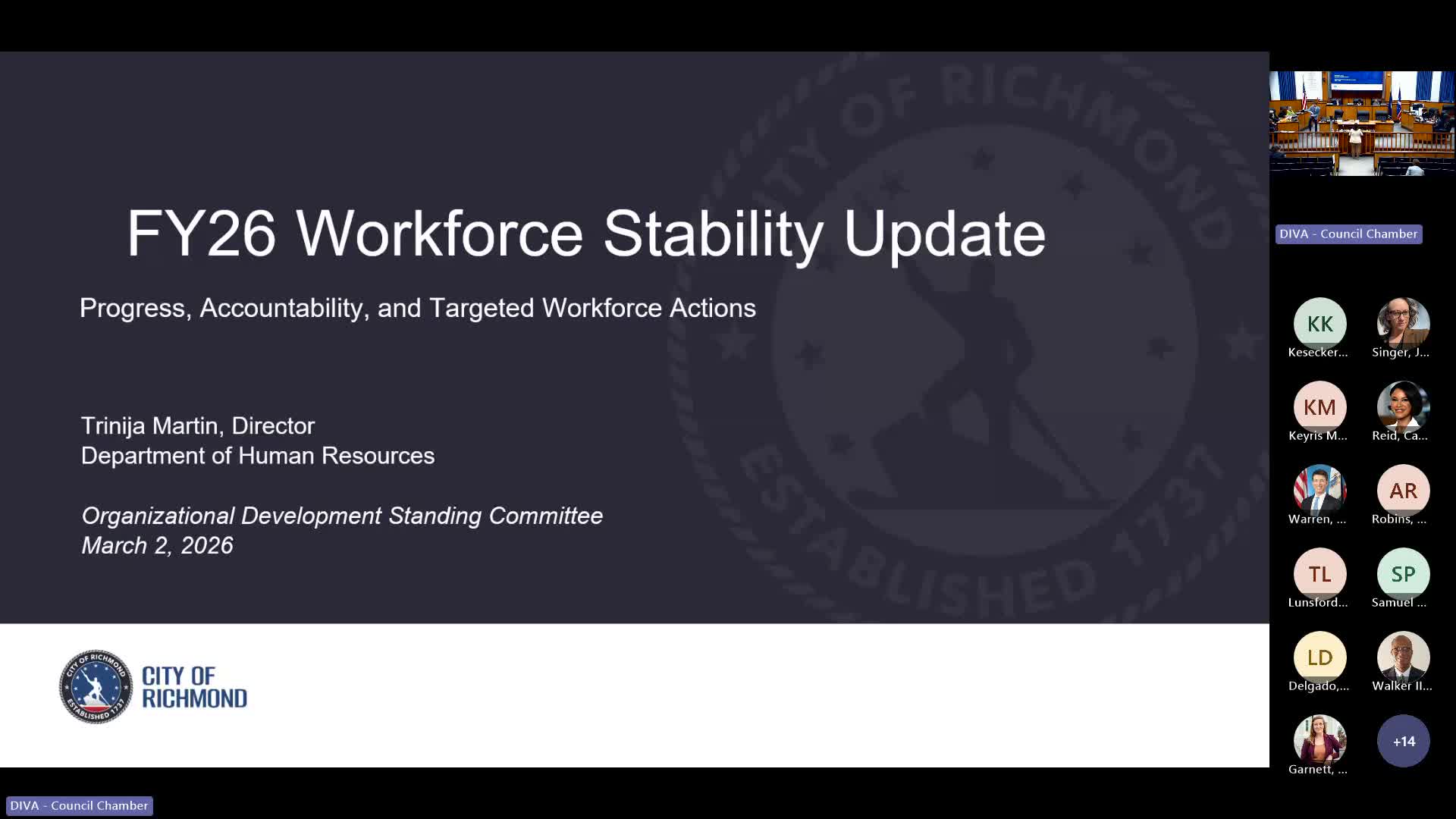
Robin Redmond, HR senior deputy director, told the committee turnover has declined more than 40% since FY22 and FY26 turnover is projected at 9.4%, but vacancies stood at roughly 12.3% with an average 130‑day time‑to‑fill; council members pressed HR on prioritization, finance vacancies and reliance on temporary/outsourced staffing.
Robin Redmond, the city’s HR senior deputy director, told the committee the city has made notable progress reducing turnover and vacancies but still faces operational risk in several departments.
Redmond said turnover has fallen more than 40% since fiscal year 2022 and that, based on eight months of data, FY26 turnover is projected at 9.4% — a multi‑year record low. Vacancies, she said, are declining and estimated at about 12.3% as of the report date, and the average time to fill open roles is 130 days; HR’s near‑term target is to reduce time to 120 days and then move incrementally closer to typical industry norms.
The report diagnosed key causes and actions: process and systems gaps that delay requisitions and recruitment, the need for modernized technology to streamline approvals, targeted strategies for high‑impact departments, and a technology gap analysis underway to identify automation opportunities. Redmond said about 50% of vacant positions are “moving” through recruitment and the department had reduced 123 vacant jobs since June.
Council concerns and exchanges: Council members asked how vacancy rates factor into budget projections and whether the city should budget for a realistic fill rate rather than full staffing. They singled out finance and public utilities as departments with high vacancy stress. Council Member Lynch and others pressed HR to prioritize hiring that underpins core city operations (finance, budget and audit functions); Redmond said finance turnover has stabilized at a lower rate and that HR and departments have new leadership working the issue.
Hiring constraints: Vice President Percival and others raised the difficulty of filling a high‑level RPS auditor role, which Redmond said the school board and district are actively recruiting and that market conditions (remote/hybrid requests and relocations) have complicated searches. Redmond emphasized the city wants a highly credentialed candidate and is not willing to hire only to fill the seat without required skills.
Temporary staffing and overtime: Redmond said some departments use outside agencies, overtime and acting pay to cover gaps; where departments rely on contractors those contractors may be eligible to apply for permanent roles. The report connected vacancies and overtime costs in fire and police to the city’s overtime expenditures and noted sworn fire vacancies were low (about five) because recruits enter in cohorts.
Next steps: HR plans continued process improvements, targeted recruitment for high‑impact vacancies, recruitment timeline standardization, and training for department staff to speed requisition approvals. Council members requested follow‑up analysis on how vacancy assumptions are modeled in budgets and specific prioritization lists for critical hires.
Ending: Redmond closed by saying the city is "bringing in people faster than we're losing them," but that “there is a lot more to do” and HR will continue to provide follow‑up information to council staff and committees.