Get Full Government Meeting Transcripts, Videos, & Alerts Forever!
Get email alerts on the Transportation Reorg topic
No spam. Unsubscribe anytime.
Richmond officials outline new Department of Transportation, pledge faster "lighter, quicker, cheaper" safety projects
Summary
City public-works leaders told the Land Use, Housing and Transportation committee the reorganization creates an in-house Department of Transportation to speed planning and delivery of safety and mobility projects, emphasizing Vision Zero goals and pilot "lighter, quicker, cheaper" interventions.
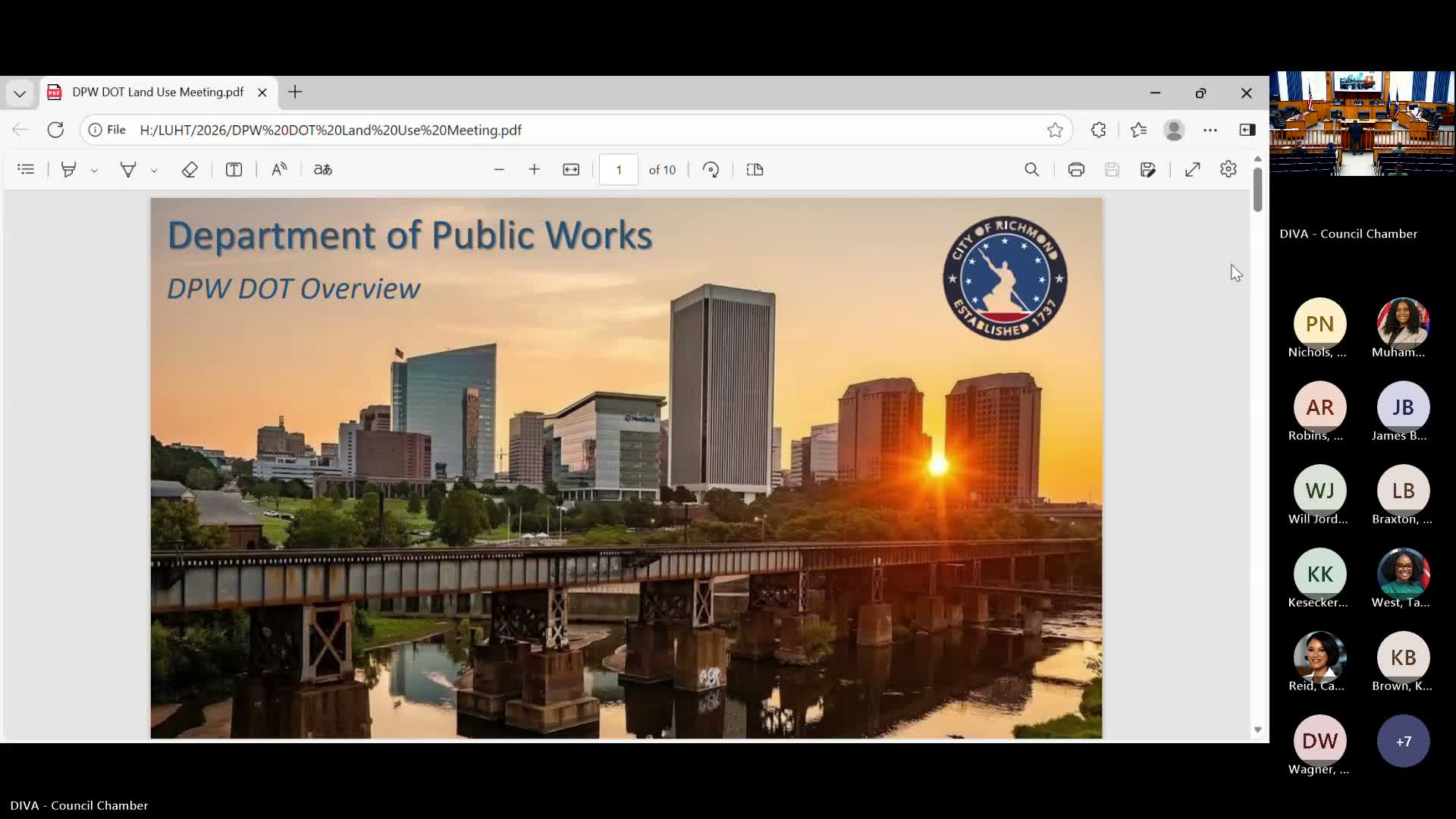
The Land Use, Housing and Transportation Standing Committee heard a detailed presentation from City of Richmond public-works staff on a reorganization that establishes an internal Department of Transportation and aims to accelerate street-safety projects.
Bobby Vincent, director of public works, told the committee his department now manages roughly $1.2 billion in projects and a roughly $105 million backlog of capital work. He said the new unit — led by newly introduced Director of Transportation Andy Bayno — will consolidate planning, engineering and operations to better coordinate grants, design and construction across the city. "We have about $1,200,000,000 coming our way in terms of the Department of Public Works," Vincent said.
Bayno said the reorganization will produce two visible changes: more frequent rapid pilots (what staff called "lighter, quicker, cheaper" projects) and a dedicated engagement team to involve neighborhoods in planning. "Having this all together to be able to, within one team, plan, implement, and then test, and then repeat," Bayno said, "We want everyone to get home alive." He described quick-build projects, tactical urbanism and community engagement as central to the approach.
The committee pressed staff on funding and outcomes. Staff said the city has increased annual paving and right-of-way funding over the past several years (Vincent described an increase from roughly $3 million historically to about $20 million annually today, made up of a combination of geo bonds, Department of Public Utilities contributions and CBTA local funds). Vincent said many projects will still rely on state and federal grants; the in-house transportation team is intended to streamline grant strategy and project delivery so the city can deploy funds more quickly.
Members asked how the reorganization will translate into safety outcomes. Staff emphasized a Vision Zero approach focused on education, engineering and enforcement and gave an example of cost reductions for traffic-calming hardware: "Every time we install a speed table, we're down now to about $8,000," Vincent said, compared with about $15,000 when the program began.
The presentation included examples of near-term quick-build projects around schools and intersections and an outline of staffing roles within the new transportation unit. Committee members and staff agreed to follow up with additional briefings and a future update after the team begins implementing pilot projects.
The committee did not take a formal ordinance to create a new independent department at this meeting; staff described the structure as a Department of Transportation operating within the Department of Public Works and said any code or council-level changes would be handled later in accordance with council authority. The committee thanked staff for the overview and signaled interest in data on project selection and outcomes.