Get Full Government Meeting Transcripts, Videos, & Alerts Forever!
Get email alerts on the Bike Safety topic
No spam. Unsubscribe anytime.
Committee backs ordinance to treat bike-lane buffers as no-parking zones; enforcement plans focused downtown
Summary
An ordinance clarifying that buffer strips adjacent to bike lanes are part of the bike lane and prohibited for parking was forwarded with a recommendation to approve. Advocates and parents testified about safety risks; transportation staff said enforcement will target the Central Business District after contractor training.
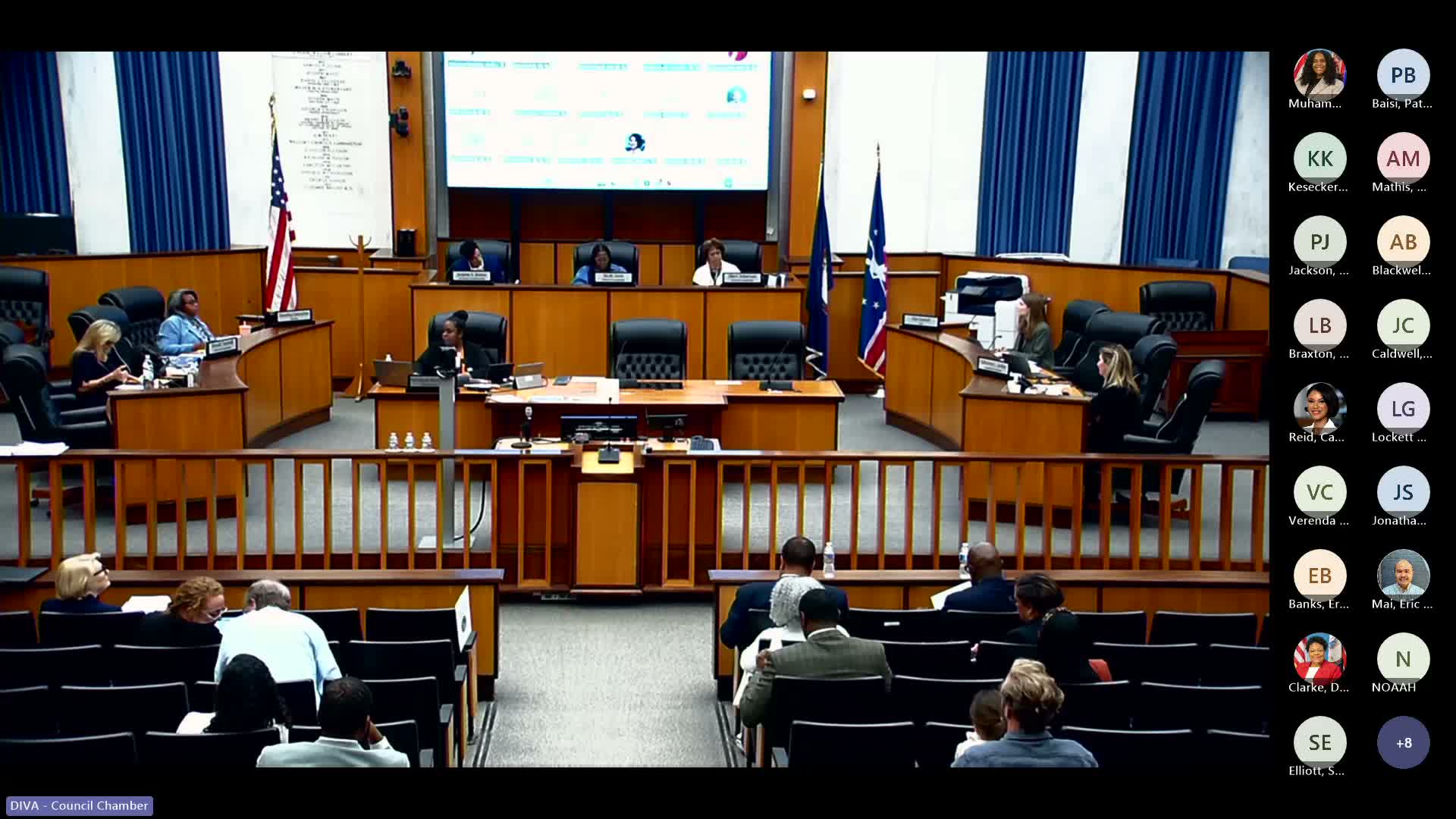
The Land Use, Housing and Transportation Standing Committee voted to forward Ordinance 2026‑088, which clarifies that striped buffer areas adjacent to bicycle lanes are included in parking prohibitions, to the full council with a recommendation to approve.
Councilor Jordan Hieh, the paper’s patron, said the change responds to documented problems of vehicles parking in buffers and forcing cyclists into motor traffic. "The amendment aligns our city code with federal and state design guidelines," she said, and it authorizes EMS providers, not just police, "to move vehicles when necessary in the course of their duties."
Residents and advocates urged swift action. John Barclay, a Northside resident and Richmond Public Schools teacher, described a daily commute with his preschool daughter and the danger posed when a parked car’s mirror or an opened door intrudes into the bike lane: "The buffer exists so that cars can safely unload and also so that I can safely pass through the bike lane with my daughter without worrying about a car door hitting me," he told the committee.
Louise Locket Gordon, chair of the Richmond City Safe and Healthy Streets Commission, described the buffer as a measure to prevent "dooring" and to support road-diet approaches that reduce speeds and improve safety for walking, biking and transit.
Daniel Wagner of the Department of Transportation said enforcement will require contractor training and a phased approach. "Most of their work does happen in the Central Business District. And that's where we see most of our violations," he said, and noted targeted enforcement in areas such as Franklin Street and new facilities planned in Southside.
Committee members pressed staff on equity and school-zone impacts, asking that enforcement and buffer placement not be limited to neighborhoods with heavier bike use and urging attention to school pull-offs where drop-off activities intersect bike lanes. Several members commended the administration’s use of initial warnings ahead of ticketing to educate the public.
A motion to forward the ordinance with a recommendation to approve passed by voice vote; several council members asked to be listed as patrons or co-patrons. The committee directed staff to follow up with enforcement rollout plans and a school-zone buffer study if the ordinance moves forward to council.
Next steps: the ordinance will proceed to council; staff will provide details on enforcement training, targeted initial enforcement areas, and a plan for school zones lacking pull-offs.