Get AI Briefings, Transcripts & Alerts on Local & National Government Meetings — Forever.
Appeals court weighs whether hospital petition forms prove authority to involuntarily commit a patient
Loading...
Summary
An appellate panel heard argument in 25P854 over whether a hospital's commitment petition and its signature provide prima facie evidence that the signer had statutory authority to seek involuntary confinement, focusing on statutory text, Bay Ridge precedent, and Department of Mental Health regulations.
An appellate panel on Thursday heard arguments over whether a hospital's commitment petition is prima facie evidence that the signer had statutory authority to seek involuntary confinement, a dispute the court said could affect fundamental liberty interests even though the patient at issue was discharged years ago.
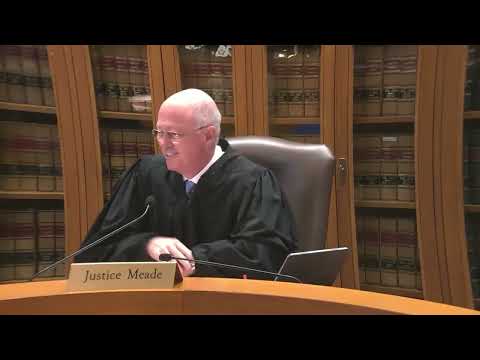
Justice Mead opened the session and called case 25P854, identifying the respondent by the pseudonym "MM." Christine Hamilton Cuiros, counsel for the appellant, told the court "this case turns on 2 statutory requirements that must be established before a person can be involuntarily confined": first, whether the petitioner was authorized by the statute to file the petition; and second, whether the hospital proved that MM's conduct placed someone in reasonable fear of imminent serious physical harm.
The panel repeatedly questioned whether the petition form itself can be read as prima facie proof of authority. "Why why isn't this moot?" Justice Mead asked early in the argument, noting MM had been discharged roughly four years earlier; counsel for the appellant said the issue implicates "fundamental liberty rights and... collateral consequences" and therefore may avoid mootness. The court and counsel also discussed whether subject-matter jurisdiction can be raised at any time.
A central factual dispute in the record is that the top of the form labels the signer as a "medical director," while the signature line indicates the person who signed did so as the vice president of nursing. Appellant counsel argued the record does not show that the person who signed the commitment petition had the specific duties or authority required by statute. "The statute is designed to ensure that authority to file is established before liberty is taken," counsel told the court.
One justice asked whether a judge could reasonably infer authority from a petition that identifies a signer by title and signature alone. Appellant counsel responded that a hospital could supply a brief affidavit or testimony to establish the signer's authority and that job descriptions and duties can change over time, so the label on a form should not automatically satisfy the jurisdictional requirement.
Respondent counsel argued that the Bay Ridge appellate-division decision (referred to in briefing as Bay Ridge v. Timothy Jackson) has informed hospital practice and that the petition can provide prima facie evidence in many cases. Counsel described Bay Ridge as an "umbrella" hospital system with multiple inpatient units and said the unit where MM was held listed Dr. Kang Vu as the medical director; the record also includes a substituted-judgment petition and a medication-treatment plan signed by Dr. Vu.
The panel also debated the relationship between the statute (chapter 123 as discussed in argument) and Department of Mental Health regulations, with one justice noting that regulations must be consistent with statute. Counsel for the respondent urged a pragmatic approach—suggesting that a short affidavit accompanying the petition or simple testimony in the initial hearing could resolve the question—while the court emphasized the legislature's statutory language naming who may petition.
The justices and counsel discussed practical consequences if courts were to require routine testimony or affidavits from hospital administrators: initial hearings are time-sensitive (often scheduled within days of filing), and expanding documentary requirements could raise logistical burdens for hospitals and courts. The record shows that emergency orders in the system can last about three days before more formal proceedings occur.
After extended questioning on whether the petition and its labels suffice to establish jurisdiction, how Bay Ridge precedent should be applied, and what minimal record would be adequate, the panel recessed. No decision was announced from the bench; the court has taken the matter under advisement.
Background: The case was argued under the impoundment rule, so the respondent is identified by initials in the record. Parties and the court repeatedly cited Bay Ridge v. Timothy Jackson and chapter 123 (statutory provisions governing commitment petitions) in framing the legal issues. The transcript records inconsistent spellings of certain proper names in the record (for example, variations of "Michael Tarmie"/"Tarmey"/"Tarmi"); the briefing and argument focused on whether the record establishes which hospital official had authority to petition.