Get Full Government Meeting Transcripts, Videos, & Alerts Forever!
Get email alerts on the Housing Policy topic
No spam. Unsubscribe anytime.
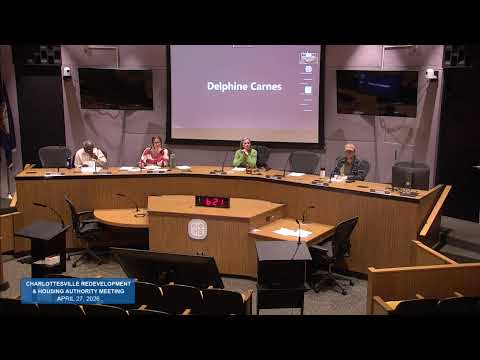
Charlottesville housing board hears call to eliminate $35 minimum rent, discusses nonprofit formation and eviction-diversion funding
Summary
At a CRHA meeting, a Legal Aid attorney urged eliminating a $35 minimum rent as economically unworkable for very low-income tenants; the board heard staff updates on eviction-diversion needs, property management outreach, and counsel outlined a 6–9 month timeline to seek IRS tax-exempt status for a proposed nonprofit entity.
Victoria Borak, an attorney with the Legal Aid Justice Center, urged the Charlottesville Redevelopment Housing Authority (CRHA) to consider eliminating the authority’s $35 minimum rent during the board’s public-comment period. “There are pending cases right now that CRHA has against tenants who only pay $35 in rent…it's almost impossible that CRHA would ever recover that income from those people through the court process,” Borak said, adding that each court filing costs the authority about $61 plus attorney fees.
Borak told commissioners the minimum-rent rule places “a lot of stress” on tenants who rely on small amounts of income for essentials and argued that removing the minimum would reduce administrative burden and legal costs for CRHA staff.
The board discussed next steps. A commissioner said staff had previously discussed running budget scenarios to estimate the financial impact and suggested CRHA pursue that analysis over the summer to inform decisions ahead of the next fiscal year. “Maybe that's something we can kind of start to think about more over the summer and get a sense of…how that would impact the budget,” the commissioner said.
Board counsel and staff also discussed a separate but related item: forming a nonprofit entity to support CRHA operations. Miss Carnes, counsel to the authority, described the legal steps: establish an entity and obtain an Employer Identification Number, then submit the application to the Internal Revenue Service. “It takes on average about 6 months, but that's just an average…about 6 to 9 months between the date of the submission and the actual approval of the tax-exempt status,” she said.
Kathleen in resident services briefed the board on operational needs tied to eviction prevention work, saying the eviction-diversion program remains challenging and that staff are seeking funding. A board member noted the city’s adopted budget did not include additional funds for the program but suggested one-time surplus or contingency funds might cover immediate needs; the board member encouraged concerned residents and board members to email city council to elevate the request.
Property management staff (Miss Banks) reported ongoing resident outreach: a spring reminder notice about updated parking passes (deadline May 1), expanded use of the text-notification system for notices, and recent and planned beautification days at sites including West Haven and Riverside. Kathleen said staff will circulate a one-page summary and talking points that board members and residents can use when contacting city council.
What happens next: staff will run a financial analysis of the minimum-rent policy for board consideration, counsel will begin steps to form the nonprofit entity and prepare the IRS application when ready, and staff will circulate the one-page materials to support outreach to the city council.