Get Full Government Meeting Transcripts, Videos, & Alerts Forever!
Get email alerts on the Municipal Budgeting topic
No spam. Unsubscribe anytime.
Denver council sponsors optional biennial budget, public-engagement and balanced‑budget charter changes
Summary
Councilmembers sponsoring a proposed charter amendment told the Budget & Policy Committee they want an optional two‑year budget cycle, a required public process to inform a two‑year strategic plan, a simplified budget timeline, and a charter definition of "balanced budget." Department of Finance staff flagged timing and threshold questions the sponsors say they will resolve before committee review.
Councilmembers sponsoring a package of charter changes told Denver’s Budget & Policy Committee that they want to give the city the option of a two‑year budget, expand resident input during budget development, simplify the budget calendar, and add a charter definition for a balanced budget.
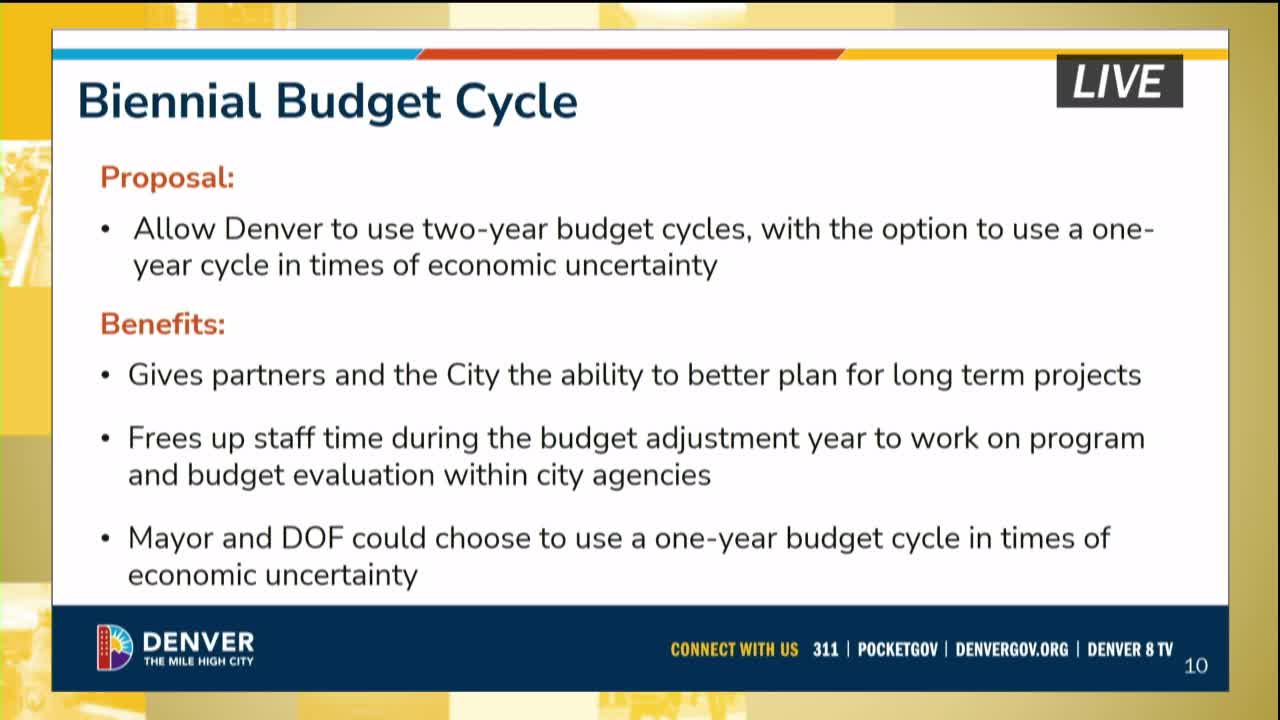
Councilmember Amanda Sawyer, one of the sponsors, said the package is meant to increase transparency and reduce surprises that can force midyear layoffs. "The uses of the general fund... it was approximately $1,500,000,000 in 2024," she said as she outlined the size of the fund and why stronger oversight matters. Sponsors proposed four primary changes: make an optional biennial (two‑year) budget available; require a public process and a two‑year strategic plan informed by resident feedback; move and simplify several calendar dates used to prepare the budget; and add charter language requiring the mayor to propose appropriation reductions by ordinance if expected revenues fall below the prior year's appropriations.
Councilmember Shawn Gill Lewis, another sponsor, said the two‑year approach would give agencies and community partners more time to plan multi‑year capital projects and to stagger the workload of budget hearings. "Capital improvement projects take more than one year," she said, arguing that an off year could be used to evaluate the main year and make smaller adjustments.
Opponents on the committee pressed for evidence that a two‑year cycle would improve oversight. Councilmember Kevin Flynn said he is "simply not supportive of that at all," arguing that an annual process preserves the council’s ability to review and respond each year. Sponsors said the proposal is optional: the mayor’s office and Department of Finance would recommend whether a one‑ or two‑year cycle is appropriate in a given period, and the language under consideration would preserve flexibility in times of economic uncertainty.
Department of Finance staff raised technical concerns about how some triggers would work. Jackson Rockaway, capital planning and budget manager, clarified that "capital funds are non lapsing, so that funding will roll to the next year," meaning multi‑year projects continue to be reported as appropriations while rolled funds are reflected in reporting. Deputy Chief Financial Officer Stephanie Hernandez Adams noted that the state‑required TABOR reserve (3%) and the city’s contingency (2%) and unassigned fund balance goal (15%) are tracked in specific budget schedules and that some midyear actions historically have been taken without ordinances. She cautioned against placing highly prescriptive operational details in the charter without piloting them by ordinance.
Sponsors also sought clarity on the reserve threshold that would trigger council review; several members said a flat 10% threshold is not necessarily the right automatic trigger. Committee members and staff discussed whether a percentage‑based trigger or a process of joint determination by council and the mayor’s office (with DOF analysis) would be better. Sponsors said they will continue conversations with the Department of Finance and with their attorneys to craft precise language and a companion ordinance that could test elements before a charter amendment goes to the ballot.
Dominic Moreno of the mayor’s office said the administration supports robust community engagement but questioned whether the charter should spell out highly prescriptive engagement mechanics. "We're open to conversations with the sponsors about what that looks like," he said.
Next steps: sponsors said they will work with DOF and city attorneys to define thresholds and draft both charter language and a companion ordinance; they expect additional committee review in the coming weeks as language is refined and a committee date is scheduled.