Get Full Government Meeting Transcripts, Videos, & Alerts Forever!
Get email alerts on the Grants And Programs topic
No spam. Unsubscribe anytime.
Caring for Denver says it has allocated most funds but council presses for clearer impact metrics
Summary
Caring for Denver told the Health and Safety Committee it has allocated roughly $246.9 million of $257 million received and touched about 88,367 residents in 2025; council members asked for better demographic, ZIP-code and outcome reporting and a clearer breakdown of funds by grassroots groups vs. institutions.
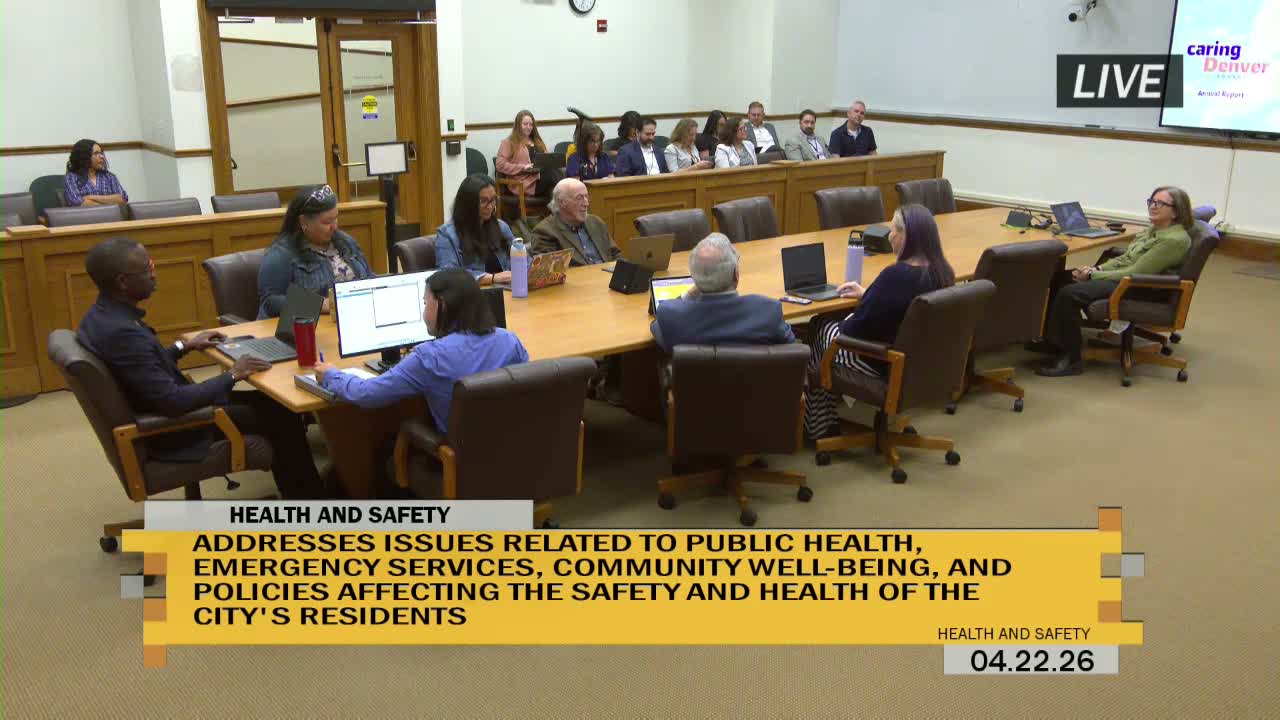
Lorez Meinholdt, executive director of Caring for Denver, presented the foundation annual report April 22 to the Denver City Council Health and Safety Committee, saying the organization had received $46,326,405 from the city in 2025 and allocated about $43,000,000 that year across youth, "community-centered solutions" and the fund now called Care Over Incarceration. Meinholdt said Caring for Denver has awarded or allocated about 96% of the dollars it has received and that, across grant programs, the foundation reported serving roughly 88,367 Denver residents in 2025.
Why it matters: Councilmembers said they support the investments but repeatedly asked for clearer evidence of who is being served and how the foundation measures impact. Councilmembers pressed for demographic and ZIP-code reporting, a clearer map showing district-level reach and more outcome information from multi-year grants so the council can evaluate returns on investments.
Councilmember Paul Cashman asked what "community-centered solutions" means; Meinholdt replied it is a funding category that embeds care in trusted community settings such as community centers or organizations (for example, the Center for African American Health or Servicios de la Raza) rather than only at clinical sites. When asked how much Caring for Denver has spent since its founding, Meinholdt said the foundation has spent $246,928,883 of about $257 million received (the program is largely multi-year and some dollars are reserved until disbursed).
Several councilmembers, including Jamie Torres and Serana Gonzalez Gutierrez, asked whether Caring for Denver tracks demographic information about who receives services. Meinholdt said grantees often decline to provide individual-level demographic data and that ZIP-code reporting is inconsistent; she said the foundation captures some group-level indicators (for example, whether services target BIPOC or LGBTQI communities) and that staff will try to produce more consistent reporting and a district-level list of grantees.
Councilmembers also asked why some sites or organizations appear on the foundation map in ways that were unclear (for example, references to Warren Village and district alignments). Meinholdt said grantees report the districts or neighborhoods they serve and Caring for Denver is working on better ZIP-code alignment and clearer visuals.
The presentation highlighted specific programs: a pilot neighborhood recovery program at Urban Peak called SPARK designed to serve up to 18 youth (three were in place at launch), a behavioral health scholars stipended program with MSU to fund clinical hours for students, and a Denver Health peer specialist program the presenter said reduced wait times for mental health services at Denver Health. Meinholdt also described grants supporting STAR, substance-use navigation and a peer support hub.
What remains unclear: councilmembers sought more end-of-grant metrics and cohort analyses that show whether multi-year grants produced sustained outcomes. Meinholdt said some outcomes are multi-year, that the foundation uses proxy measures such as engagement and retention in care, and that staff plan cohort learning and a public-facing dashboard to improve transparency.
Next steps: Councilmembers requested lists of grantees serving their districts, clearer district-level maps and additional demographic or outcome reporting; Caring for Denver agreed to follow up with supplemental materials.