Get Full Government Meeting Transcripts, Videos, & Alerts Forever!
Get email alerts on the Municipal Sentencing Reform topic
No spam. Unsubscribe anytime.
Denver Health and Safety Committee delays municipal-sentencing overhaul after wide debate
Summary
Sponsors introduced an ordinance to align Denver's municipal punishments with a Colorado Supreme Court ruling, proposing new offense classes and a 10-day cap for many municipal-only offenses. After extensive public testimony and agency concerns — particularly about a 'catch-all' cap — the committee postponed the bill to May 13 for more engagement.
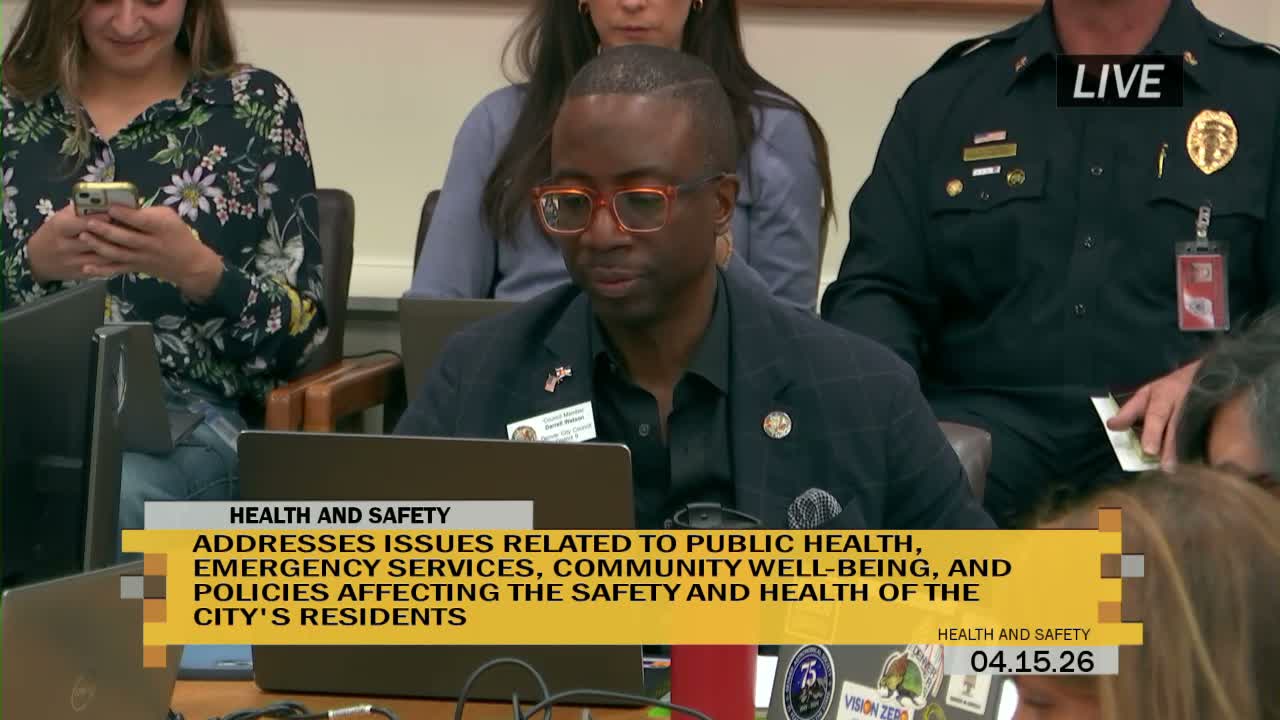
The Denver Health and Safety Committee on April 15 heard detailed presentations and hours of public testimony on an ordinance that would revise municipal criminal penalties to align Denver's code with a recent Colorado Supreme Court ruling. Committee chair Daryl Watson opened the session and, after discussion and questions from council members and city agencies, the committee voted to postpone the ordinance until May 13 for further stakeholder engagement.
Sponsors — identified during the presentation as Councilmembers Shantel Lewis, Serena Gonzalez Gutierrez and Councilmember Paradis — told the committee the ordinance is intended to bring the Denver Municipal Code into conformity with what presenters repeatedly referred to as the "Camp" decision. The sponsors said Denver's current general penalty (noted in the presentation as up to 300 days in jail and a $999 fine) created a disparity with state sentencing caps and produced harmful collateral consequences for people who face municipal-only charges. "Using lengthy jail sentences to punish poverty does not solve anything," said Javier Mabry, who identified himself as the prime sponsor of House Bill 1147, the Municipal Court Fairness Act, during public comment and urged a yes vote.
Why it matters: sponsors and supporters argued the change is both a constitutional fix and a humanitarian one. Presenters cited city data they said showed roughly 12,000 municipal criminal filings a year and about 70,000 municipal sentences over five years, and they said only about 100 cases in the last two years would have had a different outcome had a 10-day cap been in place — but that for those individuals the difference is consequential. The presentation also cited a jail cost of $240 per person per day and listed potential collateral harms including loss of SNAP, Medicaid and housing.
What the ordinance would do: the sponsors described a reclassification of municipal offenses into a tiered system (Classes 1–5) designed to map onto state offense categories, an explicit 10-day cap for many municipal-only petty offenses, retention of prosecutorial authority to seek higher sentences where municipal offenses align with more serious state offenses (sponsors emphasized maintaining charging authority for domestic-violence-related offenses), and the elimination of mandatory prostitution fines in municipal code (previously described in the draft as $500/$700/$999 tiers) in favor of judge discretion up to $300 per violation.
Public testimony split the room. Supporters included Anaya Robinson of the ACLU of Colorado, and Kim Ray of the Colorado Criminal Justice Reform Coalition, who urged adopting the 10-day limit to avoid disproportionate harms to low-income residents and people of color. "No one should face months in jail for a municipal violation that would carry far less or no time under state law," Robinson said. The bill also drew support from criminal-justice reform advocates and from Javier Mabry, who described the state-level reforms and urged Denver to follow suit.
Opponents and worried participants raised process and public-safety concerns. David Howard urged a no vote and asked sponsors to seek a narrower compliance-only revision rather than a sweeping reduction in penalties. Survivors and victim-advocates, including Britney Choate and Cecily Riney of the Rose Andum Center, said they feared the changes could weaken protections for domestic-violence survivors and interfere with the ability to document and respond to patterns of abuse. Choate said that terms like "physical contact without injury" can fail to capture coercive control and non-visible forms of abuse, adding that "coercive control is not painless." Business and downtown leaders asked for more time and technical review, warning the changes could affect compliance incentives for licensed operators.
City agencies also flagged practical concerns. A letter from Denver District Attorney John Walsh — read into the record — said the draft "goes far beyond addressing" the court's requirement and warned of collateral consequences, including risks to domestic-violence and stalking victims and potential caseload shifts to the DA's office. Presiding Judge Lombardi's letter (also read into the record) said the county court believes it is in compliance and described court-level steps to ensure defendants are advised of applicable state maximums.
Representatives from city departments described operational impacts. Alex Fiedajal, legislative liaison for the Department of Public Health and Environment, said DDPHE needs more time to identify which of its numerous code provisions should keep higher penalties. Molly Duplachey of Denver Licensing and Consumer Protection warned that reducing jail exposure for licensing violations could lower compliance among regulated businesses and make some enforcement tools less effective. Desmond Fulton, chief of Denver Fire, said lowering possible jail time could reduce leverage to compel building-safety compliance and urged further deliberation. Marley Bordoski, director of the prosecution section in the city attorney's office, said PACE appreciates ongoing collaboration but remains concerned that a broad "catch-all" 10-day cap on municipal-only offenses (the provision many speakers called the "catch-all") would create unusually low general penalties and have unintended effects across enforcement and code administration.
Council questions focused on drafting details, enforcement consequences and whether recent court steps eliminated an urgent need to change the ordinance immediately. Several council members — including Kevin Flynn and Councilmember Sawyer — urged more engagement and time to reconcile victim-safety concerns, agency operational impacts and the technical accuracy of the draft.
Outcome and next steps: Council member Paradis moved to postpone the bill to a date certain of May 13; the motion was seconded and approved by the committee, and no final vote on the ordinance occurred. Sponsors and council members said they would use the interim to continue technical edits, meet with victim-advocacy groups and city agencies, and review the county-court letters and the redline draft that sponsors circulated.
The committee also announced additional community engagement sessions the sponsors had scheduled (one-hour virtual sessions planned April 21, April 22 and April 25) and invited written comment and Legistar submissions. The committee adjourned after completing its scheduled time.
Authorities referenced in the meeting included the state high court decision repeatedly described in the record as "People v. Camp" (the "Camp" decision), House Bill 1147 (described by a public commenter as the Municipal Court Fairness Act), and letters read into the record from Denver District Attorney John Walsh and Presiding Judge Lombardi about local court compliance and legislative scope. For specific legal citations read into the record, the committee included the verbatim language provided by the DA and the presiding judge (to be posted in Legistar).
The committee will return on May 13 for further consideration and potential revision of the ordinance.