Get Full Government Meeting Transcripts, Videos, & Alerts Forever!
Get email alerts on the Vision0 Report topic
No spam. Unsubscribe anytime.
City says Vision 0 preliminary data show fewer traffic deaths; aldermen press for stronger evidence
Summary
Milwaukee’s Vision 0 team presented preliminary data showing a decline in traffic fatalities and outlined outreach and partnerships; committee members urged more rigorous evaluation and asked for comparative analysis with peer cities and follow‑up on metrics.
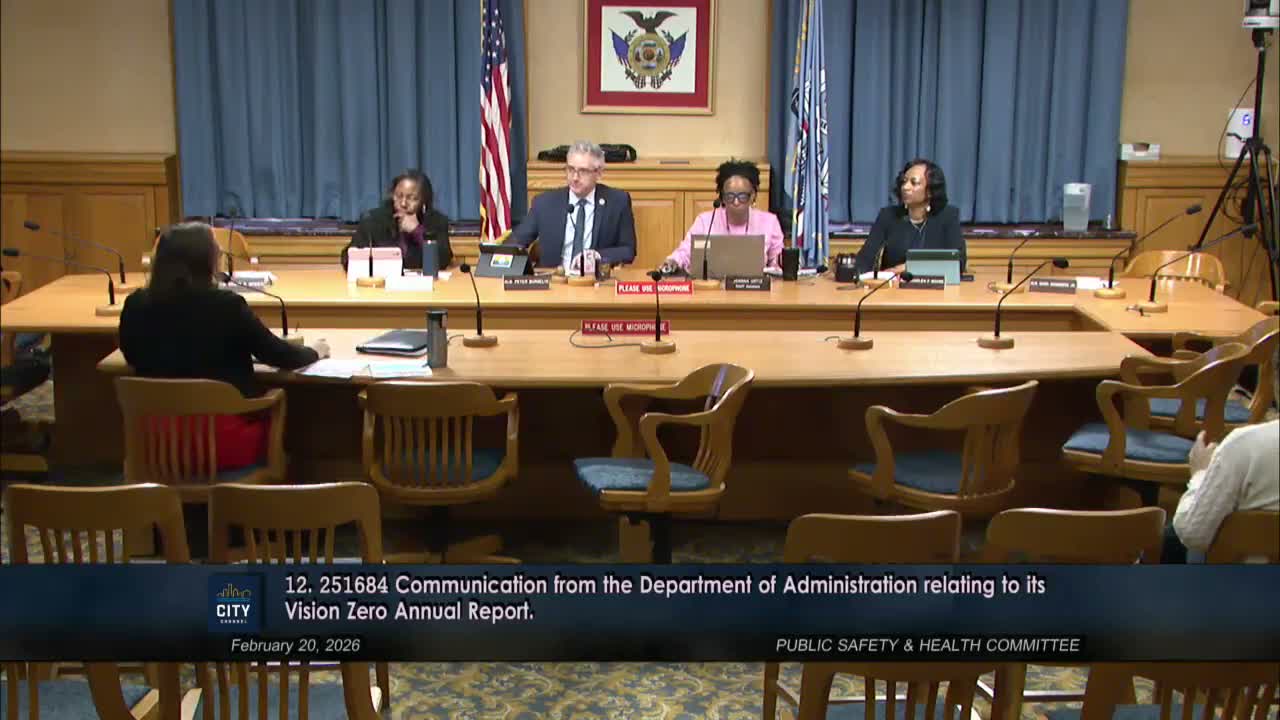
Jessica Weinberg, policy director for the city of Milwaukee’s Vision 0 program, told the Public Safety & Health Committee on Feb. 20 that preliminary counts show a decline in traffic fatalities and that the program’s layered approach is producing measurable change. “Vision 0 is working, and we are seeing a major decline in traffic deaths,” Weinberg said, while cautioning the committee that crash data remain preliminary until state certification.
Weinberg said the most recent preliminary count shows about 54 traffic deaths in the period under review, down from roughly 70 the prior year, and that the city’s community education and partnership efforts reached thousands of residents. She noted the program was recently recognized by the national Vision Zero network and said the office plans a public Vision 0 summit in early June at Milwaukee Central Library to share results and strategies.
Several aldermen welcomed the progress but pressed for more rigorous analysis tying the decline to specific Vision 0 measures. Alderman Scott Speicher said he supported the program but warned against attributing the whole decline to Vision 0 without evidence: “I don’t think we could claim victory at this point, even that the decrease has anything to do with the Vision 0 program,” he said, and asked staff to pursue comparative and evaluation work.
Weinberg acknowledged limits in local capacity for large causal studies and suggested partnering with academic institutions and continuing to collect local before‑and‑after project data. She said DPW has begun collecting speed and crash data around traffic‑calming projects and that some early projects show reduced crashes. Committee members recommended that Vision 0 return with a clearer evaluation plan and comparative data at a future meeting. The committee placed the Vision 0 communication on file.