Get Full Government Meeting Transcripts, Videos, & Alerts Forever!
Get email alerts on the Land Use Rezoning topic
No spam. Unsubscribe anytime.
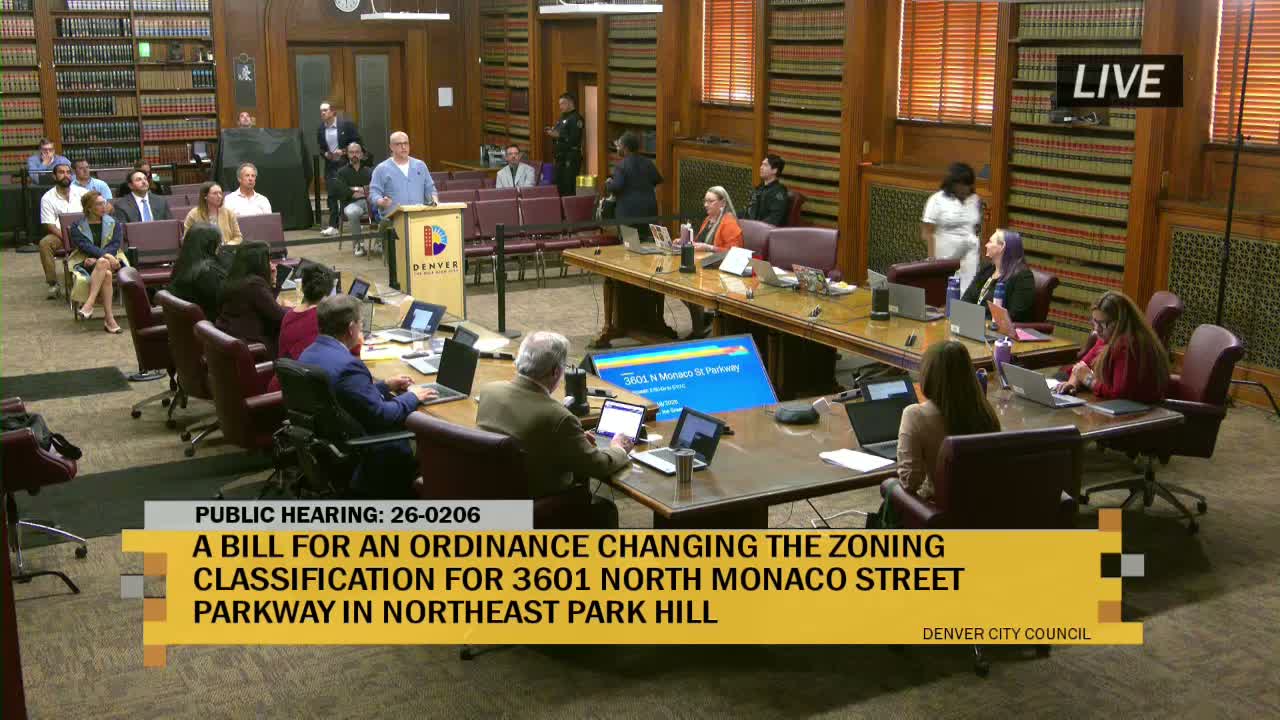
Council narrowly approves rezoning for 3601 N. Monaco Parkway amid split staff and planning board recommendations
Summary
Denver City Council on April 13 approved Council Bill 0206 to rezone a vacant lot at 3601 North Monaco Parkway to permit two-unit development, passing despite staff recommendation to deny and after a Planning Board recommendation to approve; vote 10-1 (with recorded ayes and dissent recorded in the minutes).
Denver City Council voted April 13 to approve Council Bill 0206, a rezoning request for 3601 North Monaco Parkway in Northeast Park Hill that changes the parcel from a single-unit zone to a two-unit district (allowing duplexes or tandem houses).
Community Planning and Development staff, represented by Joe Green, recommended denial, saying the request does not meet Blueprint Denver guidance because the neighborhood’s adopted small-area plan did not clearly establish intent to change the area’s zoning pattern. "Planning staff has recommended denial and planning board has unanimously recommended approval," Green told the council, noting the staff’s analysis of review criteria.
The applicant and supporters argued the existing built environment already includes duplexes and small multifamily units and that allowing a duplex on the vacant lot would unlock modest, local housing options. Property owner and architect Elizabeth Hennessy described plans for a net‑zero duplex prototype and said many lots in the immediate block already support two-unit uses.
Members debated competing interpretations of the Park Hill neighborhood plan, the age of the plan (2000) and the need for updated small-area guidance. Council member Lewis said the rezoning preserves an existing residential character and supports housing choice in the area; other members echoed the need to reconcile older plan language with current conditions.
Following public comment and debate, the council voted to approve the rezoning (final roll call recorded in the minutes). The ordinance replaces the legacy zoning for that parcel and allows future site development consistent with the two-unit district’s rules and any applicable design standards.
The decision was framed by council members as an example of tensions that arise when historic area plans conflict with present-day land uses; proponents said it enables a modest increase in housing supply while opponents and staff had urged a more holistic, citywide rezoning approach and awaited the near‑Northeast area plan update.