Get Full Government Meeting Transcripts, Videos, & Alerts Forever!
Get email alerts on the Immigration Enforcement topic
No spam. Unsubscribe anytime.
Milwaukee council adopts resolution opposing ICE actions and adds related policing language to legislative package
Summary
The Common Council voted to adopt a resolution opposing recent federal immigration enforcement tactics and took a separate resolution urging the Milwaukee Police Department to protect residents’ constitutional rights during federal operations; sponsors acknowledged the measures are largely symbolic but said they begin a broader package of local ordinances.
The Milwaukee Common Council voted to adopt a resolution opposing recent federal immigration enforcement practices and moved related policing guidance into the city’s legislative package on Wednesday.
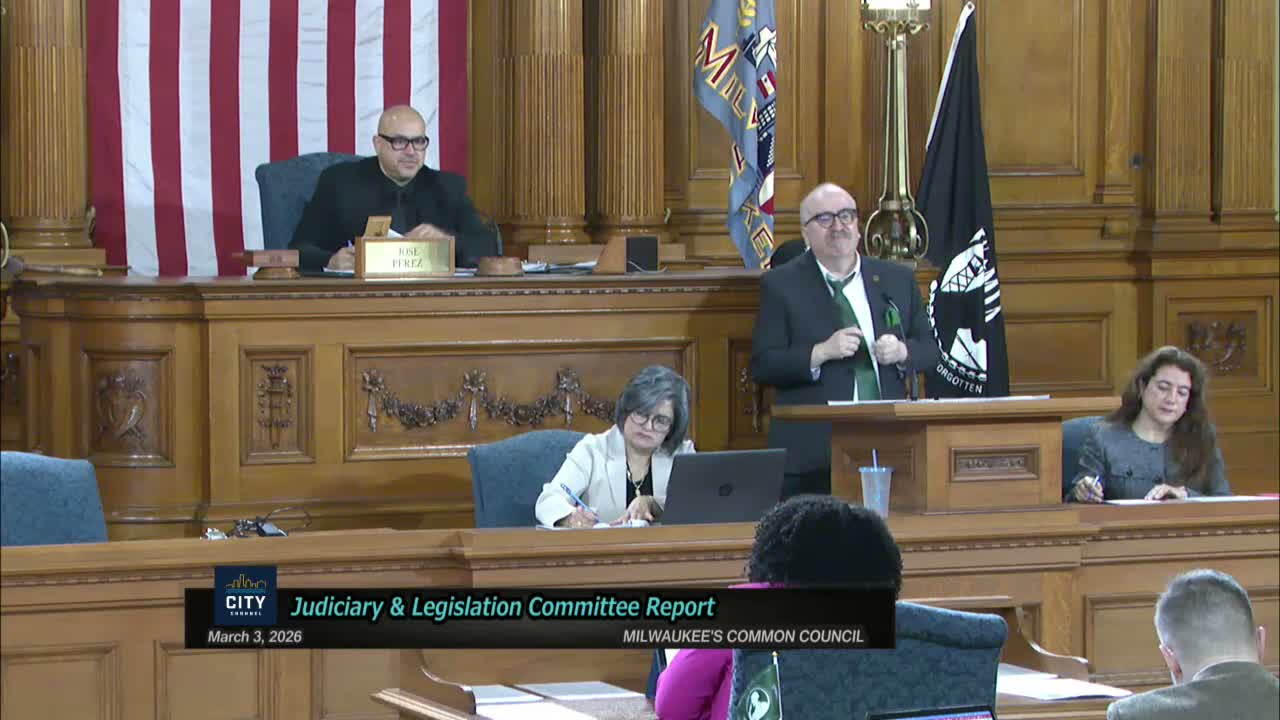
Alderman Michael Brower introduced file 251793 and urged the council to act immediately, citing constituent town halls and recent local incidents. “We need to take action today here at the council,” Brower said, arguing that a formal declaration will begin a legislative process and amplify local concerns to state and federal officials.
The resolution passed after a procedural vote to pull it from committee (14 ayes, 1 excused) and a final adoption vote (14 ayes, 1 excused). Sponsors said the measure is a starting point for an “ICE OUT” package of proposed ordinances and policy changes that will be vetted in committee and at subsequent meetings.
Council members who supported the resolution framed it as both a moral statement and a political tool. Alderman Brower recounted constituent stories and broader historical precedent, invoking Wisconsin’s history of local resistance to federal enforcement. Alderman Dimitrijevich and others said large, well‑attended town halls showed community urgency to act now rather than wait through the usual committee cycle.
Opponents and some members urged caution after the city attorney’s office sent an email warning of potential consequences — including that adopting certain language could result in the city being designated a sanctuary jurisdiction by federal authorities. “There is a consequence here that goes way beyond what we might comfortably say,” Alderwoman Piker said, asking for a fuller briefing on legal ramifications before taking measures that could affect city operations.
In a related vote, the council adopted a separate resolution (item 41, file 251801) calling on the Milwaukee Police Department to protect residents’ rights during assemblies and to “intervene” if other law‑enforcement personnel attempt to abridge constitutional rights. Supporters described that measure as symbolic but necessary to set expectations; some members said the term intervene was ambiguous and warned against creating unrealistic operational directives for officers. The item passed 13 ayes, 1 abstention, 1 excused.
City leaders said neither resolution by itself imposes enforceable changes to MPD procedures; rather, sponsors said they intend to follow with committee work and additional ordinances that could include Standard Operating Procedure changes for the department. Several aldermen urged that subsequent legislation be drafted with the city attorney’s guidance to avoid unintended consequences.
With the votes complete, sponsors said the actions mark a public expression of the council’s stance and the start of a broader local legislative effort. The council also recorded public condolences, adopted multiple committee reports and moved dozens of other agenda items before adjourning.