Get Full Government Meeting Transcripts, Videos, & Alerts Forever!
Get email alerts on the Surveillance Flock topic
No spam. Unsubscribe anytime.
Milwaukee speakers urge Fire and Police Commission to ‘deflock’ city, demand audit after alleged misuse of ALPRs
Summary
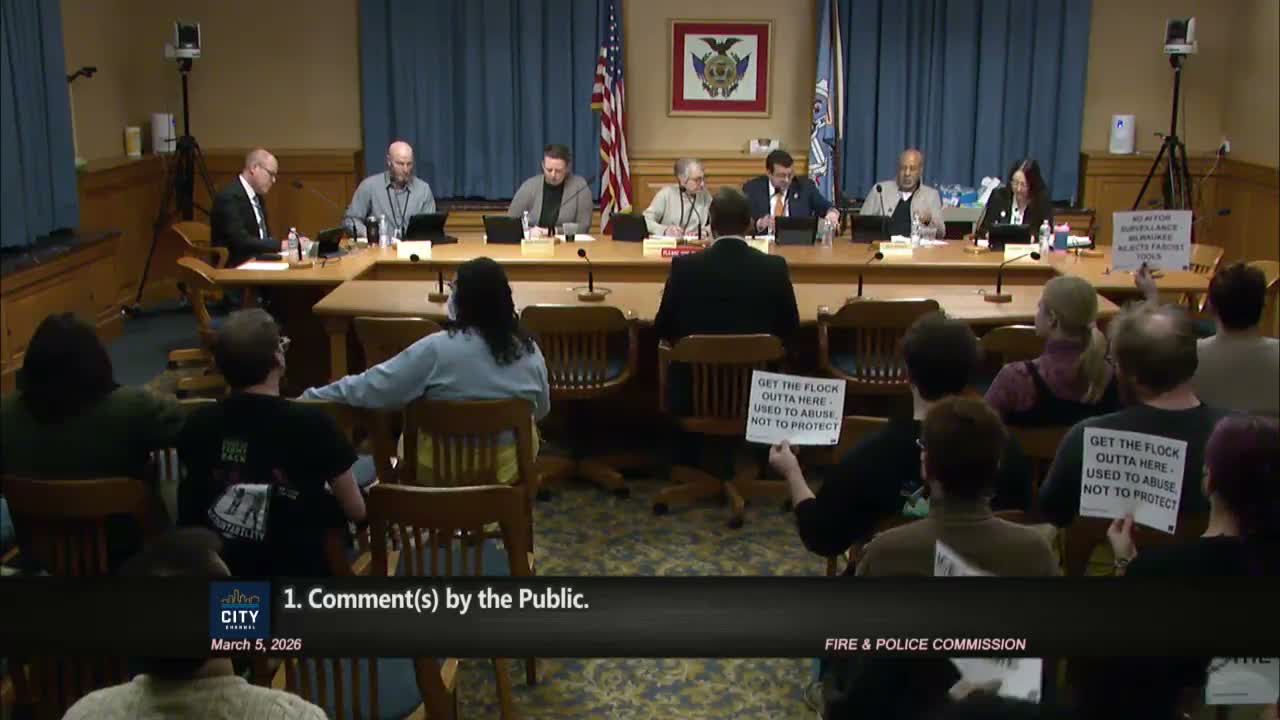
Dozens of public commenters at the March 5 Fire and Police Commission meeting urged the commission to cancel Milwaukee’s Flock Safety contract, ban automated license‑plate readers and conduct a full audit after testimony that an MPD officer used the system repeatedly to stalk someone.
Dozens of Milwaukee residents used the Fire and Police Commission’s public comment period on March 5 to press the panel to ‘‘deflock’’ the city — cancel the Flock Safety contract, remove automated license‑plate reader (ALPR) cameras and order a public audit of all system searches.
Alyssa Cole of the Milwaukee Alliance Against Racism and Political Repression told commissioners that proposed changes to MPD’s vehicle pursuit policy should be paired with far stricter limits on surveillance tools and faster transparency about pursuit footage. "Vehicle pursuits are deadly, dangerous, and cause unnecessary risks," Cole said, and footage from critical incidents should be released under existing SOP 5‑75.
Several speakers cited a locally reported case in which an MPD officer allegedly used Flock to run repeated searches of people he was romantically connected to. Kyle Welton said the officer logged into the system and searched for those individuals "a total of about 179 times," and he urged the commission to demand a full audit of all Flock requests and tighter safeguards around searches.
Amanda Merkway, advocacy director for the ACLU of Wisconsin, framed the issue broadly, listing other surveillance tools in local use — cell‑site simulators, an integrated camera/fusion platform (FUSIS), ShotSpotter microphones, drones and purchases of third‑party data — and urged a transparency framework. "At the absolute bare minimum, we need a framework for transparency about existing surveillance tech," Merkway said, and cited audit data showing extensive Flock searches originating from Milwaukee in early 2025.
Multiple commenters described harms to survivors of domestic violence and to communities overpoliced by surveillance. Kaye Lafond, a therapist and survivor, said such tools can "become weapons" in abusive relationships and urged that the common council have budget oversight over Flock spending. Other speakers described vendor practices, contract amendments and examples from other cities where communities limited or shut off ALPR systems.
Director Leon Todd told the commission the Flock/ALPR system is already slated for audit in the FPC’s 2026 audit plan, noting the commission will review the issue as part of its oversight duties. Commenters pressed for public release of audit results and for clear corrective steps including contract cancellation and a formal ban on ALPR use.
The public comment record included calls for additional transparency about pursuit data, requests for routine reporting on pursuits, and demands that all pursuit‑related video from critical incidents be made available to families and the public on a short timetable. Commenters and advocates said narrow policy language and weak enforcement had allowed misuse to continue undetected until a victim located audit logs through a third‑party site.
The commission did not take a formal vote on Flock contracts during the meeting; it acknowledged the audit plan and public pressure and will consider the findings and any recommended actions when the audit is completed.