Get Full Government Meeting Transcripts, Videos, & Alerts Forever!
Get email alerts on the Micromobility Contracts topic
No spam. Unsubscribe anytime.
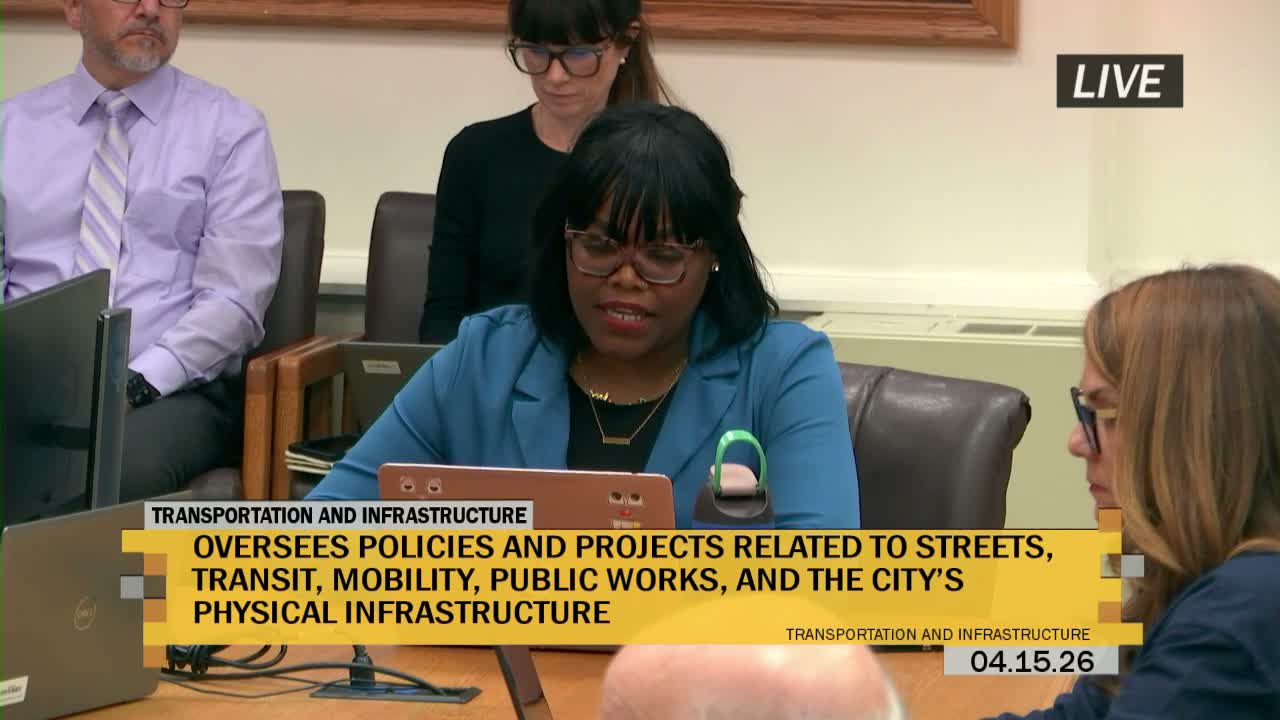
Committee forwards Veo scooter-and-bike license to full council after questions on accessibility, parking and workforce
Summary
The Transportation & Infrastructure Committee voted to send a proposed Veo (VO) scooter and bikeshare license (referenced as 260326) to full council after hearing presentations about ACCESS pre-enrollment, sidewalk-detection technology, mandatory parking corrals and whether core field staff will be W-2 employees.
The Transportation & Infrastructure Committee on Tuesday moved a proposed scooter-and-bikeshare license with Veo to the full Denver City Council after an extended presentation and questions about accessibility, sidewalk riding technology, parking enforcement and workforce rules.
DOTTI legislative-affairs manager Elena McWhorter introduced the license and said the city is actively pre-enrolling riders into an ACCESS program that will allow eligible users free or reduced-price rides. McWhorter described an "instant access" option that lets a rider self-certify and start riding on day one; she said participants would later be expected to provide documentation for verification.
Veo representatives said the operator plans a W-2 labor model for core operations and that the awarded contract would put the program on track for full-council approval April 27 and deployment May 1, with the current operator's licenses expiring May 16 to allow a two-week transition window.
Council members pressed Veo and DOTTI on several program elements. Laura Vires asked how the company would prevent sidewalk riding; Alex Keating of Veo described a layered approach that pairs geofencing and GPS mapping with sensor-based detection (radar/LiDAR or similar) and in-trip audio prompts. "Everyone who starts a trip in Denver is gonna hear, 'Welcome to VO. Please do not ride on sidewalks,'" Keating said. He added that sensor-detected events will be reported to the city so staff can analyze patterns.
Members also probed parking enforcement. Veo said the contract requires a minimum of 150 new parking corrals and app-enforced end-of-ride checks in mandatory zones (the Central Business District, 5 Points and another downtown area). In mandatory zones, the app will not allow a rider to end a trip unless the required corral is detected in the end-of-ride photo, Veo said.
Council members asked whether the contract requires all field staff to be W-2 employees rather than independent contractors (1099). McWhorter read contract language in program-structure section 3.1 about branding and field-staff identification but acknowledged that the agreement does not explicitly mandate 100% W-2 staffing for the entire three-year term. Veo said its operational roles—rebalancing, battery swap and other core functions—are planned as W-2 positions, while outreach or short-term event work could use independent contractors. Council President Amanda Sandoval asked for clearer language; DOTTI and Veo described their interpretation but did not point to a single clause that required all field labor to be W-2.
Council members also asked about contingency planning if an operator fails. DOTTI noted a service-continuity clause in the license: "If the licensee fails to meet the requirements of the service level agreements or other material obligations under this license, as determined by the city in its sole discretion, the city reserves the right to enter into a license agreement with an additional operator to operate shared micro mobility services within the city," the staff read from section 16.e. DOTTI said the city can provide written notice and a cure period, or act immediately if necessary for public safety.
After the presentation and questions, Councilmember Chris Hines moved to forward the contract (referenced in the presentation as 260326) to the full council for approval; a second was recorded and the committee agreed to advance the item for a full-body vote.
Next steps: The item will return to the full City Council for final action. DOTTI staff said they would remain available to answer follow-up questions in committee and to provide the procurement scoring summary once the procurement is finalized (the city will publish overall rankings but not individual evaluator scores).