Get Full Government Meeting Transcripts, Videos, & Alerts Forever!
Get email alerts on the Prevailing Wage topic
No spam. Unsubscribe anytime.
Councilwoman Sawyer moves clarification of Denver's prevailing-wage rule; committee forwards ordinance to full council
Summary
The Governance and Intergovernmental Relations Committee voted to send a structural clarification of the Denver Revised Municipal Code prevailing-wage language to the full City Council after debate about whether privately owned projects that receive city funds must pay prevailing wage. Advocates and developers warned of 3% or higher cost impacts; Denver Labor and HOST staff said applicability depends on which project costs are paid with city dollars.
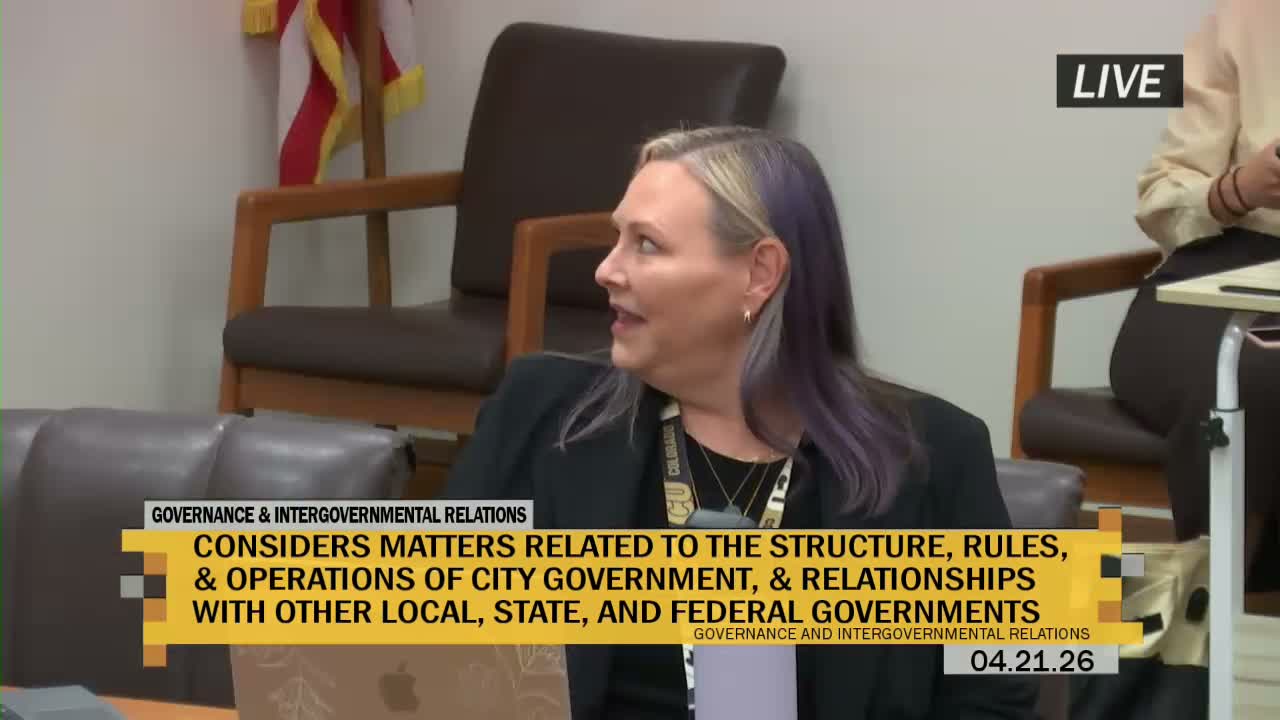
Councilwoman Sawyer, who sponsored a structural clarification to the city's prevailing-wage provision in the Denver Revised Municipal Code, told the Governance and Intergovernmental Relations Committee that the proposed change does not alter the law's substance but reorganizes one long sentence to make applicability clearer.
'The prevailing wage applies to work performed on city land, paid for by city funds, and is consistent with the federal Davis-Bacon Act,' Sawyer said, noting updates to enforcement and administration in 2016 and 2023. She said the committee's intent is to resolve a June 2024 dispute about whether privately owned projects that receive city dollars are covered.
Matt Fritzmaurer, executive director of Denver Labor in the auditor's office, told members that prevailing-wage rates vary by classification and that many residential job classifications in the Denver area fall in the high teens to low twenties per hour, while some skilled trades are higher. 'Prevailing wage is a middle-class wage,' Fritzmaurer said, adding that the ordinance tracks federal Davis-Bacon classifications adopted locally in 2018.
During public comment, Susan Powers of Urban Ventures said a contractor estimate showed applying prevailing wage to Warren Village, a recent residential affordable-housing project, 'would have added 3%,' roughly $600,000 on a $32 million construction cost. Powers warned the paperwork and compliance requirements can thin bidders and drive up prices.
John Tiapelli of the Neighborhood Development Collaborative told the committee that any cost increase either raises the subsidy the city must provide, reduces the number of units developed, or requires higher tenant incomes; he and other developers urged more time to quantify impacts.
Lia Mitchell of the Department of Housing Stability (HOST) told the committee the key question is invoicing and whether city dollars are paying covered construction work (hard costs) or noncovered items (soft costs, legal and consulting fees). HOST staff reported preliminary reviews showing project impacts varying by building type; they cited examples of 3% to 9% effects depending on classification and project size.
Several council members cited the law's legislative history and urged closer coordination with the city attorney, HOST and Denver Labor to map when prevailing wage applies to loans, gap funding and reimbursed construction costs. Clerk (former councilmember) Lopez told the committee the original legislative intent included bringing living wages and affordable housing together, and urged the council to preserve both goals.
After discussion, the committee's vice chair moved to forward the clarifying ordinance to the full Denver City Council; the committee noted there was no need for a recorded roll-call vote and the item will proceed to the council for final action. The committee indicated readiness to continue stakeholder outreach and technical drafting with city attorneys and housing partners before final council consideration.
The committee's next procedural step is the full-council calendar; staff said they are open to a delayed effective date or transition window to avoid disrupting pipeline commitments already accepted under existing terms.