Get Full Government Meeting Transcripts, Videos, & Alerts Forever!
Get email alerts on the Civil Rights Equal Rights Commission topic
No spam. Unsubscribe anytime.
Equal Rights Commission urges Milwaukee to expand local complaint authority, proposes housing-voucher resolution
Summary
At a Judiciary & Legislation Committee meeting, the Equal Rights Commission presented its 2025 annual report, described a rise in housing and employment complaints, and asked the Common Council to consider expanding Chapter 109 to give the city authority to adjudicate more discrimination complaints and pursue local remedies, including a resolution to address discrimination against voucher holders.
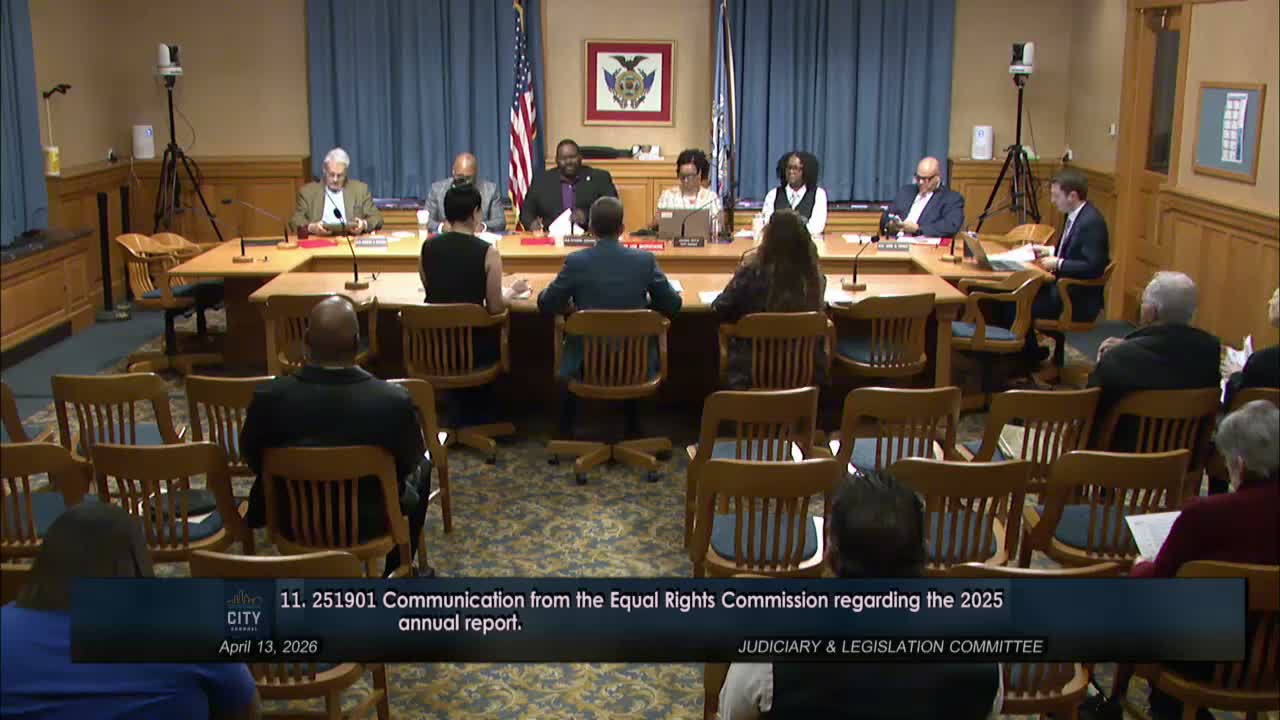
The Equal Rights Commission presented its 2025 annual report to the Judiciary & Legislation Committee on April 13, telling aldermen the citizen-led board had grown to 11 members and added staff capacity while fielding a rising number of complaints in 2025.
"The mission of the Equal Rights Commission is to promote and protect equality, equity, and human rights through education, enforcement, and community engagement," the Commission chair told the committee as she opened the presentation. Commissioners and staff cited expanded outreach at events such as PrideFest, Juneteenth and other community festivals and a newly created LGBTQ+ advisory committee.
Ramona Ramos, the Commission's complaints liaison, described intake and casework procedures and said the office aims to make initial contact within five days, then follow up at 30, 60 and 90 days. "Housing, employment, and public accommodations are the top three," Ramos said, summarizing the Commission's data.
The ERC showed a heat map of ZIP-code activity and reported the most active ZIP codes included 53209, 53206, 53225 and 53215. The Commission said many people come to ERC seeking remedies or referrals rather than filing with state or federal agencies and that ERC has become a local clearinghouse for complaints and assistance.
Committee members pressed staff about outcomes and remedies. When asked how many of the roughly 45 complaints led to probable-cause findings, ERC staff said investigators frequently find probable cause but are prevented from taking local enforcement action in many cases because Chapter 109 excludes matters that fall under state or federal jurisdiction. The Commission explained that chapter 109.7(c) limits ERC's jurisdiction when another equal-rights agency has primary authority, creating a gap as federal and state agencies take fewer timely cases.
"We want to be able to ensure trusted, accessible remedies right here at home," the Commission chair said, asking the Common Council to consider reopening or amending Chapter 109 so the city can provide local remedies in more cases. The Commission said it will return to the Council with a proposed resolution addressing housing-voucher discrimination after reviewing models in other jurisdictions.
The presentation included examples of housing discrimination complaints, including claims that landlords charge application fees (discussed figures ranged from $25 to $75) then ghost prospective tenants, and complaints that source-of-income protections are inconsistently applied to voucher holders. The ERC said it will ask the Council to clarify in city code that "source of income" explicitly includes housing vouchers and to pursue increased interdepartmental collaboration and commissioner training on complaint investigations and adjudication.
Next steps: ERC will draft a resolution on legislative remedies related to voucher discrimination and return to the Council with that proposal and additional details on staffing and case-management improvements, including a planned Q3 rollout of a web-based complaint system developed with ITMD.