Get Full Government Meeting Transcripts, Videos, & Alerts Forever!
Get email alerts on the Police Surveillance topic
No spam. Unsubscribe anytime.
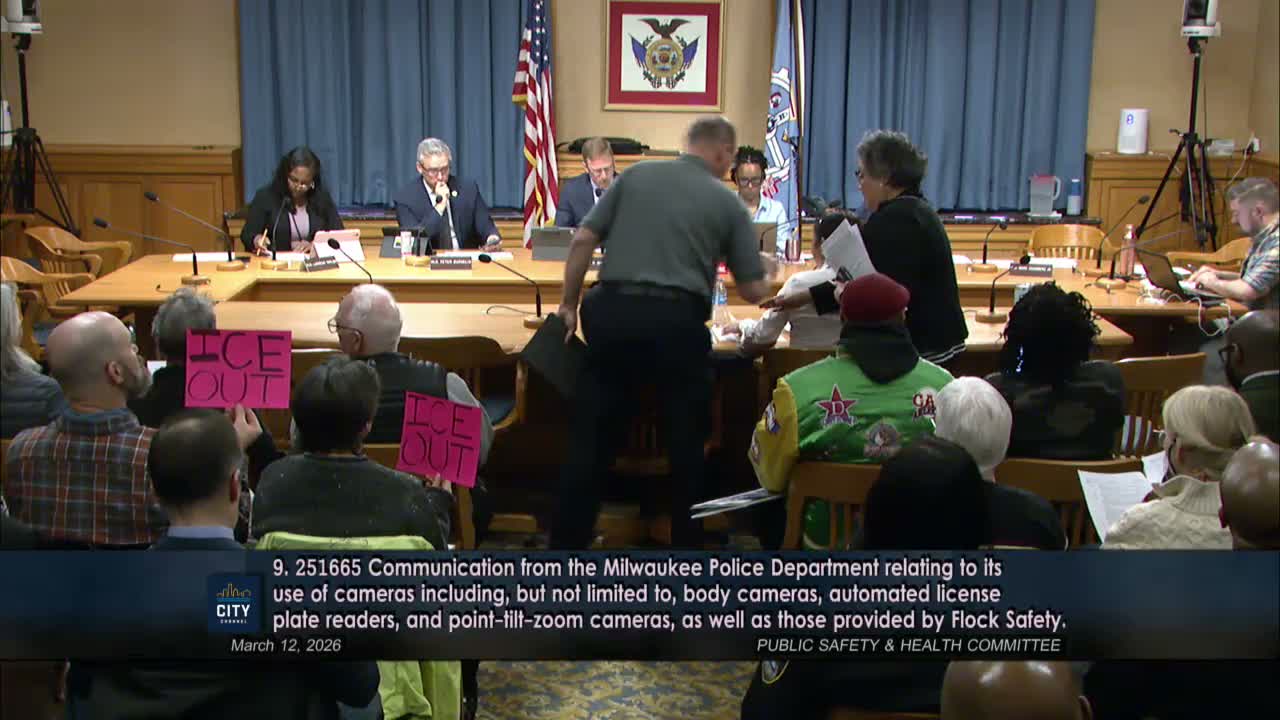
Committee presses MPD on Flock ALPR access, audits and data-sharing safeguards
Summary
Milwaukee police leaders told the Public Safety and Health Committee they have tightened access and auditing for Flock automated license-plate readers after internal misuse was discovered; the committee held further action to the chair to allow follow-up with the Fire & Police Commission and outside reviewers.
Milwaukee ' The Public Safety and Health Committee pressed the Milwaukee Police Department on Monday about who can access ALPR data gathered by the vendor Flock and what safeguards now exist after the department identified misuse.
Chief Jeffrey Norman told the committee he supports responsible use of technology and called ALPR a "force multiplier" for investigations, but said he cannot guarantee every user will never misuse the system. "I do support technology," he said, "I believe in the responsible use of this resource because it's a force multiplier." (Jeffrey Norman, Chief, Milwaukee Police Department.)
The committee focused on three practical questions: who had access historically, what training and reminders users received, and what new audit tools the department has deployed. James Lewis, MPD risk manager, said "At no point did all members of the Milwaukee Police Department have access to FLOC. Access to FLOC and the Alpers system, was governed through, the Criminal Investigation Bureau." He described a multistep fix: limited access only on a need basis, captain sign-off and user agreements, a booster-training "pack" for returning users, and a more robust automated audit that flags outlier searches to supervisors. (James Lewis, Police Risk Manager.)
Leon Todd, executive director of the Fire & Police Commission, said the FPC will audit ALPR usage in its 2026 workplan, and the committee agreed to hold the file to the chair so the departments can coordinate oversight. "FLOC or ALPER is a subject matter that we do intend to do an audit on this year," Todd said, describing a random-sample review of incidents to determine compliance with policy. (Leon Todd, Executive Director, Fire & Police Commission.)
Committee members repeatedly pressed for more public-facing guardrails: independent auditing, clearer public notice about what data are kept and for how long, and explicit limits on sharing. MPD said the vendor'held data are retained on a rolling 30-day basis by default and that the city controls sharing parameters; James Lewis said MPD'has not set up federal access as a routine sharing arrangement and that judicial orders would be handled through the city attorney.
The committee did not take final action. Members asked MPD and the FPC to return with follow-up information on (1) how many access requests had been denied historically, (2) the text of the new user agreements and booster training, and (3) how exactly interagency sharing is controlled. The committee held the item to the call of the chair to allow those briefings and the FPC audit planning to be completed.
Why this matters: ALPRs can help locate suspects and recover stolen vehicles, but they also generate time-stamped location records for thousands of vehicles. Committee members said the city must balance investigative value with civil-liberty safeguards and independent oversight.
What's next: MPD agreed to return with the requested materials and the FPC confirmed a 2026 audit. The committee will revisit the file after the departments provide the promised follow-up.
Evidence: Committee hearing with Chief Jeffrey Norman and Risk Manager James Lewis; Fire & Police Commission director Leon Todd. The committee held the matter to the call of the chair for follow-up.