Get Full Government Meeting Transcripts, Videos, & Alerts Forever!
Get email alerts on the Youth Employment topic
No spam. Unsubscribe anytime.
Employ Milwaukee: 2,276 summer applicants, capacity for about 800; council presses for more funding
Summary
Employ Milwaukee told the advisory council it has received 2,276 Earn and Learn applications but currently plans to serve roughly 800 participants; council members urged private partnerships, sponsorships and possibly a $3 million target to expand slots.
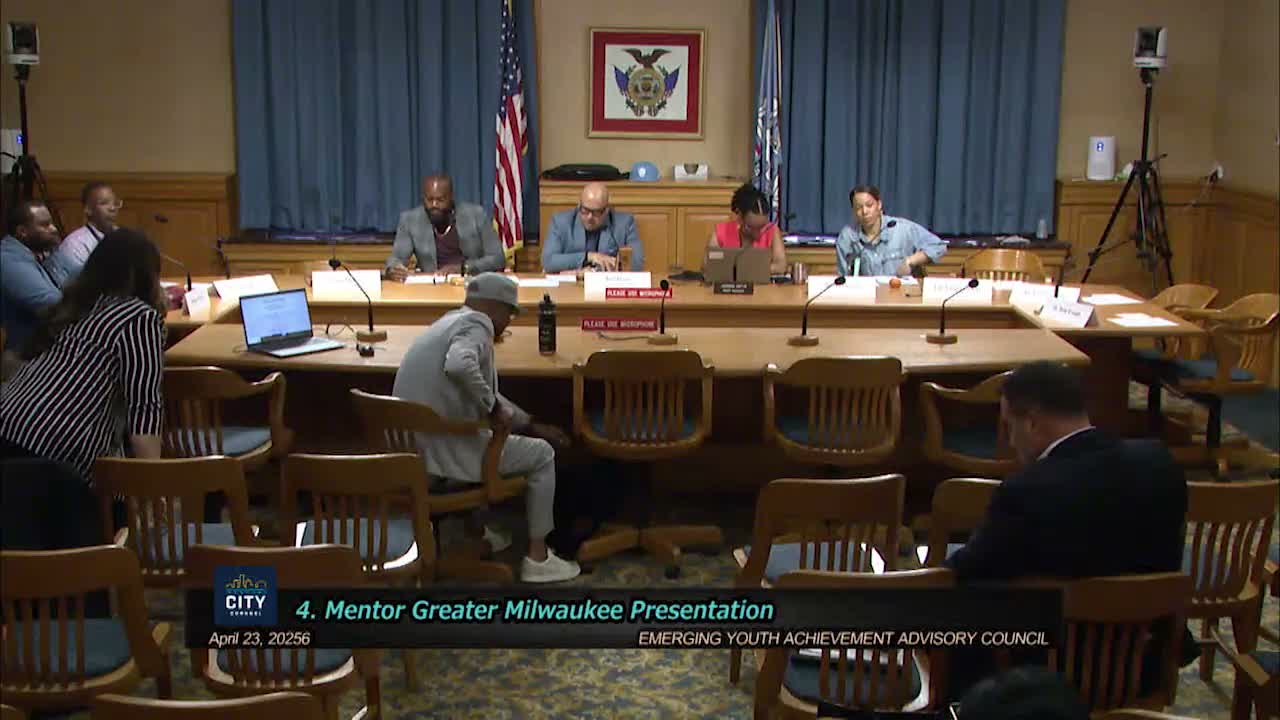
Cody Harding of Employ Milwaukee told the Emerging Youth Achievement Advisory Council on April 23 that the Earn and Learn Community Work Experience has received 2,276 applications but can currently serve approximately 800 participants.
Harding, the program's performance and reporting analyst, described Earn and Learn as a subsidized work-experience program for people ages 14–24 that covers wages for 20 hours per week over seven weeks at $12.21 per hour and provides onboarding (I-9 and W-4 help), financial-literacy training and free noncustodial bank accounts. "We subsidize the wages 100% for all the participants in the program for 20 hours per week over 7 weeks in the summer at a wage of $12.21 per hour," he said.
Why it matters: Council members raised alarm about the gap between demand (2,276 applicants) and planned capacity (~800 slots). A committee member argued the city should aim for at least 2,000 summer jobs and asked whether the program budget can scale; Harding said funding comes from multiple sources—state youth programs, CDBG dollars and some philanthropy—and that many grants carry restrictions on eligible types of work.
Numbers and budget discussion: Harding said 83 organizations have applied as worksites (more than 100 physical sites across the county), and those organizations collectively requested capacity for about 1,069 participants. Employ Milwaukee currently estimates it will serve ~800 participants; Harding said a rough program budget line he recalled was "a little over $1,000,000," while committee discussion referenced per-participant estimates near $2,000–$2,300 once taxes and overhead are included.
Council reaction and sponsorship idea: Members pushed for a clearer per‑participant budget to enable private sponsorships or tiered placements (sponsors pay for additional slots beyond the 100%‑subsidized allocations). Harding said Employ Milwaukee is piloting a sponsorship option in which private partners pay for additional paid slots but noted few partners have taken that up so far.
Camp RISE and younger cohorts: Romel Greer, Camp RISE director and special projects manager at Employ Milwaukee, described Camp RISE (serving MPS students ages 10–13) as a separate but related pipeline that this year plans to serve about 350 campers (a mix of returning participants and new slots), provide stipends and free transportation, and add four pre‑apprenticeship lanes for older 12–13 year olds (health care, manufacturing, STEM and public service).
What happens next: Committee members asked Employ Milwaukee for more complete budget breakdowns, a funding‑source pie chart and verification of per‑participant costs; Harding said the requested details can be provided to the committee for follow-up before the next meeting.