Get Full Government Meeting Transcripts, Videos, & Alerts Forever!
Get email alerts on the WIS175 Reimagining topic
No spam. Unsubscribe anytime.
DOT and city present Reimagining WIS 175 study; no preferred alternative selected
Summary
DOT and city staff presented the final Reimagining WIS 175 study (Stadium Freeway, I‑94 to Lisbon). The report compares four alternatives — including at‑grade boulevard options — and highlights public support for multimodal connections, slower speeds, and land reuse; staff did not recommend a locally preferred alternative and said NEPA/PEL phases would require additional funding.
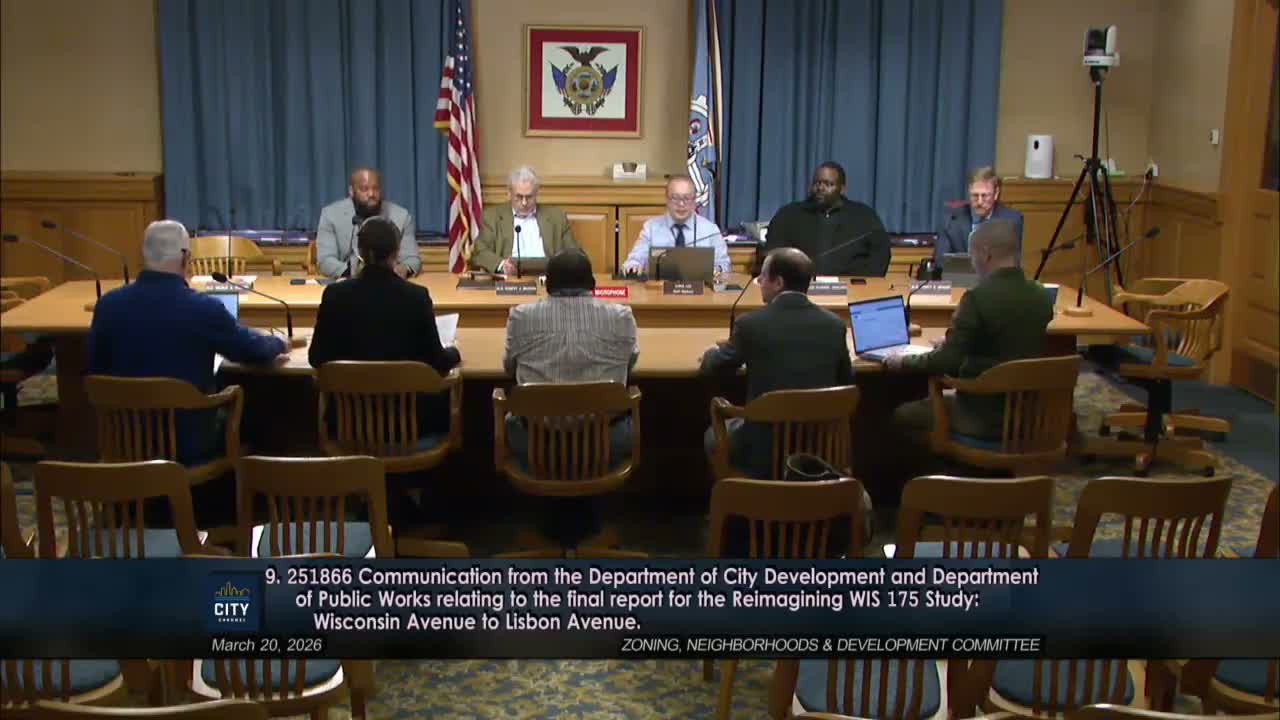
Monica Smith of the Department of City Development and DOT project managers briefed the committee on the Reimagining WIS 175 feasibility study, a collaboration with Milwaukee County that examined the Stadium Freeway stub from the I‑94 stadium interchange to Lisbon Avenue (about 1.8 miles).
Smith said the study began in 2022 and included extensive public engagement, multiple advisory meetings and outreach with community‑based organizations. Doug Hain and Andre Ost of the project team summarized a process that narrowed roughly 27 initial options to four alternatives for public review: a replace‑in‑kind option and three build alternatives that transition the corridor from an expressway to an at‑grade boulevard at various points.
Project staff said the replace‑in‑kind alternative received the least positive feedback. Public comments showed strong support for slower speeds, safer multimodal facilities, reconnection of neighborhood street grids and better access to Washington Park. The study identified developable acreage under some build alternatives (alternative 3 showed up to 37 developable acres) but also noted that the most transformative options would require property relocations and higher costs.
Cost estimates presented in the report ranged roughly from about $100 million to $126 million for the build alternatives; staff estimated a subsequent NEPA or PEL phase could cost on the order of $10 million–$14 million. Project leads said no locally preferred alternative was selected in this phase; the report’s purpose is to inform further PEL/NEPA work should funding and stakeholder direction allow.
Committee members praised the study’s community engagement and asked whether any interim, lower‑cost improvements (bike or pedestrian connections off the main corridor) could be advanced sooner. Staff said some off‑corridor interventions might be feasible but cautioned that preferred alternatives must be identified before committing to measures that could constrain future options.
The committee received the report and ordered it to be placed on file.