Get Full Government Meeting Transcripts, Videos, & Alerts Forever!
Get email alerts on the School Facilities topic
No spam. Unsubscribe anytime.
Committee hears RPS report showing $36M‑$40M in near‑term capital needs; seeks clear funding formula summary
Summary
Richmond Public Schools officials told the Education and Human Services Committee that a 2024 facilities assessment and ongoing reviews identified roughly $36 million in urgent needs this year and nearly $40 million next year, and council members pressed city staff for a clear, public summary of the funding formula used to allocate CIP dollars.
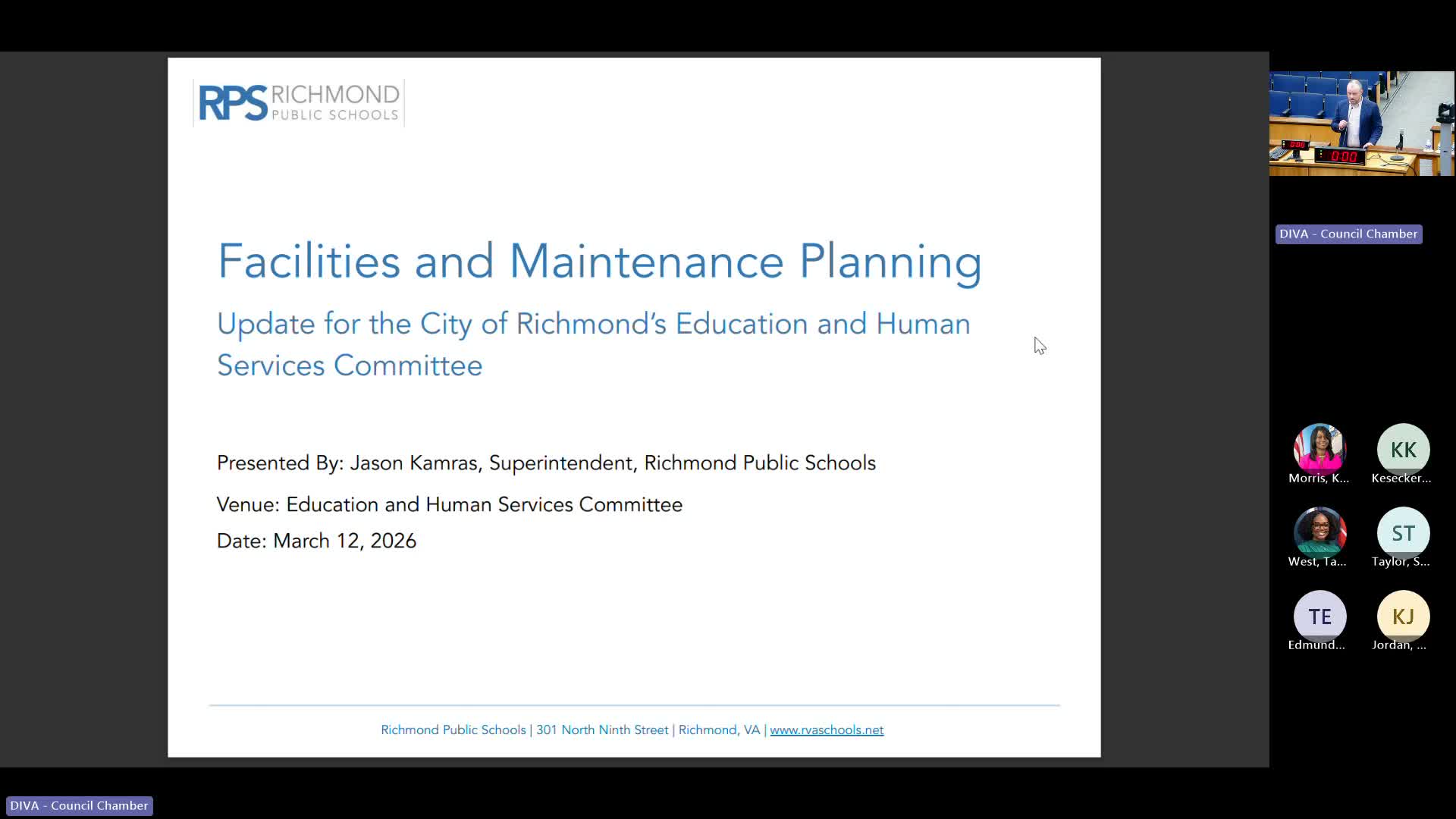
The Education and Human Services Committee on March 12 was presented with a facilities condition and maintenance report from Richmond Public Schools that officials said shows a large and growing backlog of capital needs.
Patrick Harrell, chief operating officer for Richmond Public Schools, said an outside assessment completed in 2024 identified about $7,000,000 in urgent capital needs for that year and that "for this year, they identified over $36,000,000. The following year, it was almost $40,000,000." Harrell said those figures illustrate how deferred maintenance has been "catching up to us," and stressed the connection between capital projects and operating budgets.
Why it matters: Committee members said they want clarity about which buildings will be prioritized and how the city intends to allocate limited capital funds across aging facilities, new construction plans and enrollment pressures.
Harrell told the committee RPS submitted a little over $10,000,000 in CIP requests but expected to receive closer to $2.5 million from the city in a typical year. He outlined a prioritization system that assigns high, medium and low urgency levels, saying high‑priority items — "health, life, and safety" issues such as major roof leaks — are to be addressed within two business days. Harrell quantified operating maintenance as "about 6 and a half million dollars" annually, of which roughly $4.3 million goes to preventative maintenance and about $2,000,000 remains available for unanticipated needs (roughly $170,000 per month), figures he presented to illustrate the limits of ongoing maintenance funding.
Council reaction and the CTE project: Several members, including Member Jones, pressed district leaders for a clearer prioritization list and for analysis showing where consolidation, renovation or replacement makes fiscal sense. Jones questioned whether new projects such as the proposed career and technical education (CTE) center — described by Superintendent Kamris and Harrell as a replacement for the outdated Richmond Technical Center rather than a traditional neighborhood school — would relieve overcrowding in other schools. "It does not relieve overcrowding," Kamris said of the CTE center, cautioning that it will instead serve thousands of students systemwide.
Funding‑formula dispute and follow‑up: The CAO explained the city used an existing growth model for this budget cycle in which "when the city grows, so does RPS," reporting $8,200,000 in growth for this year. Committee members asked whether the formula is based strictly on a percentage of revenue growth or additionally tied to changes in student counts and asked for a public, concise memo showing exactly how the formula was applied. The CAO committed to preparing a public facing summary and to re‑convene stakeholders this summer to refine the model and better align assessments, capital investments and housing changes.
What the committee directed: Staff recorded a follow‑up request tied to resolution 2025‑R‑023 for the city to provide the requested funding‑formula documentation and timelines. The clerk also noted that the minutes for Jan. 8 and Feb. 12 were approved as presented.
Context and next steps: RPS noted its 10‑year roofing schedule is unrealistic under current funding levels — replacing a single large roof (Harrell cited Armstrong High School at more than $3.5 million) would not fit the projected $2.5 million annual CIP maintenance allocation. Officials urged continued state advocacy, citing the School Construction Assistance Program and a proposed 1% sales‑tax referendum to support school construction as additional avenues for funding. The CAO said the city and RPS will revisit the funding model in summer and provide the committee with the requested public summary.
The committee adjourned after staff offered to deliver audited materials to council members; no formal votes on CIP allocations were taken at the meeting.