Get Full Government Meeting Transcripts, Videos, & Alerts Forever!
Get email alerts on the Surveillance And Public Safety topic
No spam. Unsubscribe anytime.
Residents urge cancellation of Flock cameras as police and council defend limited, audited use
Summary
Public commenters urged Richmond to cancel its Flock Safety contract over privacy and misuse concerns; Police Chief Rick Edwards and several council members defended the technology’s investigative value, cited court rulings and new state law (effective 07/01/2025) that limits retention and access, and said audits and penalties would be enforced for misuse.
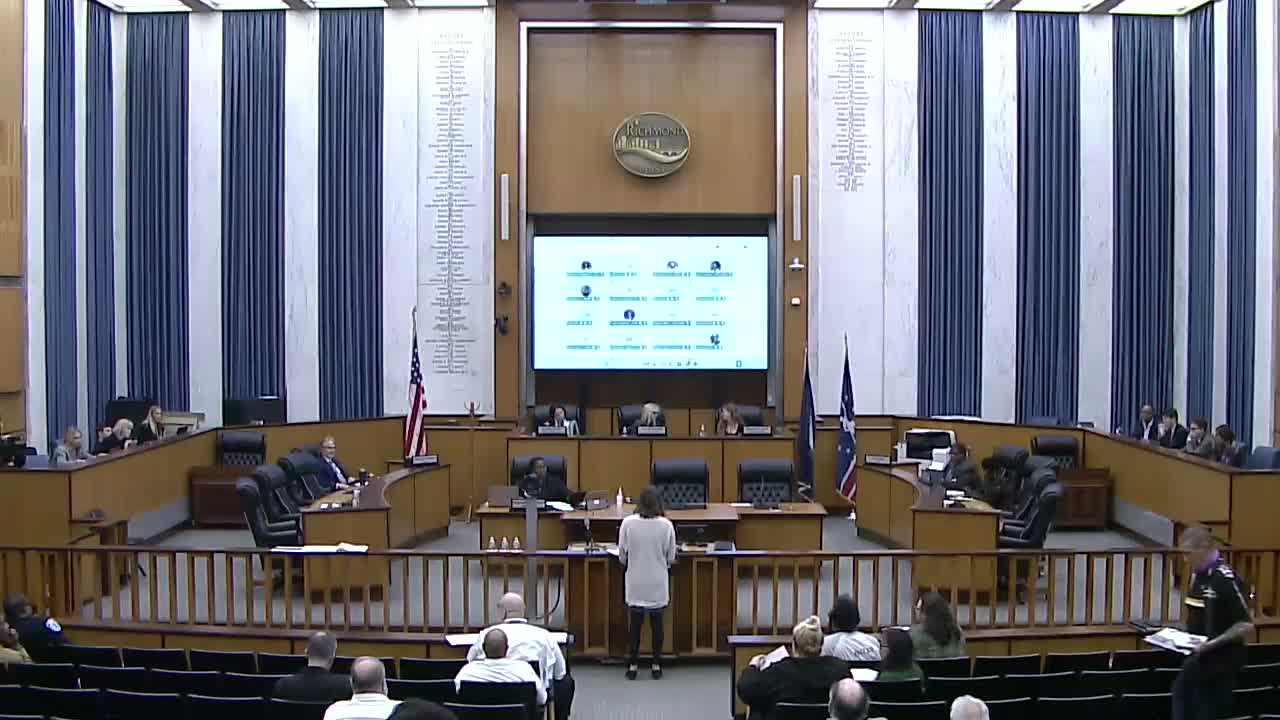
Public comment at a Richmond Public Safety Standing Committee meeting on [date] featured sharply divided views about the city’s contract with Flock Safety, the private vendor that provides automated license-plate readers (ALPR) and related systems.
"I’m here asking that you cancel the city's contract with Flock," Penny Page told the committee, arguing the technology is prone to misuse and pointing to anecdotal rather than clear research on effectiveness. Several other residents and advocates echoed that view, saying cameras and ALPRs risk unauthorized searches and disproportionate impacts on immigrant and minority communities.
Chief Rick Edwards, however, framed the systems as targeted investigative tools that have aided violent-crime investigations. "We used this technology to catch that person," Edwards said, describing cases in which ALPR alerts helped detectives identify vehicles and apprehend suspects. He cited three investigations — a 2022 case involving a teen victim, a February 2024 homicide of Marvin Ramos Hernandez, and a later killing of Darnell Christian — saying officers used ALPR hits to identify vehicles, locate suspects and secure convictions or guilty pleas.
Edwards emphasized legal and policy guardrails. He told the committee that House Bill 2724 (effective 07/01/2025) narrows permissible uses to defined law-enforcement purposes (criminal investigations, wanted persons, missing people), creates criminal penalties for misuse, shortens retention from 30 to 21 days, and limits interstate sharing. He said RPD owns the data, requires monthly audits, and uses operator-agreements as an internal control.
Supporters in the room said the technology can protect witnesses and victims who are too frightened to testify. Juan Braxton, criminal-justice chair for the Richmond NAACP branch, urged the city to keep the cameras, saying they are valuable when families need answers.
Council members pressed the chief on staffing, audit practices and contract terms. Edwards acknowledged the program’s expense — noting the city must staff reviews of footage and that operating the system requires analysts — and said the department has 99 fixed ALPR devices and two mobile units. He described prior unauthorized access incidents that were shut down and said the new law makes misuse a criminal offense.
The committee heard calls for more transparency and for the mayor’s office to explain contract terms. Several speakers said they want city leaders to guarantee stronger, enforceable safeguards and clearer public reporting on access and audits.
The committee did not take immediate action to cancel or renew the contract during the meeting. The chief and staff offered to continue community meetings and to provide clarifications on policy and contract terms.