Get Full Government Meeting Transcripts, Videos, & Alerts Forever!
Get email alerts on the Entertainment District Safety topic
No spam. Unsubscribe anytime.
Council committee presses MPD and partners for plan to curb late-night violence in entertainment districts
Summary
Milwaukee’s Public Safety & Health Committee received briefings from MPD, DCWS and community partners on shootings, Code Red deployments and 'teen takeovers', debated fenced entertainment districts and curfew centers, and asked for clearer plans to protect downtown while limiting strains on neighborhood police resources.
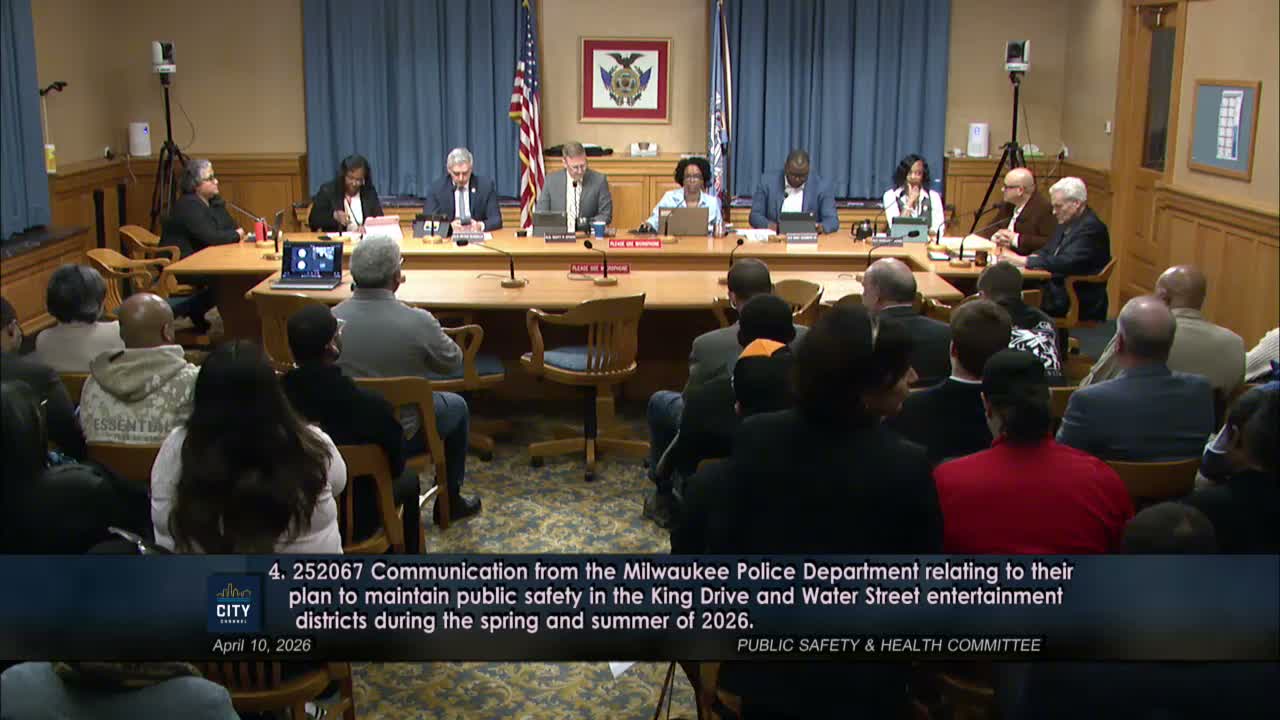
Milwaukee police and city agencies told the Public Safety & Health Committee on April 10 they are stepping up coordinated deployments and community interventions to respond to violent incidents and large congregations in downtown entertainment districts, but council members pressed for assurances that neighborhood patrols would not be hollowed out in the process.
Inspector Sharonda Grant of the Milwaukee Police Department said the department has seen a decline in its Part I crime metrics this year but detailed a March 22 incident on Water Street in which three people were shot and one was killed. "That night ... 26 officers were in deployment throughout the Code Red Entertainment District, which consists of four different zones downtown," Inspector Grant said, explaining the department increased staffing via voluntary overtime and Code Red funds to respond to the spike in warm-weather crowds.
Inspector Paul Lyle described the March 22 suspect as an individual with multiple prior felony convictions and on probation, and said that while loitering is a concern, not all violence stems from local crowding. "This guy probably should not have been out," Lyle said in the briefing.
Council members pushed MPD on whether Code Red overtime draws officers from neighborhood patrols: Alder Chambers and others warned that districts outside downtown have responded to increased calls while resources are diverted to the entertainment zones. "Those are resources that's going away from our neighborhood," Alder Chambers said, asking for clearer limits on where officers are pulled from.
Mayor's-office and MPD officials described potential tools beyond officer deployments: controlled, fenced entertainment districts with entry points and security screenings; time-limited scooter bans; and 'curfew centers' operated with the Department of Community Wellness and Safety (DCWS) to hold minors temporarily and provide wraparound resources rather than extended custody that ties up officers.
DCWS interim director Karen Tyler and outreach staff outlined prevention strategies and youth programming to reduce the demand signal that draws large downtown gatherings, noting Milwaukee’s relatively large share of young residents. Julian Pfeiffer of DCWS said the 2025 community health assessment shows Milwaukee’s share of residents under 20 is roughly 27% higher than the national average and that social-engagement gaps between neighborhoods create unequal demand for public, supervised activities.
Community partners described existing 'lock-in' and 'twilight center' programs that have had success engaging youth; advocates urged the council to sustain and scale those efforts alongside police deployments. Captain Vanetta Norberg of MPD’s school- and community-resource divisions offered to coordinate school-centered outreach and parent engagement.
The committee did not adopt a single new policy at the session but asked departments to provide more detailed operational plans — including clearer metrics, staffing projections for Code Red deployments, and vendor/private-security obligations for any controlled-entry experiment — before formalizing fencing, curfew enforcement or scooter restrictions.
The committee agreed to continue the conversation at a follow-up meeting, asking MPD and DCWS to report on enforcement plans, resource impacts on neighborhood patrols and steps for summer outreach programming.