Get Full Government Meeting Transcripts, Videos, & Alerts Forever!
Get email alerts on the Multimodal Mobility topic
No spam. Unsubscribe anytime.
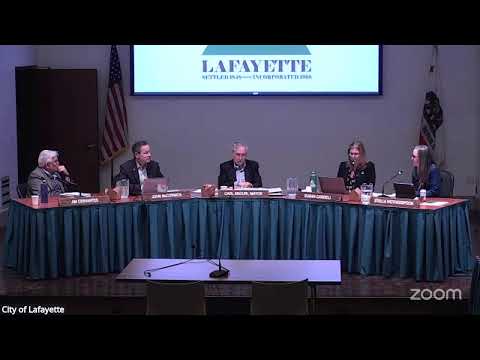
Council forms multimodal advisory committee; declines MTC TOC incentive eligibility for now
Summary
Council created an 18–24 month multimodal mobility advisory committee to coordinate downtown projects and approved recruitment for three at‑large Lafayette residents. Separately, staff recommended and council accepted a decision not to pursue MTC Transit‑Oriented Communities incentive eligibility now, citing administrative burden and tradeoffs; the council voted unanimously on both.
The Lafayette City Council approved creation of a time‑limited multimodal mobility advisory committee to coordinate overlapping downtown transportation and urban‑design efforts, and separately accepted staff’s recommendation not to pursue Metropolitan Transportation Commission (MTC) Transit‑Oriented Communities (TOC) incentive eligibility at this time.
Staff proposed the seven‑member advisory body to provide early, multidisciplinary input across projects (Mount Diablo multimodal study, aqueduct pathway design, BART access and circulation study and related corridor initiatives). The committee will be advisory only and subject to the Brown Act; composition will include two councilmembers (the mayor and vice mayor), one representative from TransCirc (Transportation and Circulation Commission), one planning‑ or design‑review representative, and three at‑large Lafayette residents. Patrick Golia said the intent is to “look at everything holistically” and to reduce conflicting project decisions by identifying trade‑offs early. Council approved the committee role and directed staff to begin recruiting three Lafayette residents.
Later in the meeting staff briefed the council on MTC’s updated TOC incentive program (a regional $45 million pool). Staff explained that the program now uses a 100‑point scoring system and requires a minimum of 85 points to be eligible; achieving that score would require multiple zoning and parking code changes (increase in minimum FAR, removal of parking minimums inside the TOC area, and adopting TDM and unbundled parking), as well as staff time to prepare amendments and documentation. Staff concluded that the administrative burden and land‑use trade‑offs were not appropriate at this time and recommended the council not pursue TOC eligibility. Council voted unanimously to accept that recommendation.
Councilmembers asked for regular milestone reports from the multimodal advisory committee and confirmed that individual studies will still run public outreach; the advisory committee will be a forum to coordinate those efforts. On TOC, members noted the potential funding but agreed the cost of code changes and the risk to local character were important considerations.