Get AI Briefings, Transcripts & Alerts on Local & National Government Meetings — Forever.
City receives downtown parking study urging management, shared parking and employee permits
Loading...
Summary
Consultants told the Lafayette City Council that downtown parking supply is adequate systemwide but unevenly distributed; they recommended a phased Phase 1 focused on inventory, employee/shared parking, simplified rules, signage and wayfinding. Council directed staff to return with a detailed implementation work program and budget.
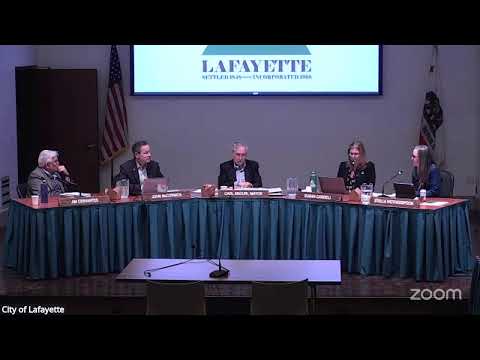
Consultants presented a downtown parking management study to the Lafayette City Council concluding that the system has capacity overall but that users perceive shortages because parking is unevenly distributed and managed across public and private owners.
The study, funded by the Metropolitan Transportation Commission and presented by Patrick Golia with Alta Consulting, said systemwide peak occupancy is only about 55 percent, with localized hotspots near Lafayette Plaza Center, Diablo Foods and the Fiesta Lane area. Golia and team said the key problems are fragmented management (more than 75 percent of off‑street spaces are privately owned), inconsistent time limits and confusing signage, and a mismatch between where employees need to park and where long‑term spaces are available.
The consultants recommended a phased approach focused on managing existing supply rather than building new parking. Phase 1 priorities are: a comprehensive inventory of public and private parking; targeted strategies to expand employee and shared parking (including negotiated shared‑use agreements); simplification of rules, enforcement consistency and an exceptions process for nonstandard time limits; and improved information, maps and wayfinding for users. Golia said the city should “focus on clarity, coordination and utilization” and estimated consultant support of roughly $80,000–$160,000 per year for a three‑year phased effort.
Councilmembers pressed the project team on why Phase 1 emphasizes more data collection when prior reports exist. Siching Yi of Alta responded that the new inventory will include privately held supply that is currently not publicly accessible and could identify additional shared‑use opportunities. Councilmembers also asked how the analysis accounted for potential future loss of BART parking if those lots are redeveloped; the consultants said their future‑conditions analysis included housing pipeline and RHNA assumptions but did not assume BART lot losses because BART had not provided concrete plans.
Public commenters raised concerns about private operator enforcement practices, suggested revenue‑sharing or permit models with private lot owners, and urged the city to pursue low‑cost coordination steps quickly. After discussion the council affirmed the study’s strategic direction and directed staff to prepare a detailed Phase 1 implementation work program with an associated funding request and timing for return to the council.
The council did not adopt any regulatory changes tonight; staff will return with an implementation program and budget for council approval.