Get Full Government Meeting Transcripts, Videos, & Alerts Forever!
Get email alerts on the Impact Fees topic
No spam. Unsubscribe anytime.
St. Tammany Parish officials present updated impact-fee study, propose raising income threshold for waiver
Summary
Consultants presented a parishwide update of drainage and transportation impact fees, recommending calculated fees (not simple CPI adjustments), modest net changes for most land uses, and a proposed change to raise the residential waiver from a “very low income” to a “low income” threshold so more households qualify.
Consultants for St. Tammany Parish on Thursday presented a parishwide update to development impact fees and proposed raising the income threshold that qualifies households for a waiver.
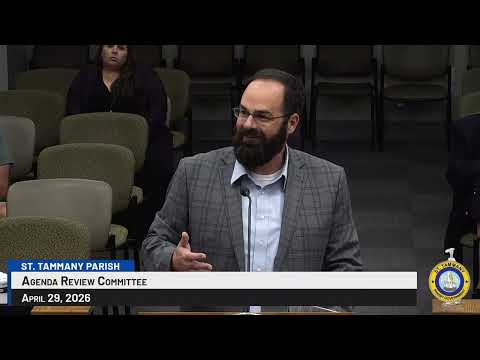
Steve Villavazzo of Villavazzo & Associates told the council that an impact fee is a one-time, calculated charge placed on new development to offset the residual, cumulative costs a project imposes on roads, drainage and other infrastructure. “An impact fee has to be specific, related to a specific area,” Villavazzo said, and the study, he said, uses established methodologies rather than simple inflation indexing to set reasonable, defensible fees.
Ross Lyon, the parish director of planning and development, and Fred (Villavazzo’s colleague) said the analysis revisits the 2005 and 2012 studies and expands the study area to the entire parish. The consultants said some fees would modestly increase while others decline compared with earlier studies when analyzed on an equivalent (2005-to-2026) basis. Villavazzo summarized the legal standard: a fee must be calculated and used for the purpose it is collected.
On drainage, staff explained that, for some land‑use categories, the updated fee is substantially lower in real-dollar terms than the 2005 level once grant credits and other adjustments are applied; the one exception noted in the presentation was a higher mobile-home fee relative to 2005. On transportation, the consultants said increases are generally more modest; the model uses vehicle-miles-traveled and trip-length estimates to determine road impacts.
Council members pressed staff for examples and comparisons. Lyon presented sample results: the consultants said a typical single-family project’s combined legally imposed fees would have been about $3,077 in 2005 and about $2,787 under the updated combined schedule when measured on the same basis. Councilmember Laughlin asked whether the proposed 2026 drainage component for a single-family detached home (discussed in the hearing) equates to roughly $1,200 in incremental parish liability without an impact fee; staff confirmed that the fee is intended to offset that incremental cost.
The presentation also proposed changing the income threshold for the residential impact-fee waiver. Villavazzo and staff said the current HUD-based “very low income” cutoff (example cited in the presentation: about $35,000 for a family of four) is so low that few households qualify; the consultants recommended moving the waiver to the HUD “low income” threshold (the presentation cited a working example near $75,000 for a family of four) so more households could qualify.
Staff outlined next steps: finalize the report, meet additional stakeholders and present to the planning commission (planned in June), then draft an ordinance with recommended fees and income threshold adjustments for legislative consideration. Officials said the fee revenue must be placed in restricted accounts and directed to the infrastructure category (roads or drainage) for the area where the fees were collected or the designated study area.
The council spent extended time on modeling details, credits, and how collected fees would be applied. No final vote on adopting new fees occurred Thursday; staff said a formal ordinance would come later after stakeholder outreach and additional review.
St. Tammany Parish officials plan to bring the draft ordinance and final study back to the council following the planning commission and stakeholder review.